phenomenon

maser

A natural cosmic amplifier that produces intense, focused microwave radiation through stimulated emission.
18 related articles
Concept graph →

Related articles · 20

Optics2026-08-192 minarXiv:2608.18692express
A Diamond That Pulses with Light
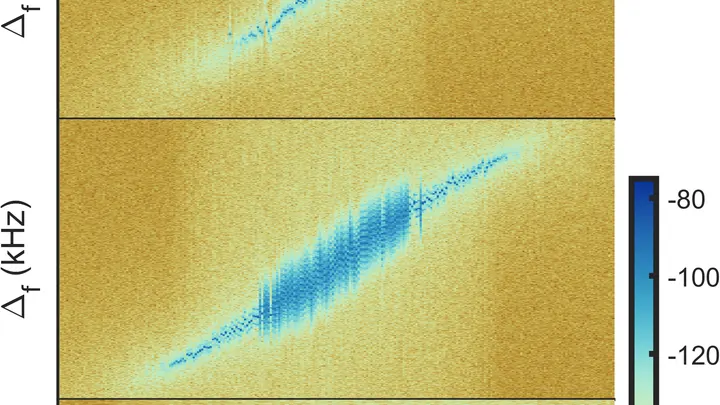
An ordinary lamp shines steadily, while a lighthouse flashes. Scientists in London have made a tiny diamond work like a lighthouse, but not for light — for radio waves. To do this, they added a bit of nitrogen to the crystal and then shone a green laser on it.

Optics2026-08-192 minarXiv:2608.18692express
A Diamond That Pulses with Light
An ordinary lamp shines steadily, while a lighthouse flashes. Scientists in London have made a tiny diamond work like a lighthouse, but not for light — for radio waves. To do this, they added a bit of nitrogen to the crystal and then shone a green laser on it.

Plasma Physics2026-08-151 minarXiv:2608.15039express
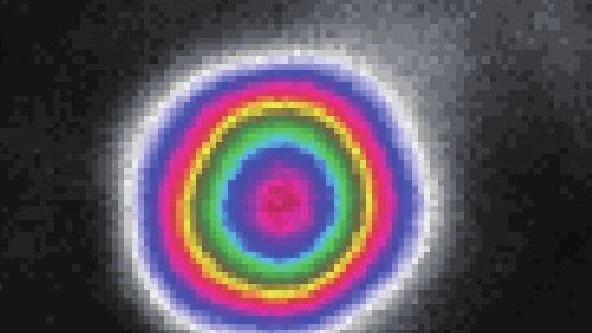
Laser Corkscrew Accelerates Electrons
A regular laser beam travels straight, like the light from a flashlight. But light can be twisted into a spiral, like the thread of a corkscrew. Such a beam carries orbital angular momentum: it doesn't just illuminate, it also spins anything it encounters.
High Energy2026-07-312 minarXiv:2608.00332express
A Leaky Bucket Doesn't Quench a Cosmic Maser
Deep inside molecular clouds hide natural amplifiers — cosmic masers. They work like lasers but in the radio band: excited molecules collectively emit waves of a single frequency, creating a bright beam. The catch is that these molecules often have several ways to shed energy.
High Energy2026-07-312 minarXiv:2608.00332express
A Leaky Bucket Doesn't Quench a Cosmic Maser
Deep inside molecular clouds hide natural amplifiers — cosmic masers. They work like lasers but in the radio band: excited molecules collectively emit waves of a single frequency, creating a bright beam. The catch is that these molecules often have several ways to shed energy.
Galaxies2026-07-242 minarXiv:2607.22812
Space Fireflies: Hunting for the Laser Pulse of Extraterrestrial Civilizations
In the silent ocean of the Galaxy, mature civilizations have likely long chosen an unexpected strategy: instead of loud beacons, they scatter quiet fireflies — autonomous interstellar laser beacons, drifting in the void and dropping microsecond flashes. These 'seeds of contact' are not tied to their home stars and do not drown in their glow.
Dark Energy Symphony: LHC Catches the Unheard Sound
In the late 1990s, the night sky delivered a surprise: Saul Perlmutter and Adam Riess found that the expansion of the Universe is accelerating. Ever since, the greatest riddle has been dark energy — a substance making up nearly 70% of the cosmos, yet evading laboratory study.
High Energy2026-06-231 minarXiv:2606.25054express
Cosmic Accelerator Flirts with the Limit
In the constellation Aquila, about 40,000 light-years away, one of the most powerful natural accelerators in the Galaxy is at work. It's the microquasar GRS 1915+105—a pair consisting of an ordinary star and a black hole.
High Energy2026-06-222 minarXiv:2606.23818express
Stellar Wind Blows the Ashes Away
A pot of porridge boiling over a high flame: bubbles carry grains from the bottom to the surface. A similar mechanism works on a neutron star. As it accumulates hydrogen and helium from a companion star, it occasionally triggers a powerful nuclear explosion — an X-ray burst.
General Relativity2026-06-061 minarXiv:2606.08220express
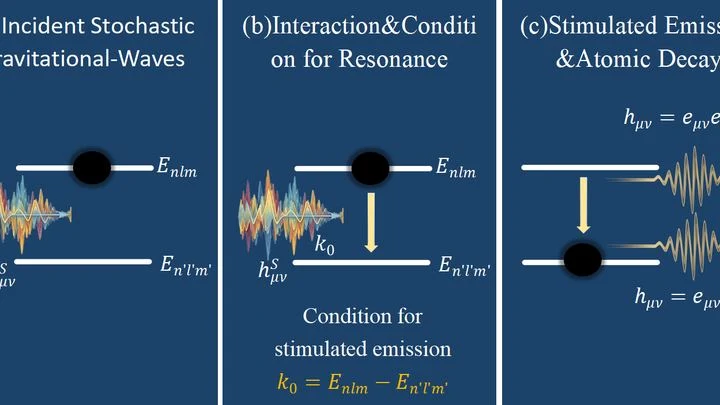
How Black Holes Amplify Gravitational Waves
Gravitational waves — the cosmic tremors from distant cataclysms — are so faint that detecting them is like trying to hear a whisper in a hurricane. But a black hole can amplify that whisper many times over.
Plasma Physics2026-06-052 minarXiv:2606.07147express
Industrial laser accelerates electrons
A factory laser that cuts and welds metal on production lines has been made to work as a particle accelerator for the first time. Physicists took a standard ytterbium laser, its heart is a crystal the size of a palm, and turned its flashes into a tool for accelerating electrons to nearly the speed of light.
HEP Phenomenology2026-05-292 minarXiv:2606.00237express
How to Catch Dark Matter with a Wave
Drop two pebbles into a pond at the same time — the ripples will spread evenly and in sync. The same happens in a quantum interferometer: a particle is split into two waves that travel along different paths and then meet. Ideally, their crests align.
Quantum Physics2026-04-061 minarXiv:2604.05105express
A Micromaser from a Microwave Circuit
A regular laser is a light amplifier in which atoms, after receiving energy, collectively emit waves of a single frequency. A maser does the same thing, but for microwaves — the invisible radiation that heats food in a microwave oven and carries signals in phones.
Optics2026-03-291 minarXiv:2603.27554express
A Light Pulse That Won't Spread Out
A laser flash lasting 50 femtoseconds is like a shot that lasts one billionth of a second. In that time, light travels only 15 micrometers — less than the thickness of a human hair. But if you send such a flash through an amplifier, it starts to stretch like a rubber band and loses its sharpness.
physics.acc-ph2026-02-221 minarXiv:2602.19081express
Light from a Perfectly Even Stream
Modern X-ray light sources are like an orchestra without a conductor: electrons in the beam fly every which way, and the radiation comes out blurry. The new idea is to make electrons line up in neat rows with a spacing of a few nanometers. Then the light they emit becomes coherent, like a laser beam.
Quantum Physics2026-02-181 minarXiv:2602.16215express
The Laser Where Atoms Listen to Each Other
A regular laser is like a choir where everyone sings their own part — the sound is loud, but with inevitable roughness. In the new quantum laser, the singers hear each other and harmonize their voices.
Mesoscale2026-01-291 minarXiv:2601.21370express
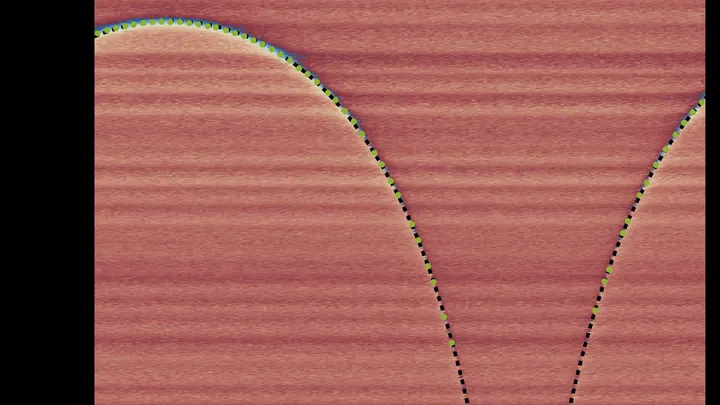
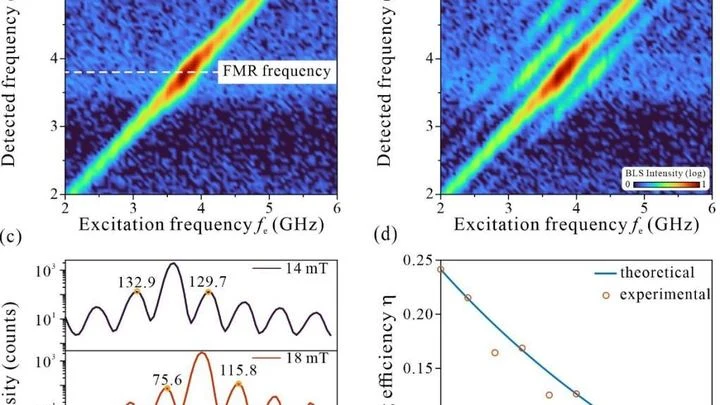
A Comb for Magnetic Waves
Waves in magnets resemble the vibrations of a string: if you pluck a string, it sounds a single note, but with a strong pluck, overtones appear — sounds at multiple frequencies.
Stellar2026-01-281 minarXiv:2601.20371express
Cosmic Laser Blinks
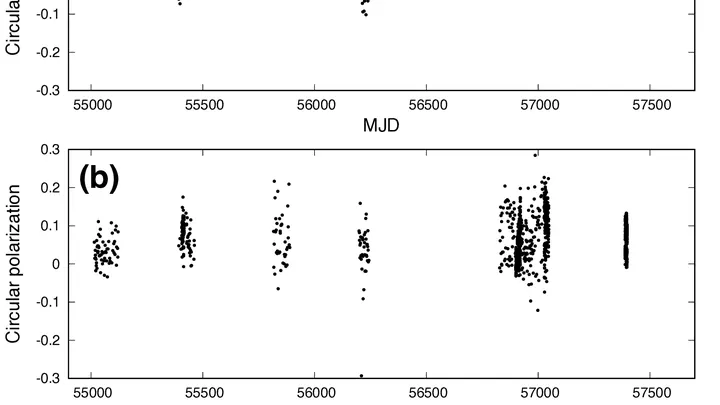
In a dense gas cloud where a star heavier than the Sun is forming, there is a tiny source of radio waves. It works like a laser: methanol molecules amplify the radiation, and we see a bright spot. But this spot behaves strangely: its brightness jumps up and down within a matter of hours.
Invisible Photons from the Void: Quantum Optics in the Reversed Regime
In a superconducting circuit cooled to below 10 millikelvin, a mechanical oscillator vibrates at 5.33 megahertz. Usually in such systems, the mechanics outlives the light, but here the roles are reversed: the oscillator decays faster than the photons in the resonator.