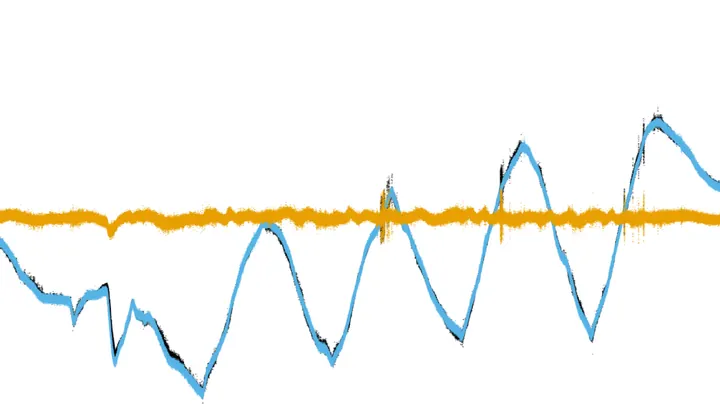
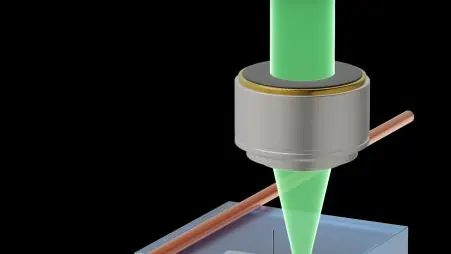
A nitrogen-vacancy (NV) center is a point defect in a diamond crystal where a carbon atom is replaced by a nitrogen atom and an adjacent lattice site is empty. This tiny structure behaves like a quantum system that is extremely sensitive to magnetic fields, electric fields, temperature, and pressure. Because it can be manipulated and read out with light and microwaves at room temperature, it has become a workhorse for quantum sensing, enabling measurements at the nanoscale that were previously impossible.
History
The NV center was first identified in the 1960s, but its potential for quantum sensing was recognized in the late 1990s and early 2000s, with major developments by groups in Germany, Japan, and the US.
How it works
The NV center has a spin state that can be initialized and read out optically. When exposed to a magnetic field, the energy levels of the spin split (Zeeman effect), and by measuring the frequency of this splitting via microwave spectroscopy, one can determine the field strength with high precision. The defect is embedded in a diamond lattice, which protects it from environmental noise, allowing it to maintain quantum coherence even at room temperature. Techniques like microwave pulsing and optical detection of magnetic resonance (ODMR) are used to extract the signal.
In practice
Used in magnetocardiography to detect weak magnetic fields from the heart, in imaging pressure inside cells, and in quantum information processing as a qubit.
Fun fact
NV centers can be used to detect the magnetic field of a single electron spin, a sensitivity that has enabled imaging of individual proteins and even the magnetic fields of neurons.
Surf doesn't roll onto the shore as an even front. It comes in tongues of foam that merge and split apart. Magnetic fields inside materials behave much the same way: they breathe in waves, and until now nobody had seen them whole.
An aluminum sphere the size of a large globe sits in a neutron beam and answers each hit with a precise note. Inside the sphere there is nothing but nitrogen and eleven tiny steel balls, each the size of a pinhead. When a neutron enters the sphere, it knocks a particle out of a nitrogen atom, and that jolt turns into an electrical signal.
Imagine a carousel carrying not children but tiny magnetic needles inside diamond dust. Usually these needles point randomly, and their signal is lost in noise. But if you tilt the carousel at a special angle and shine a green laser on it, the needles start aligning in one direction. That is exactly what physicists did with diamond particles, spinning them at 54.74° to the magnetic field.
Diamond is not just a gemstone. Hidden inside its crystal lattice are defects that sense magnetic fields better than many instruments. One such defect, the NV center, acts as a tiny compass, but its needle wavers from heat and noise. For the compass to point accurately, calibration is needed.
A tiny defect in a diamond crystal is like a sensitive microphone picking up the faintest magnetic fields. That's how sensors based on nitrogen-vacancy centers work (where a nitrogen atom and a neighboring vacancy form a quantum system). To hear the whispers of individual molecules, the sensor is placed right at the surface.
For thirteen billion years, light battled through cosmic emptiness. It bent around massive galaxy clusters that, as Einstein predicted, acted as giant lenses — amplifying and distorting the distant glow. In 2023, the NIRSpec instrument on the James Webb Space Telescope captured this light and spread it into spectra.
Building a quantum network node is like teaching a dancer to balance on a carbon thread over an abyss. One leg must spring lightly from the wire, hurling photon-messengers into the external world. The other must grip the rope tightly, guarding precious quantum information.
Deep underground, iron glows white-hot, and the pressure is so intense that an ordinary instrument would be crushed flat. To peer into this world, physicists built a special microscope based on tiny diamond defects (so-called NV centers).
Ordinary magnetic sensors lose sensitivity as they shrink. But scientists turned a tiny diamond into a light-based compass. Unlike jewelry diamonds, what matters here isn't purity but artificially created defects — these are what turn the crystal into a compass.
Trying to count people in a dark room by the sound of their breathing hits a wall of background noise — individual breaths are inaudible. Scientists working with quantum spins in solids face a similar challenge. Each spin (the electron's magnetic moment) has its own "voice," but it is drowned out by the technical noise of the instruments.
A tiny diamond with a defect — a nitrogen atom next to a vacancy in the crystal lattice. This defect, the NV center, acts like a magnetic needle: under green light, it glows red, and the brightness of that glow depends on the direction of its magnetic field.
A substance's spectrum is its fingerprint. Usually, to record one, you place the sample in a strong magnetic field, like in an MRI scanner. But there is a way to do without a magnet altogether: detect the signal from atomic nuclei at zero field. Until now, this method suffered from poor sensitivity, and its complex spectra were hard to predict.
A laser beam as faint as a whisper of light has stirred a thorium-229 nucleus into a higher energy state. Most nuclei demand a blast of energy, but thorium-229 has such a tiny energy gap that even this gentle nudge works.
A spinning top, set in motion on a perfect surface, topples from the slightest tremor. Likewise, a quantum bit, created at a defect in a diamond, has its state destroyed by magnetic disorder from impurities and external interference.
In the crystal lattice of diamond, defects occasionally appear: a nitrogen atom grabs a foreign spot, and next to it gapes a void. Such a flaw turns into a supersensitive diamond compass: its magnetic needle quivers at the slightest external field. Paradoxically, a blemish that lowers a stone's value has become a coveted tool for physicists.
If you hold an iron nail near a magnet, it will be attracted. Inside the magnet, tiny atomic magnetic arrows point in the same direction, like soldiers in formation. But in some crystals, the formation is different: neighboring arrows point in opposite directions. This order is called altermagnetism, and it is hard to see directly.
A tiny defect in a diamond crystal works like a sensitive antenna. When a magnetic field oscillates nearby, this defect, a nitrogen vacancy, responds by glowing. Previously, to hear the signal, you had to accumulate many repeated measurements, like listening to a whisper with your ear pressed against a door. Now a single short "look" suffices.
A thin crystal of hexagonal boron nitride is a relative of graphite, but transparent and insulating. Occasionally, single defects appear in its lattice: a boron or nitrogen atom is missing, leaving a trap for electrons. Such a trap can absorb light and re-emit it, like a tiny flashlight.
Diamonds sometimes have a defect: instead of two adjacent carbon atoms, there is one nitrogen atom and an empty spot. This defect acts like a tiny antenna that responds to magnetic fields. Scientists aimed a laser and microwaves at such a diamond, and the defect started spitting out electrons.
A magnetic field is invisible, but you can make it 'glow' using tiny defects in diamond — nitrogen-vacancy centers. Each such defect acts as a miniature compass, telling you which way the field points. The problem is that there are many of these compasses, and reading them all in sequence is like transcribing every letter in a thick book by hand.
A tiny defect in diamond is like a microscopic ear, able to pick up the magnetic 'breath' of the heart. Such sensors work at room temperature and are no bigger than a grain of sand.
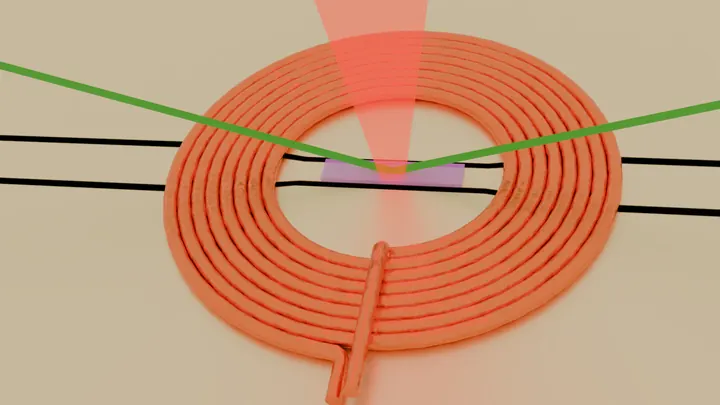
A diamond speck smaller than a hundredth of a millimeter glows red. Inside it is a crystal defect: two neighboring carbon atoms, where one is missing and a nitrogen atom sits nearby. Such a pair captures light and re-emits it, like a tiny beacon that doesn't fade at room temperature.
This speck was brought near a pathway on the chip's surface.
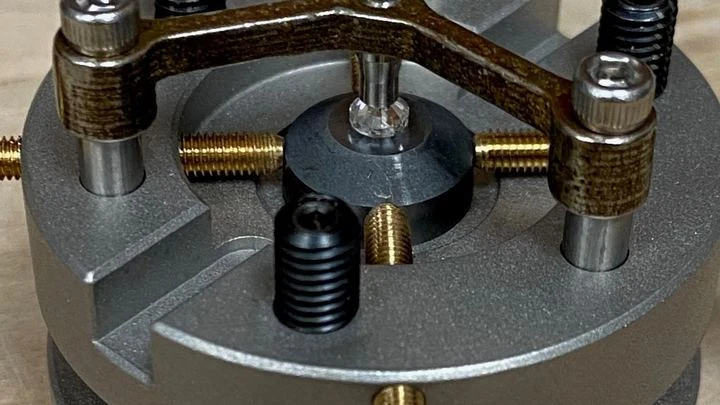
In a diamond anvil cell, pressure squeezes a material as if it were buried hundreds of kilometers deep inside the Earth. Inside this chamber, tiny diamond sensors, color centers, respond to microwaves and report on the magnetic fields and temperatures around them.
A magnetic field is invisible, but you can make it 'glow'. To do that, take a tiny diamond with defects — places where a carbon atom is replaced by nitrogen and a neighboring lattice site is vacant. These defects, like sensitive compass needles, respond to the slightest changes in the magnetic field and emit light of varying brightness.
A tiny diamond, smaller than a dust speck, hovers inside a magnetic trap made of microchips. Inside the crystal is a single defect acting as a beacon. Scientists coax the diamond into being in two places at once, like a magician’s ball that honestly rests under two cups.
This isn't just a trick.
A cell doesn't just lie on a surface: it probes it, pulls it, and pushes it. Until now, instruments could only detect direct forces: how hard a cell presses or stretches its support. But if you grab a cell by the "shoulders" and give it a slight twist, it responds by rotating, and until recently, no one could measure that rotation.
Heat an ordinary quartz watch by ten degrees, and it will start losing seconds each day. Atomic clocks are more precise, but they take up an entire cabinet. Diamond with a tiny defect, a nitrogen vacancy, promises atomic-clock accuracy in the volume of a grain of sand.
Diamond crystals harbor invisible cracks — dislocations. These are places where rows of atoms are shifted, like a sheet of paper pulled halfway out of a stack. Stress builds up around these spots, affecting how the material breaks, bends, or conducts electricity.
Emptiness isn't always empty: it can hide energy, like supercooled water hides ice. Physicists call this false vacuum — a state that only needs a nudge to cascade into the true one.
In diamond, you can embed a “spy.” Simply replace a carbon atom with nitrogen: you get a defect that responds to magnetic fields and sends a light signal.
Inside a diamond anvil cell, a device where two diamonds squeeze a sample to hundreds of gigapascals, pressure is distributed unevenly. Some regions are compressed more, others less. This affects experimental results: the material may behave differently than under perfectly uniform compression.
Inside a diamond, you sometimes find tiny flaws — a spot where a carbon atom is replaced by nitrogen, with a vacancy right next to it. Physicists call this an NV center (a nitrogen-vacancy defect). Such a defect acts like a magnetic needle that can store information in its spin.