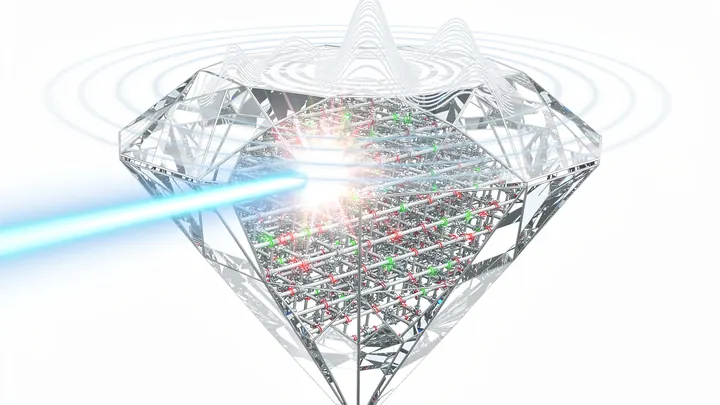
Diamond NV center spectroscopy exploits the nitrogen-vacancy (NV) center — a point defect in diamond where a nitrogen atom sits next to a vacant lattice site — as a quantum sensor. The NV center's electronic spin state is sensitive to magnetic fields, electric fields, temperature, and strain, and can be read out optically. This makes it a versatile probe for nanoscale measurements in biology, materials science, and quantum technology.
History
The NV center's spin properties were first characterized in the 1990s, but its use as a practical sensor gained momentum in the 2000s with demonstrations of single-spin magnetic resonance and nanoscale imaging.
How it works
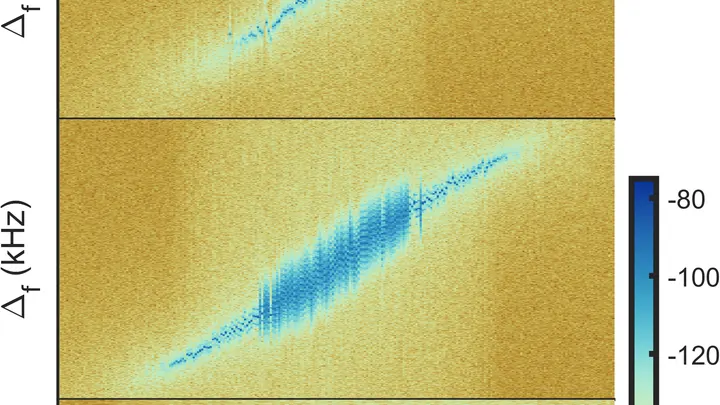
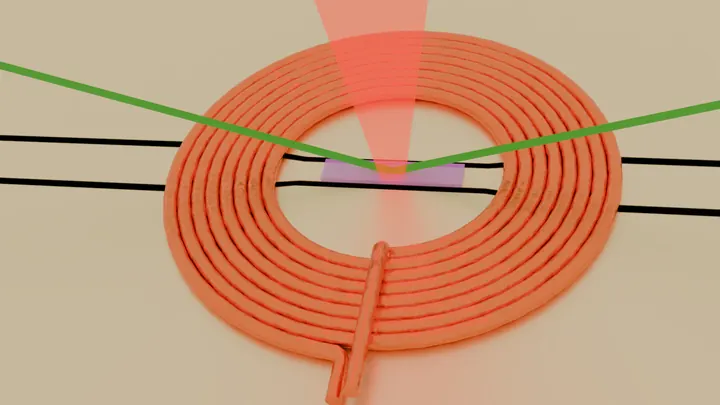
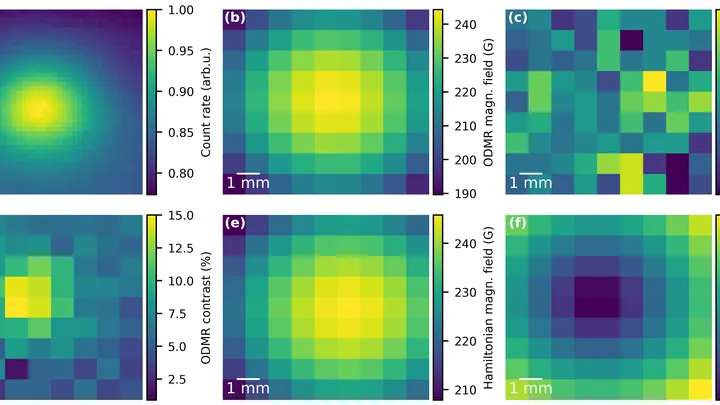
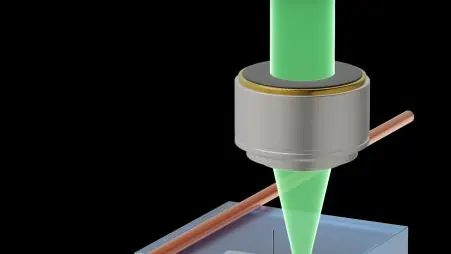
A green laser excites the NV center, and its red fluorescence intensity depends on the spin state, which is manipulated with microwave pulses. By measuring the fluorescence as a function of microwave frequency, one obtains an optically detected magnetic resonance (ODMR) spectrum. Shifts in the resonance frequencies reveal local magnetic fields, temperature changes, or stress with high precision, even at the single-defect level.
In practice
Used for high-resolution magnetic imaging of biological cells, mapping temperature gradients inside living organisms, and sensing magnetic fields in spintronic devices.
Fun fact
A single NV center in diamond can detect the magnetic field of a single electron spin at room temperature.
Imagine a carousel carrying not children but tiny magnetic needles inside diamond dust. Usually these needles point randomly, and their signal is lost in noise. But if you tilt the carousel at a special angle and shine a green laser on it, the needles start aligning in one direction. That is exactly what physicists did with diamond particles, spinning them at 54.74° to the magnetic field.
In a molecule, hydrogen sometimes resembles not a ball but a wave that can leak through an energy barrier, like a ghost through a wall. Chemists call this tunneling, and it underlies many processes, from enzyme function to charge transfer in materials. But how exactly does a molecule find its path for such a transition?
Diamond is not just a gemstone. Hidden inside its crystal lattice are defects that sense magnetic fields better than many instruments. One such defect, the NV center, acts as a tiny compass, but its needle wavers from heat and noise. For the compass to point accurately, calibration is needed.
An ordinary lamp shines steadily, while a lighthouse flashes. Scientists in London have made a tiny diamond work like a lighthouse, but not for light — for radio waves. To do this, they added a bit of nitrogen to the crystal and then shone a green laser on it.
Imagine an orchestra where every musician is a tiny magnetic sensor inside a diamond. To play cleanly, they need silence: no extra vibrations, no background noise. But when creating such orchestras, thin diamond films with nitrogen defects, dissonance bursts into the material.
An international team of physicists studied how this disorder arises.
A tiny defect in a diamond crystal is like a sensitive microphone picking up the faintest magnetic fields. That's how sensors based on nitrogen-vacancy centers work (where a nitrogen atom and a neighboring vacancy form a quantum system). To hear the whispers of individual molecules, the sensor is placed right at the surface.
The universe is a grand orchestra, with dark energy conducting the expansion. Ten billion years ago, the conductor changed its gesture: the negative pressure that had been holding back galaxy assembly gave way to accelerating expansion — the very phenomenon discovered by [scientist:Saul…
In the depths of a diamond crystal, studded with NV centers, a symphony slumbers. Each defect is like a tuning fork, ready to respond to a passing acoustic wave. But alone, their voices are barely audible: the spin-phonon coupling is weaker than a whisper. A maestro is needed, one who can turn timid vibrations into a resounding choir.
Ordinary magnetic sensors lose sensitivity as they shrink. But scientists turned a tiny diamond into a light-based compass. Unlike jewelry diamonds, what matters here isn't purity but artificially created defects — these are what turn the crystal into a compass.
Magnetic particles are attached to the surface of the diamond by DNA strands, like puppets on strings. They constantly dance under the thermal motion of the liquid molecules. The liquid's viscosity sets the pace: in honey, the particles barely tremble; in alcohol, they dance quickly.
Hot gas settles on a substrate, building up a transparent film layer by layer. But instead of a perfect mirror, the surface sometimes gets covered with tiny bumps, like frost patterns on glass in severe cold. Usually, people try to remove them because they get in the way of making smooth components. Physicists from Oxford and their colleagues did the opposite: they looked inside the bumps.
In diamond quantum devices, there's a tiny defect — the nitrogen-vacancy center (a nitrogen atom plus a vacancy where a carbon atom should be). It acts as a switch that spontaneously flips back and forth: it can carry an extra electron or not, and this determines whether it emits light or not.
A tiny diamond with a defect — a nitrogen atom next to a vacancy in the crystal lattice. This defect, the NV center, acts like a magnetic needle: under green light, it glows red, and the brightness of that glow depends on the direction of its magnetic field.
Strike a diamond and it rings, but sound lives inside it even without a strike. Waves of compression and rarefaction constantly ripple through it, like the ripples a stone makes on water. Except this ripple is the thermal jitter of the atoms themselves, and it can be detected with a laser.
A substance's spectrum is its fingerprint. Usually, to record one, you place the sample in a strong magnetic field, like in an MRI scanner. But there is a way to do without a magnet altogether: detect the signal from atomic nuclei at zero field. Until now, this method suffered from poor sensitivity, and its complex spectra were hard to predict.
Diamond crystals sometimes harbor 'guests'—single atoms of other elements that take the place of carbon. One such guest, a tin atom, emits light of a strictly defined color when irradiated by a laser. This color changes if the diamond is squeezed. Physicists calculated exactly how much.
A spinning top, set in motion on a perfect surface, topples from the slightest tremor. Likewise, a quantum bit, created at a defect in a diamond, has its state destroyed by magnetic disorder from impurities and external interference.
Lasers usually heat things up. But in some crystals, light can carry heat away, like a teapot cooling under a bright lamp. In diamond, this job falls to defects: spots where a nitrogen atom replaces carbon, with a vacancy nearby.
In the crystal lattice of diamond, defects occasionally appear: a nitrogen atom grabs a foreign spot, and next to it gapes a void. Such a flaw turns into a supersensitive diamond compass: its magnetic needle quivers at the slightest external field. Paradoxically, a blemish that lowers a stone's value has become a coveted tool for physicists.
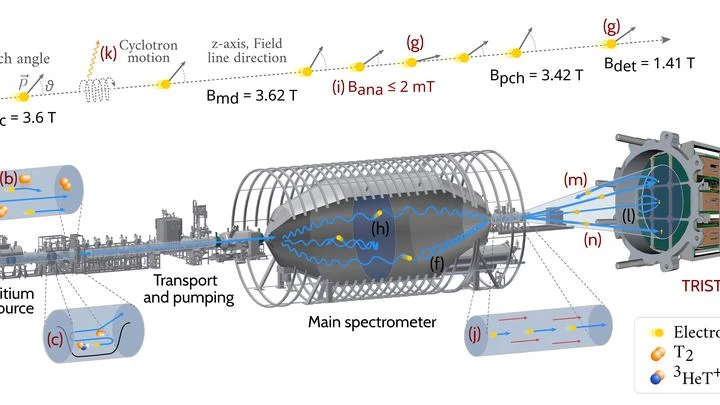
Radioactive tritium decays, emitting an electron. Its energy is almost always the same, but sometimes, just a little less. This shortfall could mean that alongside the ordinary neutrino, another, hidden particle was born.
The Standard Model describes three types of neutrinos, but scientists suspect there is a fourth — the sterile one.
Inside a piece of diamond hides a tiny defect — a nitrogen atom next to a vacancy. This defect catches magnetic fields like an antenna catches radio waves and responds with flashes of light. Such sensors already measure temperature inside living cells and find defects in microchips.
A tiny diamond hangs in the air, held by an electric field like a speck of dust in a beam of light. Hidden inside are defects — places where a carbon atom is replaced by nitrogen, with a vacancy nearby. These defects behave like little magnets that can be flipped with laser and microwaves.
Heat inside a cell is like traffic in a city: on some streets the lanes are wide and traffic flows fast, while in narrow alleys everything gets stuck. Scientists have found a way to map such 'traffic jams' for heat without opening the cell.
They took tiny diamonds, so small they are invisible to the naked eye, and placed them on a thin gold plate.
When treating epilepsy, doctors adjust the drug dose almost blindly. Too little, and seizures continue; too much, and side effects appear. Usually, a patient's blood is sent to a lab, and the result comes back a day or two later. Now, the same test can be done on a tiny silicon chip.
The sensor works like a highly sensitive nose.
A tiny defect in a diamond crystal works like a sensitive antenna. When a magnetic field oscillates nearby, this defect, a nitrogen vacancy, responds by glowing. Previously, to hear the signal, you had to accumulate many repeated measurements, like listening to a whisper with your ear pressed against a door. Now a single short "look" suffices.
Diamonds sometimes have a defect: instead of two adjacent carbon atoms, there is one nitrogen atom and an empty spot. This defect acts like a tiny antenna that responds to magnetic fields. Scientists aimed a laser and microwaves at such a diamond, and the defect started spitting out electrons.
A tiny vanadium oxide particle behaves like a window with adjustable transparency: in one state it lets infrared light through, and in another it starts absorbing it. The switch doesn't happen abruptly but smoothly, like turning a dimmer knob to adjust a lamp's brightness.
A magnetic field is invisible, but you can make it 'glow' using tiny defects in diamond — nitrogen-vacancy centers. Each such defect acts as a miniature compass, telling you which way the field points. The problem is that there are many of these compasses, and reading them all in sequence is like transcribing every letter in a thick book by hand.
A quantum computer is like an orchestra where electrons and nuclei play different instruments. Usually, the conductor needs two batons: microwaves for electrons and radio waves for nuclei.
A tiny defect in diamond is like a microscopic ear, able to pick up the magnetic 'breath' of the heart. Such sensors work at room temperature and are no bigger than a grain of sand.
A diamond speck smaller than a hundredth of a millimeter glows red. Inside it is a crystal defect: two neighboring carbon atoms, where one is missing and a nitrogen atom sits nearby. Such a pair captures light and re-emits it, like a tiny beacon that doesn't fade at room temperature.
This speck was brought near a pathway on the chip's surface.
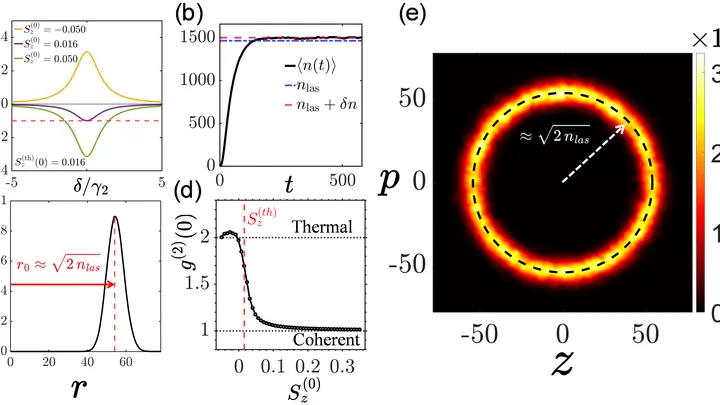
A diamond dust particle made of carbon floats in a vacuum on a laser beam. Inside there is a defect: a nitrogen atom next to a vacancy. Under the influence of light and microwaves, it starts to jitter, rocking the entire particle. This is how a sound laser starts: weak random nudges turn into a powerful steady hum.
Tiny diamonds with a defect inside can act as ultra-sensitive magnetic field sensors. But to be useful in medicine, they need to be carefully placed on soft, wet, curved surfaces, like a hydrogel bandage or a hair. It's like applying a temporary tattoo to a wet ball: the usual methods either burn the pattern or leave messy residues.
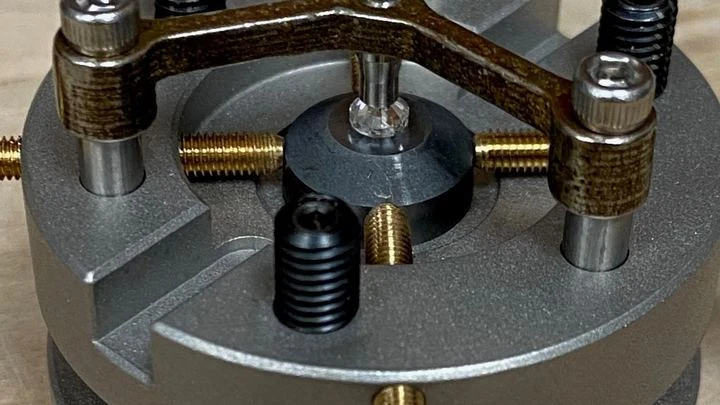
In a diamond anvil cell, pressure squeezes a material as if it were buried hundreds of kilometers deep inside the Earth. Inside this chamber, tiny diamond sensors, color centers, respond to microwaves and report on the magnetic fields and temperatures around them.
A magnetic field is invisible, but you can make it 'glow'. To do that, take a tiny diamond with defects — places where a carbon atom is replaced by nitrogen and a neighboring lattice site is vacant. These defects, like sensitive compass needles, respond to the slightest changes in the magnetic field and emit light of varying brightness.
In a dark room, a tiny diamond glows red when a green laser hits it. This glow isn't just for show: it's a signal: its brightness changes when a magnetic field is nearby. Inside the diamond sit defects — nitrogen atoms with an empty neighboring site. They act like sensitive needles that rotate under the influence of a magnet.
A cell doesn't just lie on a surface: it probes it, pulls it, and pushes it. Until now, instruments could only detect direct forces: how hard a cell presses or stretches its support. But if you grab a cell by the "shoulders" and give it a slight twist, it responds by rotating, and until recently, no one could measure that rotation.
Heat an ordinary quartz watch by ten degrees, and it will start losing seconds each day. Atomic clocks are more precise, but they take up an entire cabinet. Diamond with a tiny defect, a nitrogen vacancy, promises atomic-clock accuracy in the volume of a grain of sand.
Diamond crystals harbor invisible cracks — dislocations. These are places where rows of atoms are shifted, like a sheet of paper pulled halfway out of a stack. Stress builds up around these spots, affecting how the material breaks, bends, or conducts electricity.