Underground Detector Finds Water in Soil express
In a field stands a tank of water that usually catches particles from space. Now it keeps an eye on how much moisture is in the soil underfoot. The water in the tank acts as a trap for neutrons — tiny particles that fly out of the soil when cosmic rays hit it. The drier the ground, the more neutrons escape, and the more often the tank registers them. It's like an echo: by the loudness of the response, you can judge how solid the barrier is.
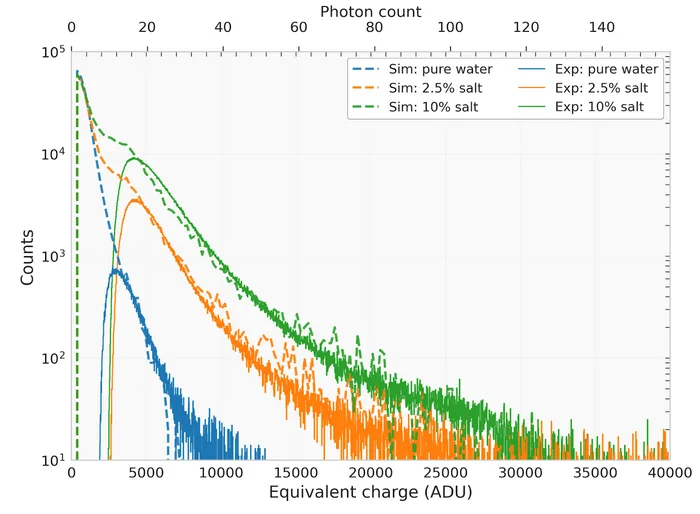
Previously, measuring moisture meant pushing probes into the soil — laborious and damaging to the field. The new method leaves the ground untouched: the tank sits on the surface, and neutrons bring the information from below on their own. The device senses even small changes in moisture, which is crucial for precise irrigation. In experiments with dry and wet soil, the signal changed noticeably, and a computer model confirmed the link between neutron count and moisture.
This method is a bridge between particle physics and agriculture. A farmer could see where the soil is already dry and water only the spots that need it. Water isn't wasted, and crops stay healthy. Of course, the device is still a bit pricey and not suitable for all soils, but the first steps are promising. Soon, perhaps, tanks will appear in fields, listening to the ground and telling us when it needs water.
Original abstract
as written by the authors arXiv:2601.17595
Water Cherenkov Detectors (WCDs), traditionally employed in cosmic-ray detection, are repurposed here for precision soil moisture monitoring using cosmic-ray neutron sensing. This approach offers advantages over conventional neutron probes, including enhanced sensitivity to low moisture levels and the ability to cover larger soil volumes without subsurface intrusion. This study evaluates the feasibility of WCDs for agricultural neutron hydrometry, addressing challenges such as background suppression and data interpretation in heterogeneous soils. We present experimental results from controlled wet and dry soil-condition emulations, alongside Monte Carlo simulations using Geant4 with an atmospheric neutron spectrum to correlate signal variation with soil-moisture differences. By bridging particle physics and agronomy, WCDs could advance soil moisture monitoring, offering a non-invasive, scalable, and accurate alternative for optimizing agricultural water use. Preliminary findings suggest a transformative potential for sustainable farming, though further research is needed to enhance cost-efficiency and adaptability to diverse soil types.
In dry soil, neutrons scatter farther than in wet soil — water slows them down, like thick jelly slows a spoon.
In Frank Herbert's novel "Dune," inhabitants of a desert planet wear special suits that collect and recycle body moisture: there, every drop of water is worth its weight in gold, and precise moisture control would be priceless.