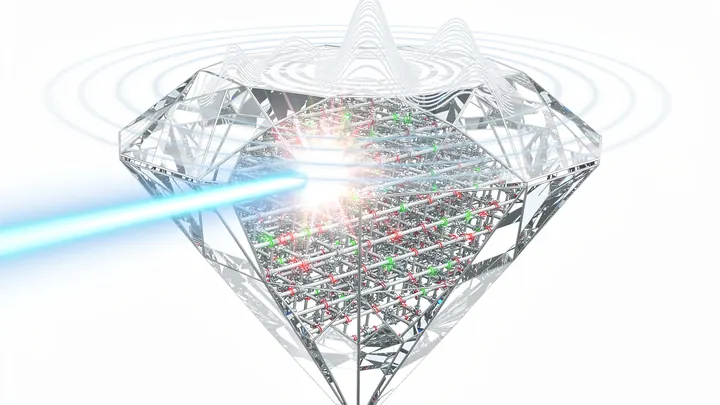
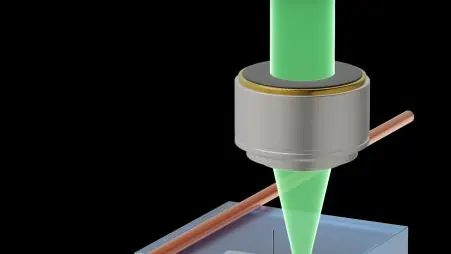
Nitrogen-vacancy (NV) centers are atomic-scale defects in diamond where a carbon atom is replaced by a nitrogen atom and an adjacent lattice site is empty. These defects have remarkable quantum properties: they can be manipulated and read out with light, and their electron spin is extremely sensitive to magnetic fields, electric fields, temperature, and pressure. This makes them powerful sensors that can operate at room temperature and even inside living cells, providing a unique window into nanoscale phenomena.
History
NV centers were first observed in 1965 by du Preez, but their potential for quantum sensing was recognized in the late 1990s and early 2000s, with key demonstrations by groups such as Jörg Wrachtrup and Fedor Jelezko in Stuttgart.
How it works
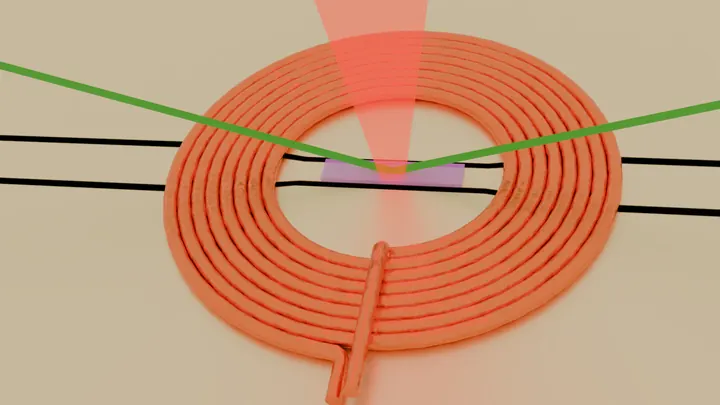
The NV center's electron spin has energy levels that depend on the local magnetic field (Zeeman effect). A green laser initializes the spin state and causes red fluorescence, whose intensity depends on the spin state. By applying microwave pulses and measuring the fluorescence, one can determine the magnetic field with high precision. The same principle applies to other perturbations: strain or temperature shifts the energy levels, altering the spin resonance frequency.
In practice
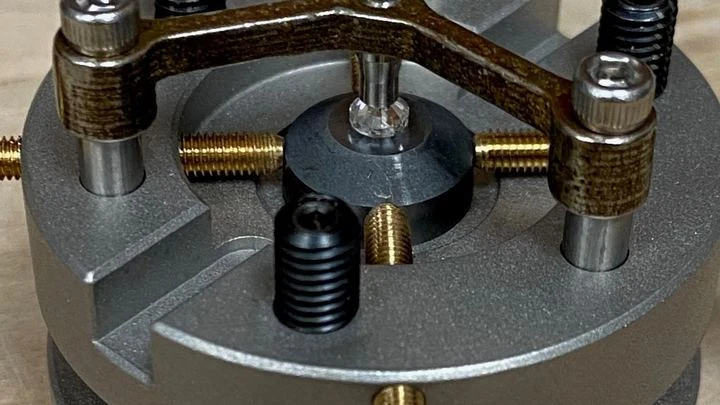
NV centers are used in magnetocardiography (mapping heart magnetic fields), imaging magnetic fields in geological samples, and detecting pressure changes in diamond anvil cells for high-pressure physics experiments.
Fun fact
A single NV center can detect the magnetic field of a single electron spin, which is about a billion times weaker than Earth's magnetic field.
Surf doesn't roll onto the shore as an even front. It comes in tongues of foam that merge and split apart. Magnetic fields inside materials behave much the same way: they breathe in waves, and until now nobody had seen them whole.
A tiny diamond, invisible to the naked eye, sits on a chip and senses heat like no ordinary thermometer can. Hidden inside it are two defects: places where a carbon atom is replaced by a nitrogen atom, with a vacancy nearby.
A tiny defect in a diamond crystal is like a sensitive microphone picking up the faintest magnetic fields. That's how sensors based on nitrogen-vacancy centers work (where a nitrogen atom and a neighboring vacancy form a quantum system). To hear the whispers of individual molecules, the sensor is placed right at the surface.
In the depths of a diamond crystal, studded with NV centers, a symphony slumbers. Each defect is like a tuning fork, ready to respond to a passing acoustic wave. But alone, their voices are barely audible: the spin-phonon coupling is weaker than a whisper. A maestro is needed, one who can turn timid vibrations into a resounding choir.
Deep underground, iron glows white-hot, and the pressure is so intense that an ordinary instrument would be crushed flat. To peer into this world, physicists built a special microscope based on tiny diamond defects (so-called NV centers).
Ordinary magnetic sensors lose sensitivity as they shrink. But scientists turned a tiny diamond into a light-based compass. Unlike jewelry diamonds, what matters here isn't purity but artificially created defects — these are what turn the crystal into a compass.
A tiny diamond with a defect — a nitrogen atom next to a vacancy in the crystal lattice. This defect, the NV center, acts like a magnetic needle: under green light, it glows red, and the brightness of that glow depends on the direction of its magnetic field.
A substance's spectrum is its fingerprint. Usually, to record one, you place the sample in a strong magnetic field, like in an MRI scanner. But there is a way to do without a magnet altogether: detect the signal from atomic nuclei at zero field. Until now, this method suffered from poor sensitivity, and its complex spectra were hard to predict.
Magnetic sensors smaller than a match head can already detect weak fields — from a beating heart or a distant planet. But making them even more sensitive involves a trade-off: improve one part, and you lose performance in another.
In the crystal lattice of diamond, defects occasionally appear: a nitrogen atom grabs a foreign spot, and next to it gapes a void. Such a flaw turns into a supersensitive diamond compass: its magnetic needle quivers at the slightest external field. Paradoxically, a blemish that lowers a stone's value has become a coveted tool for physicists.
A tiny defect in a diamond crystal works like a sensitive antenna. When a magnetic field oscillates nearby, this defect, a nitrogen vacancy, responds by glowing. Previously, to hear the signal, you had to accumulate many repeated measurements, like listening to a whisper with your ear pressed against a door. Now a single short "look" suffices.
A pinch of diamond dust dropped into a glass of liquid acts like hundreds of tiny magnetic compasses. When molecules with unpaired electrons, known as paramagnetic, appear nearby, the needles of these compasses start to quiver. From that quiver, you can tell what the molecule is and how much of it is there.
In a dark room, a hunter waits for a barely audible rustle. Similarly, physicists have spent years listening for signals from dark matter particles — the invisible substance that holds galaxies together but doesn't emit light. The new detector makes this 'hearing' a hundred thousand times sharper.
Inside the device is SF₆ gas (the same stuff that quenches sparks in electrical grids).
A tiny defect in diamond is like a microscopic ear, able to pick up the magnetic 'breath' of the heart. Such sensors work at room temperature and are no bigger than a grain of sand.
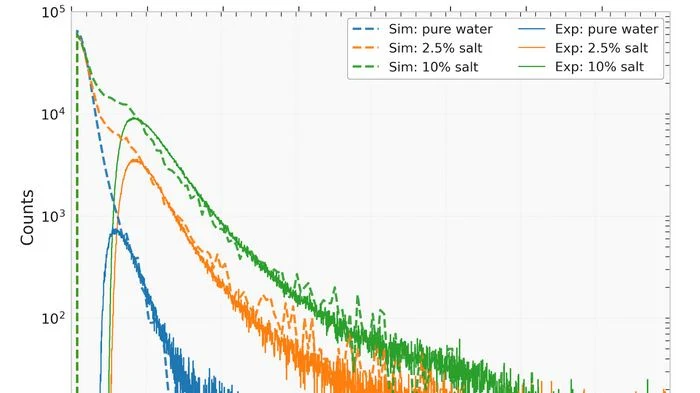
In a field stands a tank of water that usually catches particles from space. Now it keeps an eye on how much moisture is in the soil underfoot. The water in the tank acts as a trap for neutrons — tiny particles that fly out of the soil when cosmic rays hit it. The drier the ground, the more neutrons escape, and the more often the tank registers them.
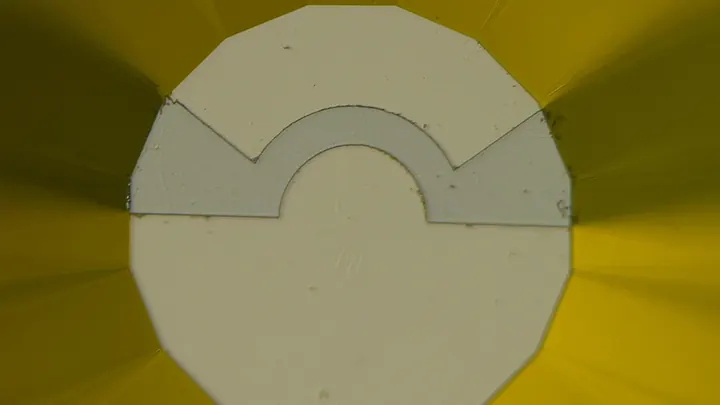
In a diamond anvil cell, pressure squeezes a material as if it were buried hundreds of kilometers deep inside the Earth. Inside this chamber, tiny diamond sensors, color centers, respond to microwaves and report on the magnetic fields and temperatures around them.
A cell doesn't just lie on a surface: it probes it, pulls it, and pushes it. Until now, instruments could only detect direct forces: how hard a cell presses or stretches its support. But if you grab a cell by the "shoulders" and give it a slight twist, it responds by rotating, and until recently, no one could measure that rotation.
Diamond crystals harbor invisible cracks — dislocations. These are places where rows of atoms are shifted, like a sheet of paper pulled halfway out of a stack. Stress builds up around these spots, affecting how the material breaks, bends, or conducts electricity.
In the 1930s, Fritz Zwicky, observing the Coma cluster, noticed anomalously high galaxy velocities: their motion pointed to a huge hidden mass gravitationally binding the system.
In diamond, you can embed a “spy.” Simply replace a carbon atom with nitrogen: you get a defect that responds to magnetic fields and sends a light signal.
A crowd of thirty-one quantum sensors whispers within a diamond slab. Previously, this whisper was drowned out by the roar of floodlights: the random photon bursts used to read out the spin states masked the ensemble's own quantum noise. Now physicists have learned to switch off the floodlights and listen to the crowd itself.
Inside a diamond anvil cell, a device where two diamonds squeeze a sample to hundreds of gigapascals, pressure is distributed unevenly. Some regions are compressed more, others less. This affects experimental results: the material may behave differently than under perfectly uniform compression.