Precision photometry is the science of measuring light's properties—intensity, wavelength, polarization, or timing—with extreme accuracy, often at the quantum limit. It goes beyond simply detecting light to quantifying it so precisely that subtle physical effects become observable. In modern physics, this underpins everything from astronomical surveys that map galaxies to medical imaging that peers into tissue, and from testing the foundations of quantum mechanics to searching for dark matter particles.
History
The field grew from astronomical photometry in the 19th century, but modern precision techniques emerged with the laser in the 1960s and the development of charge-coupled devices (CCDs) in the 1970s, which allowed measurements to reach photon-counting accuracy.
How it works
The key is controlling and calibrating every step of light detection. Techniques like laser ranging use the time-of-flight of light pulses to measure distances with sub-millimeter precision, while superradiance—where many atoms emit coherently—amplifies tiny signals. In practice, precision photometry involves ultra-stable detectors, careful noise reduction, and often quantum-optical tricks like squeezing or single-photon counting to extract information that would otherwise be buried in background noise.
In practice
Used in LIGO's gravitational-wave detectors, in medical imaging like optical coherence tomography (which sees 12 cm into tissue), and in dark matter detectors that use photomultipliers to catch faint scintillation signals.
Fun fact
A precision photometer can measure the light from a single photon, which is the smallest possible amount of light—about 10^-19 joules.
Light knocks electrons out of a crystal, and they fly toward the detector like arrows toward a target. From their trajectories, physicists reconstruct how electrons behaved inside the material: with what energy and in which direction they moved. But switch on a magnetic field, and the trajectories bend. The arrows start to curve, the target turns into a warped mirror, and the picture blurs.
A conductor raises the baton, and the orchestra produces not just sound but a complex score: each note sounds at its own moment, at its own pitch, with the right volume. Light can also be a score, if you control its spectrum and timing. Previously, this required bulky setups that could not be reconfigured after assembly.
An assembly line spits out parts one by one per cycle. If the cycle is short and defects are few, the line runs fast. In quantum optics, a single-photon source plays the role of such a line: it must emit exactly one quantum of light per cycle, and the more cycles per second, the more photons go into the fiber.
When an alpha particle tears through a gas, it leaves behind not a continuous track but a chain of individual ionizations: tiny flashes where electrons are knocked off atoms. In a living cell, such flashes damage DNA, and the denser they are packed into a clump, the more severe the damage.
If a smell seeps into a room through a slightly open door, you could stand in the middle and sniff. But the most accurate way to catch the moment the smell arrives is to stand right at the threshold. A cell behaves much the same way when it needs to measure the concentration of a substance around it.
Radiation therapy is a precision strike on a tumor, but every shot must be calibrated to within a millimeter and a fraction of a second. The problem is that existing dosimeters are either bulky, or they distort the beam themselves, or they require pauses for readout.
A neutron star is the collapsed core of a massive star, squeezed to the size of a city. A teaspoon of its material weighs as much as a mountain. But inside this superdense sphere, a surprise may lurk: under unimaginable pressure, neutrons break apart into quarks, giving the star a new, more compact core.
Two photons meet at a half-silvered mirror. If they arrive at exactly the same time, they always leave together — side by side, like twins who refuse to be parted. This effect, discovered in 1987, became the basis of a quantum ruler for measuring tiny delays.
Each positron annihilation is like the birth of a pair of dancers, connected by an invisible thread of polarization. Two gamma quanta fly apart, but their states remain entangled: measuring one instantly determines the other — as if one partner senses every movement of the other, no matter the distance.
Light waves are never perfectly smooth — they are constantly jittered by quantum ripples. These almost invisible nudges were studied by Nobel laureate Roy Glauber, who laid the foundations of quantum optics. Now physicists have learned to freeze these ripples.
Ever since Paul Dirac theoretically predicted antimatter, physicists have been hunting for the tiniest differences between particles and their antiparticles.
A black hole is like a perfect vault: everything that falls in disappears without a trace. But in the 1970s, Jacob Bekenstein and Stephen Hawking discovered that the horizon carries an indelible "sticker" — entropy (a measure of hidden information about swallowed matter).
An ordinary rain gauge collects water in a bucket and shows the total volume of precipitation. But the new device is like a sensitive palm that feels every falling drop and keeps count, even when the drops number in the thousands.
That's exactly what physicists have built.
The light bulb turns on only in the room where you need it. That's roughly how photoactivatable drugs work: they 'switch on' only where light is directed, leaving the rest of the body untouched. This is especially important in cancer treatment: conventional chemotherapy hits all dividing cells indiscriminately, causing severe side effects.
Imagine a balance scale with identical weights, yet one pan always tips lower. In the world of elementary particles, this imbalance is called CP violation: particles and their mirror twins (antiparticles) behave slightly differently.
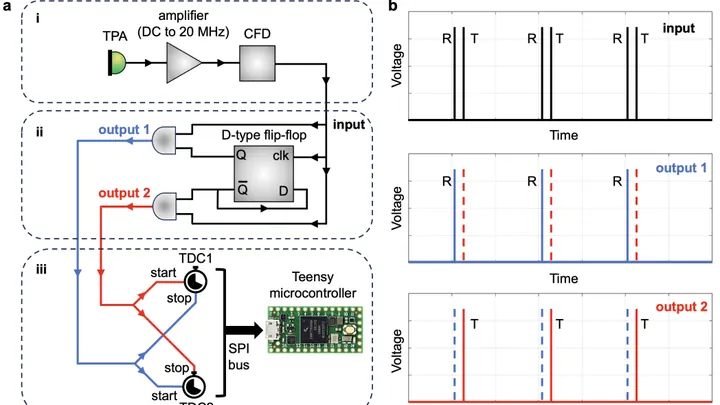
In giant accelerators, particles zip through detectors in billionths of a second, and telling one from another requires a stopwatch of incredible precision. The new µRWELL-PICOSEC detector acts as such a stopwatch: it captures the moment a particle passes with a precision of 48 picoseconds: that's 48 trillionths of a second.
The laser based on diamond converts almost half of the pump energy into bright yellow light — an efficiency of 47.7%, a record for such devices. But the main advantage is not the power, but the exceptional purity of the color: the beam is so monochromatic that it can be compared to a musical instrument playing just one note without the slightest wavering.
A standard laser rangefinder works like a stopwatch on a 100-meter dash: it times how long light takes to run to the target and back. But such a stopwatch has a limit: it ticks in steps of tens of picoseconds (trillionths of a second). In that step, light travels about a centimeter, so finer details are invisible.
In particle scattering experiments, the target is often polarized: nuclei are aligned so that their spins point predominantly in one direction. The degree of this alignment affects the collision outcomes.
Two laser beams, like two pencils, draw an invisible scale on the wall. One tip moves slightly faster than the other, and by the way their strokes alternately coincide and diverge, you can calculate the distance to the wall with an accuracy down to the thickness of a spider's thread.
In the new work, physicists made these two beams work continuously, without pauses.
In underground laboratories where dark matter or neutrinoless double beta decay is sought, detectors are surrounded by silence. But even in this silence, radioactive dust quietly settles on their walls. One source is radon, an invisible gas that seeps from rocks. Its short-lived progeny stick to surfaces and spoil measurements.
When matter accumulates on the surface of a neutron star, the ultra-dense remnant of a dead star, an explosion occurs, akin to a giant thermonuclear bomb. In this inferno, nuclei of elements not found on Earth are born within seconds. To understand which ones, their masses must be known with great precision.
An X-ray image usually brings to mind a bulky machine in a hospital. But such a picture can be taken by a device the size of a palm, assembled from hobbyist electronics. The authors took a Raspberry Pi mini-computer, a 12.3-megapixel camera, and a screen that glows under X-rays.
The night sky is not all that dark. Even far from cities, it glows faintly — which hampers astronomers trying to catch weak flashes from distant cosmic rays.
A good chef tastes the soup and adds a pinch of salt. Ordinary scales won't notice that pinch, but sensitive ones will. In the quantum world, pairs of entangled particles play the role of such scales. It was previously thought that the entanglement had to be as strong as possible, otherwise precision wouldn't improve.
Light passing through a lens bends slightly. For an optical computer, this is like a warped mirror for an artist: the image is there, but the details blur. An Ising machine using light beams tackles problems like packing luggage or planning a courier's route.
An ordinary free-electron laser is like a musical instrument with a single string: it can play only one note until you change its design. To get a different wavelength, you have to retune magnets or accelerate electrons harder. That's expensive and bulky.
A laser pulse racing through plasma is like a runner carving a path through a crowd. It shoves electrons aside, leaving behind a rarefied channel, just as the crowd parts for a sprinter. In this channel, the crest of the light wave moves slightly faster than light in a vacuum, and it is this speed that determines how efficiently the pulse transfers energy to particles.
In the dark, a tiny spark flashes. A gamma ray born inside a patient's body strikes a crystal and knocks out a shower of light. The detector's job is to figure out exactly where that happened. The more precise the answer, the sharper the image on the tomograph screen.
The new detector resembles a honeycomb, but not a flat one — the cells narrow toward the bottom.
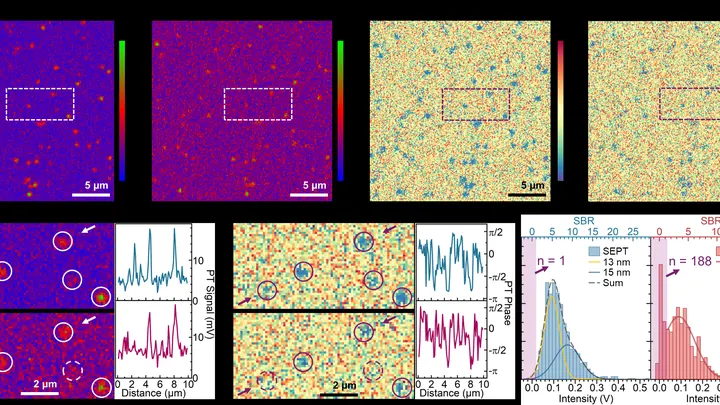
Imagine a vast field of fireflies, each flashing alone rather than in a swarm: that's what the new automated setup is hunting for. It sweeps a laser across the sample like a flashlight and records the color and brightness of the glow at every spot.
The helium in a party balloon is the very gas that makes it float. But long before balloons, helium appeared in the first minutes after the Big Bang. Its exact abundance in the universe is like a fingerprint: it tells you how many kinds of neutrinos (ghostly particles that pass through walls) exist.
Light in a microscope doesn't arrive as a steady stream but like buckshot from a bag: sometimes more photons, sometimes fewer. This random scatter is the shot noise. It sets a limit: faint signals from tiny objects get lost in the ripple.
Scientists have found a way to calm this buckshot.
A typical 3D printer squeezes out plastic like a pastry chef piping cream from a bag. Here, instead of plastic, it's light. A laser beam draws in liquid resin, making it solidify at precise points. This creates parts too small to see without a microscope.
Until now, such printers were slow: the beam crawled across the surface like a pen on paper.
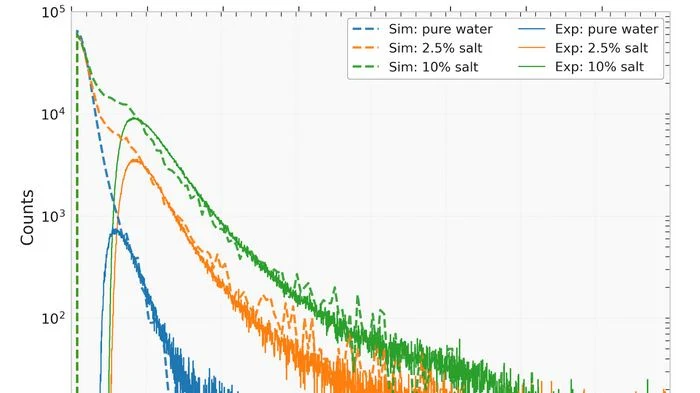
In a field stands a tank of water that usually catches particles from space. Now it keeps an eye on how much moisture is in the soil underfoot. The water in the tank acts as a trap for neutrons — tiny particles that fly out of the soil when cosmic rays hit it. The drier the ground, the more neutrons escape, and the more often the tank registers them.
Even a laser beam has an invisible tremor — quantum noise. Physicists have learned to 'squeeze' it, like a balloon pinched at the waist: the noise quiets in one direction but amplifies in another. Scientists hid the excess noise where it doesn't interfere with precise light measurements.
Light, regardless of its source, consists of photons — elementary particles, quanta of the electromagnetic field. The simplest light detector, such as a photometric illuminance meter, operates in a binary mode: it merely registers whether photons hit it or not, giving a 'yes/no' answer.
Dark matter doesn't emit or reflect light, yet its gravity holds galaxies together. What it's made of is a mystery. One leading candidate is the axion, an ultra-light particle. Searching for axions is like listening for a very faint radio signal, but the receiver's own noise gets in the way.
Entangled photons are like twins: what affects one instantly affects the other, even if they are separated by kilometers. Until recently, observing such a connection required detectors that counted each photon individually in pitch darkness. Physicists simplified the task by swapping them out for a regular scientific camera.
Astronomers read the history of galaxies by their portraits. Previously, they used either lengthy analysis of light by colors or quick filtered snapshots, losing the details of shape.