Neutrino geophysics uses neutrinos to study Earth's interior, a technique that complements traditional seismic methods. Neutrinos pass through matter almost undisturbed, so they can carry information from deep within the planet. The corpus titles include 'Нейтринная томография Земли' (neutrino tomography of Earth) and 'Недра Земли на просвет' (Earth's interior in transmitted light), indicating that this is an active area of research. The goal is to map density variations and even identify the distribution of elements like hydrogen.
History
The idea of using neutrinos for Earth tomography was proposed in the 1970s, but only recently have detectors become large enough to make it practical. The first tentative measurements were made in the 2010s using the IceCube detector.
How it works
Neutrinos interact with matter via weak nuclear forces, and the probability of interaction depends on the density and composition of the material they traverse. By placing detectors at different locations and measuring the flux of neutrinos from cosmic rays or the Sun, scientists can reconstruct the density profile of Earth. This is analogous to how X-rays are used in medical CT scans, but with neutrinos instead of photons.
In practice
Neutrino tomography could help locate dense mineral deposits, monitor volcanic activity, and improve our understanding of Earth's heat flow and mantle convection.
Fun fact
Neutrinos from the Sun pass through Earth and can be detected at night from the opposite side, effectively allowing scientists to 'see' the planet's interior in real time.
At nine in the morning, the DarkSide-50 detector, 1400 meters beneath Gran Sasso, records a weak ionization pulse. By eleven at night, the frequency of such events drops noticeably. This is not an electronics glitch or a seasonal background variation.
For almost a century, seismology has been the planet’s chief X-ray, probing the interior through elastic waves. But neutrinos, ghost particles predicted by Wolfgang Pauli, offer a different perspective.
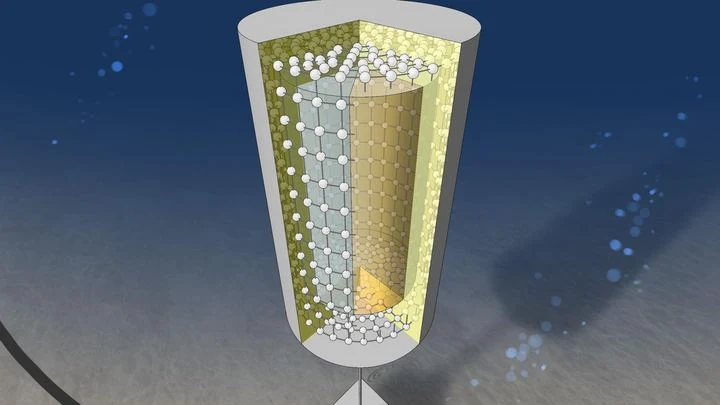
In the depths of the ocean, where light never reaches, a plan is taking shape to capture particles that barely interact with anything. Geoneutrinos, tiny messengers from the scorching mantle, are emitted during the decay of uranium and thorium. Their flux carries information about how much heat lies hidden beneath our feet.
In the scorching heart of a dying star, an invisible stream is born — a neutrino gas. The particles race through matter almost without stopping, but when their density is enormous, they start to feel each other. Old calculations described this as a jostle in a crowd: each shove changes direction, but no connection arises between passersby.
A clock isn't just hands. Every atomic nucleus is a natural metronome: it oscillates with nearly perfect regularity. If you lift one such metronome a couple of meters, its rhythm speeds up ever so slightly — that's time warping, as predicted by Einstein.
A giant sphere filled with liquid flashes when an elusive particle, a neutrino, flies through it. Inside the sphere, like fireflies on a Christmas tree, hang thousands of tubes that catch these flashes. To pinpoint exactly where the flash occurred and how much energy arrived, you need to know the position of each tube to within a millimeter.
A neural network trained on collisions of protons and electrons transferred its skills to a completely different experiment — catching neutrinos. Like a chef who learned French cuisine and then, without preparation, baked an excellent Uzbek plov.
Deep beneath our feet, within the planet's bulk, radioactive elements are slowly decaying. This process spawns tiny particles — geoneutrinos. They pass through the crust, mantle, and core, barely interacting with anything.
In a field stands a tank of water that usually catches particles from space. Now it keeps an eye on how much moisture is in the soil underfoot. The water in the tank acts as a trap for neutrons — tiny particles that fly out of the soil when cosmic rays hit it. The drier the ground, the more neutrons escape, and the more often the tank registers them.