A gamma-ray telescope is an instrument designed to detect gamma rays from cosmic sources. Since gamma rays do not penetrate Earth's atmosphere, ground-based telescopes use an indirect method: they observe the Cherenkov radiation emitted when a gamma ray strikes the upper atmosphere and creates a cascade of particles. This allows astronomers to study the most energetic phenomena in the universe, such as supernovae, active galactic nuclei, and gamma-ray bursts.
History
The technique was pioneered in the 1960s by the Whipple Observatory, which built the first dedicated gamma-ray telescope. The field expanded significantly with the construction of the H.E.S.S., MAGIC, and VERITAS arrays in the early 2000s.
How it works
When a gamma ray enters the atmosphere, it produces an electron-positron pair, which then triggers an air shower of relativistic particles. These particles travel faster than light in air, emitting a brief flash of blue Cherenkov light. A ground-based telescope uses a large mirror to collect this faint flash and focus it onto an array of photomultiplier tubes. By analyzing the shape and timing of the flash, the instrument reconstructs the energy and direction of the original gamma ray.
In practice
Gamma-ray telescopes are used to monitor blazars, search for dark matter annihilation signals, and study the acceleration of cosmic rays in supernova remnants.
Fun fact
A single gamma-ray flash lasts only a few nanoseconds, so the telescope's cameras must capture images in that tiny window to catch it.
The night sky in neutrino light resembles a canvas worked on by two hands. One holds a broad, soft brush: these are supernova remnants, the shells left behind after stellar explosions. The other grips a fine, hard pen — microquasars, binary systems where a black hole twists matter into narrow jets.
Gamma rays are the most energetic light in the Universe. But one part of them, the medium-energy range, long remained invisible: instruments couldn't catch them, leaving a gaping hole in the sky. Scientists call it the "MeV gap," named after the unit of energy these rays carry.
The new camera works like a three-layer detective.
In July 1969, as Apollo 11 flew toward the Moon, astronauts noticed something unusual: brief flashes of light that appeared even with their eyes closed. At first, this was attributed to fatigue, but the flashes recurred in different crews. Gradually, it became clear: cosmic rays were to blame — tiny particles hurtling through space at tremendous speeds.
Imagine a huge stadium packed with people dressed in black. You're standing outside, trying to figure out what's happening inside, even though you can't see a single person. But if two people bump into each other and exchange bright T-shirts, you'd spot a flash of color.
The gamma sky, captured by the Fermi telescope, is a grand symphony of thousands of sources. Here, the rhythmic pulsations of pulsars, the powerful chords of active galactic nuclei, but most of all — unidentified objects, whose part remains a mystery.
Gravitational waves are ripples in space from the mergers of black holes and neutron stars. Existing detectors, built with contributions from Kip Thorne and Rainer Weiss, work like highly sensitive microphones but only hear the highest 'notes'.
A galaxy is like a glowing pancake studded with stars. If you look at it face-on, you see everything at once — both the bright spiral arms and the dark dust lanes. But tilt the pancake, and the picture changes: layers overlap, light blends together. This very effect, it turns out, creates the illusion of a tight link between radio and gamma-ray emission in distant star systems.
Conventional dark matter detectors are like a soccer goalkeeper waiting for a powerful shot while the ball barely rolls. The invisible particles filling our galaxy often move too slowly to be noticed by sensitive sensors.
At the very heart of the Milky Way, something is continuously glowing in gamma rays. This light is special: its energy is exactly 511 thousand electronvolts. Such energy is produced when an electron meets its antimatter counterpart, a positron, and they annihilate, leaving behind a flash of light.
The Fermi telescope spent 17 years recording gamma rays from the active nuclei of galaxies with giant black holes at their centers. The glow of their jets resembles a chaotic cacophony: it constantly changes.
Deep beneath our feet, within the planet's bulk, radioactive elements are slowly decaying. This process spawns tiny particles — geoneutrinos. They pass through the crust, mantle, and core, barely interacting with anything.
Dark matter is like an invisible glue that holds galaxies together. It emits no light, but if its particles collide, gamma rays can flash. Scientists hunted for such flashes in dwarf galaxies — small stellar clusters with lots of dark matter and almost no ordinary matter.
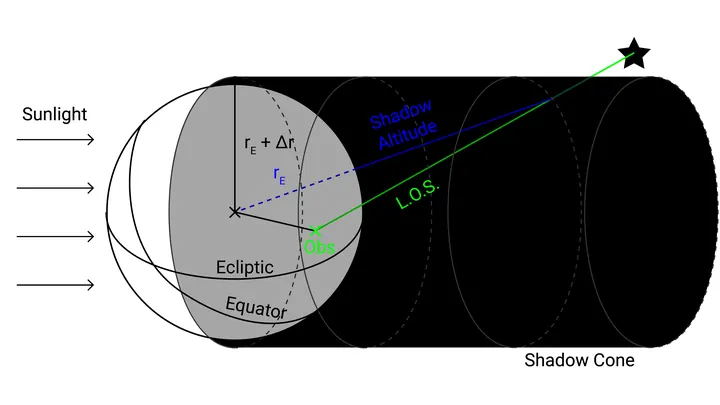
At night, the sky is never completely black. Even far from cities, the upper atmosphere glows faintly: sunlight makes hydrogen atoms emit a reddish glow that astronomers call geocoronal emission. For a telescope, it's like a fogged-up window: it adds extra light and hinders seeing distant galaxies.
A firefighter with a thermal imager can see the source of a fire through smoke. But how do you see a radiation source that has no smell, no glow, and no heat? Gamma cameras solve this problem: they capture gamma rays emitted by radioactive materials and overlay their 'trace' onto a regular photograph. The result is an image showing that the source is, say, behind the far door.
A solar flare is like a shot from a giant cannon: it blasts a stream of charged particles into space. When that stream reaches Earth, the planet's magnetic field usually deflects it, but in polar regions, particles penetrate the atmosphere.
In a field stands a tank of water that usually catches particles from space. Now it keeps an eye on how much moisture is in the soil underfoot. The water in the tank acts as a trap for neutrons — tiny particles that fly out of the soil when cosmic rays hit it. The drier the ground, the more neutrons escape, and the more often the tank registers them.
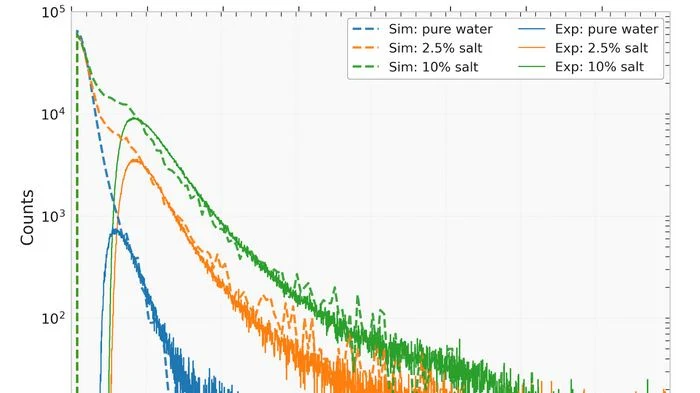
In a tank of pure water, particles traveling faster than light in that medium leave bluish flashes, like a plane breaking the sound barrier creates a sonic boom. From these flashes, you can tell what kind of visitor passed through: a gamma quantum or a neutron. This is no idle task: at borders and warehouses, you need to quickly distinguish a harmless radioactive cargo from weapon-usable material.
Neutrinos are ghost particles: predicted by the Standard Model, they barely interact with matter. Catching them is like trying to hear a whisper in the roar of a waterfall.
Throw pebbles along a tight row of posts: they ricochet into a dense spray. Throw at an angle, and they scatter. Gamma rays in a crystal do the same: they spawn particle cascades that spread out unless the crystal’s atomic rows are perfectly aligned. Align them within a hair’s width, and the cascade sharpens into a tight beam. A small crystal then outperforms a large one.
Cosmic rays are like a downpour pelting from all sides. But when the wind blows, the droplets change direction. In the same way, a solar storm, a cloud of magnetized gas from the Sun, bends the paths of these particles that normally rain down on Earth evenly. Cosmic rays are invisible messengers from distant galaxies.
Mass curves spacetime like a heavy stone pressing into an asphalt road. Light passing by skirts around this dent, its path lengthens, and it arrives late. Astronomers have observed this Shapiro effect many times near the Sun and planets.
A new plan proposes to recreate this delay on a lab bench.
Back in the 18th century, William Herschel was searching for life on Mars. Today, astronomers are targeting not planets but artifacts — for example, alien probes lurking in the Solar System. The problem is that spotting a tiny object next to the blinding Sun is nearly impossible.
At the heart of many galaxies lies an invisible beacon — a supermassive black hole. As it devours matter, it blasts a dazzling beam of gamma rays into space. If that beam points towards Earth, astronomers see a blazar — a bright but fickle point.
A firefly blinks for one ten-billionth of a second somewhere above the Siberian taiga. Seeing such a thing is impossible, but the TAIGA-HiSCORE array, spread across a valley in the Tunkinsky district of Buryatia, tried to catch exactly such flashes — not from insects, but from the depths of space.