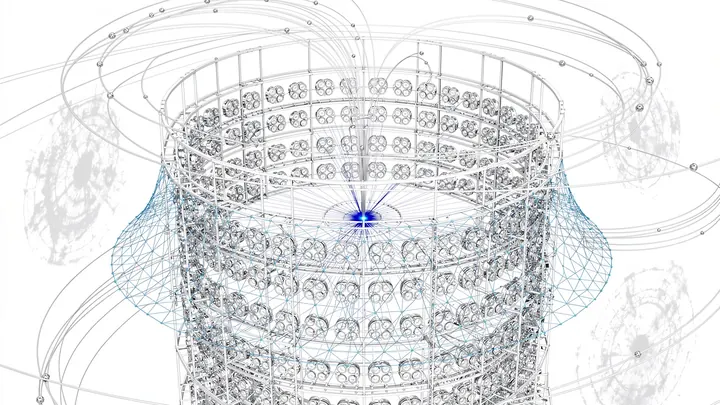
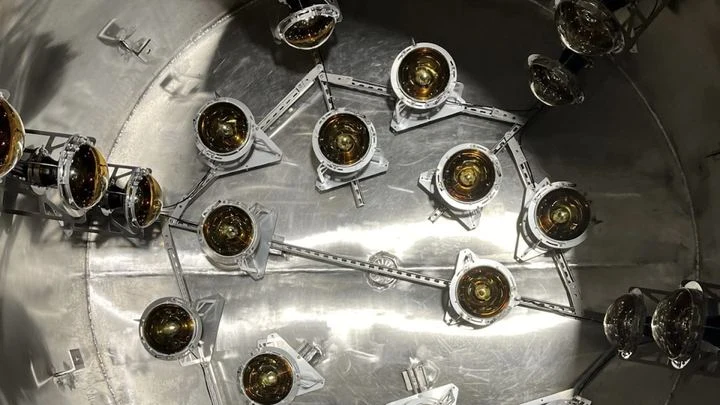
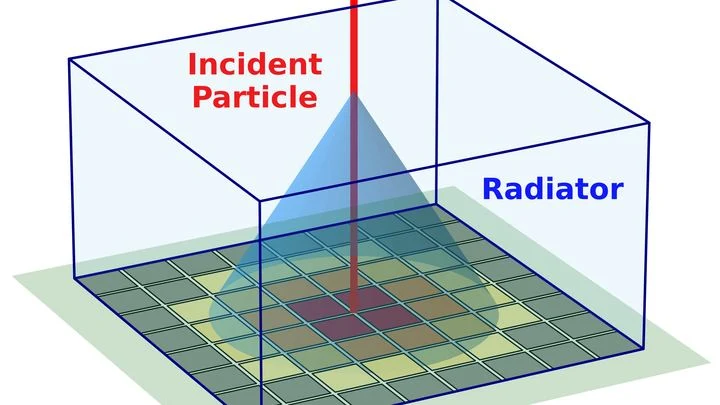
Super-Kamiokande (often abbreviated as Super-K) is a massive underground neutrino detector located in the Kamioka mine in Japan. It consists of a cylindrical tank filled with 50,000 tons of ultra-pure water, surrounded by about 13,000 photomultiplier tubes that detect faint flashes of light. When a neutrino interacts with a water molecule, it can produce a charged particle that moves faster than light in water, generating a cone of blue light known as Cherenkov radiation. By analyzing the pattern and timing of these light flashes, physicists can determine the neutrino's direction, energy, and type. Super-K has been instrumental in studying neutrinos from the Sun, the atmosphere, and supernovae, and it played a key role in the discovery of neutrino oscillations, which showed that neutrinos have mass.
History
Super-Kamiokande began operating in 1996, succeeding the smaller Kamiokande detector. It was built by a collaboration led by Masatoshi Koshiba, who later shared the 2002 Nobel Prize in Physics for pioneering neutrino astronomy. In 1998, Super-K announced the discovery of neutrino oscillations, providing the first strong evidence that neutrinos have mass.
How it works
Neutrinos rarely interact with matter, so a huge detector volume is needed to catch a few events. When a neutrino collides with an electron or a nucleus in the water, it can create a charged lepton (such as an electron or muon) that travels faster than the speed of light in water. This triggers Cherenkov radiation — a shockwave of light — which is captured by the photomultiplier tubes lining the tank. The ring-shaped pattern of light on the detector walls reveals the particle's direction and energy. The detector is located 1,000 meters underground to shield it from cosmic rays and other background radiation.
In practice
Super-K is used to study solar neutrinos, atmospheric neutrinos, and neutrinos from supernovae, as well as to search for proton decay — a key prediction of grand unified theories. It also serves as a far detector for the T2K long-baseline neutrino experiment.
Fun fact
Super-K detected neutrinos from Supernova 1987A — but that was actually the earlier Kamiokande detector; Super-K itself has been ready to catch the next galactic supernova, and it would detect thousands of neutrinos in a burst lasting only a few seconds.
Imagine an interpreter at a meeting where everyone speaks a language they don't know. At first, they have to listen to every word, write it down verbatim, and then check against the original. That's how simulations for the IceCube neutrino telescope work: they track every photon born in the Antarctic ice, traveling hundreds of meters to hit a sensor.
The universe is constantly sending us signals, but many are too faint to notice. Relic neutrinos, particles left over from the Big Bang, pass through Earth by the billions every second, yet catching even one is a feat on the edge of possibility. We need a detector that can sense energy a thousand times smaller than what it takes to move a speck of dust.
A massive star exhausts its fuel, and its core collapses in a fraction of a second. A supernova is born, along with a brief but powerful shower of neutrinos. These particles barely interact with matter, so they fly away freely, carrying information about the catastrophe.
A huge pool of clear liquid is hidden deep underground. Inside, there is nothing but a pristine 'broth' that flashes with faint light when an invisible particle flies through. This is the JUNO detector—20,000 tons of liquid scintillator built to hunt for neutrinos.
The main enemy of such a hunt is not darkness but its own noise.
The nickelate family consists of layered crystals, like a stack of pancakes: nickel and oxygen layers alternate with lanthanum spacers. Two years ago, superconductivity was discovered in them — the ability to conduct electricity without resistance when cooled.
Engineers create an alloy for solar concentrators by adding hard particles — like raisins in dough, to help it hold its shape under extreme heat. Too big a raisin and the material cracks. Previously, scientists manually counted these particles on microscope images.
When a massive star dies, its core collapses, and a supernova explosion occurs. The cataclysm births streams of particles — like ripples from a thrown stone. The first to arrive are swift neutrinos, which pierce the Earth, hardly interacting. Then, hours later, ghost particles with a tiny charge appear.
Neutrinos are often compared to a radio broadcast picked up by different receivers. One station sends a signal, but antennas in Japan, Antarctica, and at the bottom of the Mediterranean Sea hear it differently — due to distance, interference, and antenna orientation.
An old photograph taken at the moment of the universe's birth has been carrying its light to us for nearly 14 billion years. This snapshot is the cosmic microwave background, the cooled echo of the Big Bang. It captures the tiny inhomogeneities from which galaxies later grew.
In April 2021, in a galaxy 35 megaparsecs away, supernova SN 2021foa erupted. It immediately puzzled astronomers: its spectrum feverishly switched between hydrogen and helium lines — as if the star, in agony, was frantically shedding its outer layers.
A photographer shoots a night forest, trying to catch fireflies in the frame. The flashes are rare and faint, while around there's the noise of wind and distant lights.
Deep underground in Japan, a huge tank of ultrapure water waits for rare visitors — neutrinos arriving from distant stellar explosions. Such guests are few and far between: over years of observation, Super-Kamiokande registers only a handful of events.
A giant tank of ultrapure water sits deep underground in Japan. Its walls are lined with thousands of light-sensitive sensors that catch faint flashes — the traces of ghostly particles passing through the water.
An invisible fence blocks the strait. You can't climb over it or dive under it: it's not made of steel, but of a stream of particles penetrating the water column. That's one way to describe the idea of detecting nuclear submarines by their antineutrino emission.
Deep in the Mediterranean Sea, where water presses down with the force of hundreds of atmospheres, a network of light-sensitive spheres waited for a rare guest. And it came — a neutrino that carried through the bulk of the Earth an energy comparable to the impact of a flying brick.
A translator halfway across the hall suddenly starts rendering the message backwards. That's roughly how a neutrino, a ghost particle that barely notices matter, might behave if it encounters a cloud of ultralight dark matter.
Inside every atom lives a proton. For a long time, it was considered as eternal as matter itself. But theories that unify all forces of nature predict that, sooner or later, the proton will decay. The only question is how long we have to wait.
In the Japanese detector Super-Kamiokande — a giant tank of ultra-pure water — physicists searched for signs of such a decay.
Deep beneath Japan's Mount Ikeno sits a tank holding 50,000 tons of the purest water. Inside, it catches neutrinos — ghostly particles that zip through Earth as if it weren't there. When a star explodes in our galaxy, neutrinos arrive first, hours before the light.
A distant lamp shines through uneven glass. The glass bends the rays, and instead of one flame on the wall, several appear — some brighter, some fainter. In much the same way, a massive galaxy bends the light of an exploded star. There was one explosion, but the images show four glowing points.
Neutrinos are tiny particles that pass through the planet's bulk like light through a windowpane. Every second, billions of them fly through your pinky fingernail, but catching even one is no easy feat. To do it, scientists dug a two-kilometer-deep mine in Canada and installed the SNO+ detector.
Deep beneath our feet, within the planet's bulk, radioactive elements are slowly decaying. This process spawns tiny particles — geoneutrinos. They pass through the crust, mantle, and core, barely interacting with anything.
Plain water in a glass is clear and calm. But if you add tiny carbon dots made from sugar and citric acid in an ordinary microwave, the water starts to glow when a charged particle flies through it.
Neutrinos — elementary particles rightly dubbed “ghosts”—barely interact with matter, making their detection a formidable challenge. The existence of neutrinos was predicted by Wolfgang Pauli, and the name was coined by Enrico Fermi.
In a dark tank holding thirty tons of water, the liquid glows when a ghostly particle streaks through. Neutrinos barely interact with matter, but occasionally they bump into atoms, and a flash is born. To catch it, a special substance, a liquid scintillator, is added to the water to amplify the light.
To align particle spins in one direction, physicists usually cool a substance to near absolute zero and place it in a strong magnetic field. That is expensive and bulky.
A new method resembles tuning many spinning tops with a gentle touch: mediator molecules temporarily bind to target atoms and pass on their order.
Deep within the Antarctic ice, at depths where sunlight never reaches, antennas hang suspended. They listen not for sounds but for radio waves, waiting for a signal from a particle that is nearly impossible to catch. A neutrino passes through the Earth like a bullet through fog, but occasionally, very rarely, it grazes an ice atom.
When a particle zips through a transparent material faster than light can travel through it, it leaves behind a faint blue flash, just as a jet breaking the sound barrier creates a shock wave. This Cherenkov radiation fires instantly, with no delay, making it perfect for ultra-precise timing in the world of elementary particles.
In April 2023, Japanese satellites detected a super-intense X-ray burst on the neutron star MAXI J1752–457. The star cooled down in 4 days — five times faster than usual. Like someone cracked open a cosmic window.
Light from the earliest epoch of the universe has been traveling toward us for billions of years. On its way, it passes by enormous galaxy clusters. Their gravity slightly bends this light, just as a shop window distorts the view of the street behind it. As clusters grow, the bending becomes more noticeable. This effect is known as the Rees-Sciama effect.
In an underground hall at Fermilab, a huge tank holds liquid argon — a transparent fluid at minus 186 degrees. When an invisible neutrino flies into the tank, it occasionally strikes an argon nucleus, and a short track of charged particles flashes.
In a field stands a tank of water that usually catches particles from space. Now it keeps an eye on how much moisture is in the soil underfoot. The water in the tank acts as a trap for neutrons — tiny particles that fly out of the soil when cosmic rays hit it. The drier the ground, the more neutrons escape, and the more often the tank registers them.
In a tank of pure water, particles traveling faster than light in that medium leave bluish flashes, like a plane breaking the sound barrier creates a sonic boom. From these flashes, you can tell what kind of visitor passed through: a gamma quantum or a neutron. This is no idle task: at borders and warehouses, you need to quickly distinguish a harmless radioactive cargo from weapon-usable material.
Deep inside a dying star eight times heavier than the Sun, a quiet fever begins a few days before the final explosion. The star's core contracts and heats up, releasing neutrinos — tiny particles that barely interact with matter. This stream is like a faint whisper before a loud cry: the supernova hasn't flashed yet, but it's already sending a signal of its imminent demise.
When a massive star explodes as a supernova, its material slams into the surrounding shell of cosmic dust and gas, like an invisible fur coat. The impact spawns myriads of neutrinos, ghostly particles that zip through planets without swerving.
Cosmic neutrinos are ghost particles, passing freely through the Earth. The IceCube telescope in the ice of Antarctica once caught such a neutrino, and it matched an infrared flare. That flare turned out to be the moment a black hole tore a star apart in a distant galaxy.
An electron flies out of a tritium nucleus with an energy of 18.57 keV, leaving behind an invisible partner: a neutrino. If that neutrino has access to a fifth dimension, its mass splits into a whole tower of states, and each one takes its own bite out of the spectrum.