Cosmic rays are high-energy particles, primarily protons and atomic nuclei, that originate from astrophysical sources and travel through space at relativistic speeds.
Cosmic rays are an invisible shower of particles from deep space that passes through your body every second. They are born in the most powerful explosions in the universe and travel to us like messages from the stars.
History
In 1912, the Austrian Victor Hess proved in a balloon that the ionizing radiation had an extraterrestrial origin. In the 1930s, at the Pic du Midi, Pierre Auger discovered extensive air showers—cascades of secondary particles. Fritz Zwicky suggested that supernova explosions are the sources of the particles. In the 1960s, Arno Penzias, while working on antennas for studying cosmic rays, accidentally discovered the cosmic microwave background.
How it works
Particles are accelerated in shock waves of supernova remnants (first-order Fermi mechanism). Magnetic clouds scatter particles, causing them to cross the shock front repeatedly and gain energy. Upon collision with the atmosphere, a cascade is initiated: a proton produces pions, which produce muons, electrons, and photons. Detectors such as the Pierre Auger Observatory register either particles at ground level or the fluorescent glow of the air. Ultra-high-energy rays lose energy through photopion production when interacting with the cosmic microwave background—this creates the Greisen–Zatsepin–Kuzmin limit.
Fun fact
The most energetic cosmic ray particle, the 'Oh-My-God particle', had the energy of a baseball thrown by a champion. Such a tiny speck could light a bulb for a second.
The blue glow in water around a nuclear reactor is light born when a charged particle outruns light in that medium. The effect was discovered by Pavel Cherenkov in 1934, with the theory provided by Igor Tamm and Ilya Frank.
The night sky looks serene, but it is actually pierced by an invisible rain of charged particles: cosmic rays. Scientists have long tried to figure out where the most energetic ones are born. Until recently, it was thought that our Galaxy supplies particles up to about 4 EeV, the so-called "ankle" in the spectrum.
A particle with an energy of $$10^{18}$$ eV hitting Earth's atmosphere is like a tennis ball traveling at 200 km/h slamming into a wall. Astrophysicists have debated for decades where such projectiles come from. Gamma-ray bursts, brief and powerful explosions of gamma radiation, have long been suspected as accelerators.
The night sky looks serene, but it is actually pierced by an invisible rain of charged particles: cosmic rays. Scientists have long tried to figure out where the most energetic ones are born. Until recently, it was thought that our Galaxy supplies particles up to about 4 EeV, the so-called "ankle" in the spectrum.
A particle with an energy of $$10^{18}$$ eV hitting Earth's atmosphere is like a tennis ball traveling at 200 km/h slamming into a wall. Astrophysicists have debated for decades where such projectiles come from. Gamma-ray bursts, brief and powerful explosions of gamma radiation, have long been suspected as accelerators.
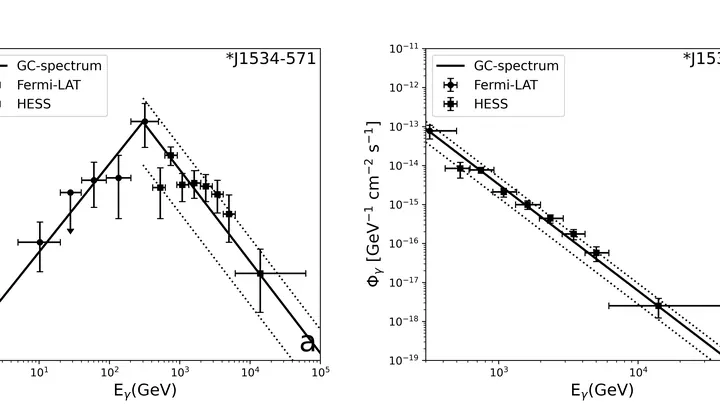
At the center of the Milky Way, where the supermassive black hole Sagittarius A* churns gas clouds like a millstone, astronomers have caught an irregular pulse. Gamma-ray emission, the most energetic light in the universe, arrives not as a smooth wave but with a break, as if the Galaxy's heart beats with arrhythmia.
Cosmic rays are particles that race across our Galaxy at enormous speeds. Their energies can be millions of times higher than those of particles in the most powerful accelerator on Earth. But the higher the energy, the fewer such particles there are: the plot of their numbers shows a noticeable kink, which is called the knee.
In July 1969, as Apollo 11 flew toward the Moon, astronauts noticed something unusual: brief flashes of light that appeared even with their eyes closed. At first, this was attributed to fatigue, but the flashes recurred in different crews. Gradually, it became clear: cosmic rays were to blame — tiny particles hurtling through space at tremendous speeds.
The night sky looks calm, but in reality, invisible particles, cosmic rays, are constantly flying through us. Among them are electrons and their antimatter counterparts, positrons. When they collide with detectors on satellites or balloons, the instruments record their energy.
Pulsar PSR J1740+1000 is a city-sized star spinning faster than a kitchen blender. After a supernova explosion, it left behind a dense core that accelerates particles to near-light speeds. These particles fly into space, and previously it was thought they scatter in all directions, like splashes from a stone thrown into water.
Cosmic rays aren't rays in the usual sense: they're fast particles bombarding Earth from all directions. Mostly they're protons and atomic nuclei. Their energies vary widely, from modest to fantastically huge. When such a particle heads our way and the Moon or Sun gets in its path, it gets absorbed.
A proton or an atomic nucleus slams into Earth's atmosphere at tremendous speed, and a cascade of billions of particles is born. This extensive air shower races toward the surface, while sensitive telescopes catch its faint glow. From the shape of the glow, physicists determine how deep the shower penetrated the atmosphere and what it was made of.
Dark matter is the invisible scaffolding of the universe. It's there, we know from the motion of stars and galaxies, but what this scaffolding is made of remains unknown. One guess is ultra-light particles similar to axions. They barely interact with ordinary matter, yet occasionally they do get involved.
Deep beneath the ice of the South Pole, nearly two and a half kilometers down, an unusual telescope is at work. It is not pointed at the sky but through the Earth. Its quarry: neutrinos, nearly elusive particles that pass through planets and stars without interacting with anything.
Right after the Big Bang, space cooled unevenly. In some places, folds could have formed — threads of energy as thin as a hair but incredibly dense. Physicists call them cosmic strings. They oscillate, collide, and emit gravitational waves — ripples in the fabric of space itself.
At the center of a distant galaxy, where a supermassive black hole weighing a hundred million suns spins, space is threaded with magnetic fields. They coil into tight vortices, like a drain in a sink, but instead of water, there's plasma whipped up to near-light speeds.
The mystery of antimatter in space has long puzzled astrophysicists: where do positrons come from, settling like snowflakes into our detectors? The answer might lurk in the most ubiquitous gamma-ray background. The Universe is soaked in diffuse light — the cosmic photon background (CPB).
In the silent ocean of the Galaxy, mature civilizations have likely long chosen an unexpected strategy: instead of loud beacons, they scatter quiet fireflies — autonomous interstellar laser beacons, drifting in the void and dropping microsecond flashes. These 'seeds of contact' are not tied to their home stars and do not drown in their glow.
For a long time, astronomers searched for the 'factories' of the most energetic cosmic rays — particles that carry the macrocosm compressed to the size of an atomic nucleus. Colossal star-forming regions like Cygnus OB2, where winds from young giants collide, were prime suspects.
Cosmic rays do not travel in straight lines. Charged particles accelerated to enormous speeds loop through the Galaxy's magnetic field like dust motes in a gust of wind. It's usually assumed that they simply scatter along and across field lines.
The universe is a vast orchestra playing the score of expansion. Galaxies race apart to the beat of inaudible music of dark energy. But here's the trouble: the conductor's baton held by Edwin Hubble, Adam Riess, and Vera Rubin sets two incompatible tempos.
A fire hose blasts into a snowdrift. The water doesn't just shove the snow aside — at the point of impact, spray, steam, and a roar are born. That's roughly how jets behave: narrow streams of matter shooting out from around a black hole at enormous speeds.
Every second, about a hundred invisible particles, muons, pass through your body. They are born high in the sky when cosmic rays collide with air atoms, raining down on Earth. These particles are so penetrating that they can pass through a multi-story building, but they slightly change direction when they encounter dense material, such as lead or uranium.
Blacksmith's bellows fan the fire by forcefully pushing out air. In space, the shock wave from a supernova, a concept introduced by Fritz Zwicky, acts like such bellows: it catches up with a giant bubble of charged particles and magnetic fields formed around a spinning neutron star…
On a scorching afternoon, a stifling haze hangs over the city, and not a single cloud is on the horizon. Usually, in such weather, all you can do is wait for nature to take pity and send some cool relief. But what if shade and rain could be switched on schedule, like a light in a room?
A stone falls into a pond, and ripples spread across the water. Likewise, light from distant galaxies spreads in all directions — calmly and steadily. But at the center of some galaxies, it's not a stone but a veritable cannon: it fires particles with monstrous force. Astronomers call such objects HSP BL Lac.
Inside the proton, life is boiling. Quarks don't just sit there: they're glued together by carrier particles called gluons (from the word glue). Usually, this glue is spread evenly, like butter on a skillet. But when energies become enormous, gluons start clumping together. This is the gluon condensate — an ultra-dense state of the gluon field.
Two neutron stars (the remnants of dead stars, compressed to the size of a city but weighing as much as the Sun) spiral around each other and eventually collide. At that moment, something between a black hole and a super-powered magnet is born: a field billions of times stronger than that of the most powerful MRI machine.
The end of the Universe is not just the fading of light. If dark energy, the mysterious substance accelerating cosmic expansion, tears it apart in a Big Rip scenario, or if expansion reverses into a contraction that pulls everything back to a point like a big bang in reverse, a…
In the dense gaseous cocoon around a young massive star, streams of matter collide as if in a giant chemical flask. One stream moves relative to us at about 11 kilometers per second, the other at about 5. The telescope at Onsala (Sweden) caught their radio voices and resolved them into hundreds of spectral lines — molecular fingerprints.
The universe is permeated by an invisible substance, dark matter, whose gravitational influence is obvious, but whose composition remains a mystery. One hypothesis suggests it consists of ultralight particles so light that they exhibit wave-like behavior, forming a kind of cosmic ripple.
Cosmic rays are particles from deep space, accelerated to colossal energies. Smashing into the atmosphere, they trigger particle showers with radio waves. These waves are fingerprints, revealing the energy and direction of the intruder.
A translator gets distracted by every rustle in the hall, and a one-hour meeting stretches into two. Gluons, the particles that carry the strong force inside protons, behave much the same way. Usually, they dart back and forth, holding quarks together.