Dust of the Pleiades: How Stars Paint Patterns in Space express
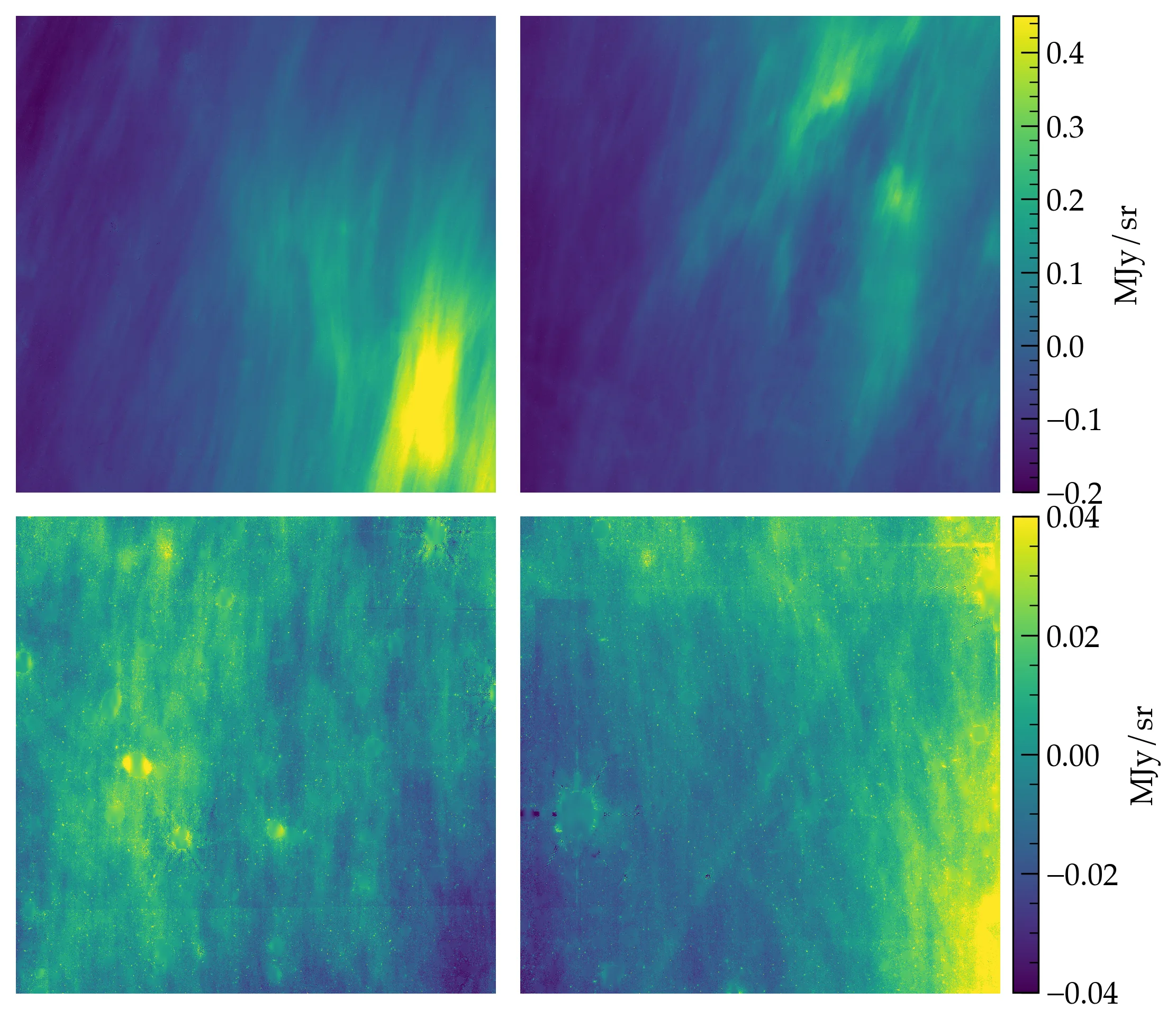
Images of the Pleiades nebula taken by the James Webb Space Telescope reveal a striking sight: clouds of interstellar dust glow unevenly, as if someone had stretched them in one direction. Scientists analyzed these images and found that the dust's glow is elongated along the magnetic field lines that thread the nebula. It is as if invisible threads were guiding the motion of gas and dust.
To discern the structure of the dust, astronomers removed stars and galaxies from the images, leaving only the faint glow of dust grains. They then studied how this glow varies across different scales — from tiny details the size of our solar system to large regions. It turned out that the dust pattern has no characteristic size: it looks the same up close and from afar. This is like a coastline that appears jagged both on a map and from an airplane.
Near the star Merope, the dust is more stretched than farther away. Perhaps the radiation and wind from this bright star stir up turbulence in the gas, causing the dust to align along magnetic fields. Such observations help us understand how turbulence in cold interstellar gas influences the birth of new stars. After all, it is in these clouds, where gas slowly moves and densifies, that future suns ignite.
Original abstract
as written by the authors arXiv:2602.03672
Interstellar medium studies rely on magnetohydrodynamic (MHD) turbulence as a framework for interpretation. In this context, the statistical characterization of interstellar observations is of prime importance. We open a new perspective on diffuse interstellar matter by analyzing James Webb Space Telescope (JWST) observations of the Pleiades nebula with NIRCam. These observations are remarkable in that they provide a microscope view at the cold neutral medium (CNM) with a spatial resolution of 0.2 mpc (40 au). A two-dimensional Fourier analysis is used to characterize the structure of PAH emission in regions near and far from the Pleiades star Merope. To produce maps of the interstellar emission, stars and galaxies are filtered out. The final step in the data cleaning involves subtracting a component, in Fourier space, which we infer to be a residual of the near-infrared cosmic background. The PAH emission power spectra are highly anisotropic. They are well fitted with a break-free power-law, suggesting that we do not observe a specific scale for energy dissipation. Power-law indices are -3.5 near Merope and -3 in the more distant field. The magnetic field orientation, as derived from the Planck dust polarization data, aligns with the PAH anisotropy. The power anisotropy is constant across scales. These findings are discussed in relation to interstellar turbulence that may be driven by the Pleiades stars. The JWST observations of the Pleiades offer a new viewpoint for comparing observations and theoretical models, as they examine physical scales at which turbulence in the CNM is subsonic and decoupled from the thermal instability. The observations may indicate that the turbulent energy cascade in the CNM is anisotropic.
The Pleiades is one of the most prominent star clusters in the sky. On a clear night, you can see six or seven stars with the naked eye, though there are actually hundreds. The ancient Greeks considered the Pleiades to be seven sisters, daughters of the Titan Atlas.