Binning is the process of grouping continuous data into discrete intervals, or 'bins', to simplify analysis or reveal underlying patterns. In cosmology, redshift binning specifically involves dividing a sample of astronomical objects (like galaxies or supernovae) by their measured redshift—a proxy for distance and cosmic time—into separate groups. This allows researchers to study how properties like the equation of state of dark energy evolve over cosmic history, rather than treating all data as a single average.
History
Binning as a statistical technique has roots in the 19th century with the development of histograms, but its systematic use in cosmology for equation-of-state reconstruction became prominent in the early 2000s with large supernova surveys.
How it works
Given a set of measurements (e.g., redshifts), you define bin edges (e.g., z=0.0–0.2, 0.2–0.4, etc.) and assign each data point to its corresponding bin. Within each bin, you can compute average quantities, fit models, or compare predictions. The choice of bin width is a trade-off: narrower bins give finer resolution but fewer data points per bin, increasing statistical noise; wider bins smooth over variations but may hide real changes.
In practice
Used in cosmology to reconstruct the dark energy equation of state from Type Ia supernova data, and in particle physics to analyze event distributions (e.g., invariant mass histograms).
Fun fact
The choice of bin edges can sometimes artificially create or hide peaks in data—a phenomenon known as 'binning bias'—which is why researchers often test multiple binning schemes.
Two figure skaters on a lake frozen to the horizon. They are so far apart that their silhouettes turn into dots, and their mutual attraction becomes almost an article of faith. By Newton's law, they should circle in an unimaginably slow waltz. But telescopes see otherwise.
The optical sky background is a cosmic palimpsest, where light from billions of unresolved galaxies is layered, each layer corresponding to a different epoch. Until now we could only distinguish the brightest "letters"—individual stars and nearby galaxies.
Neutron stars are the last clumps of visible matter before collapsing into a black hole. In their interiors, matter is squeezed to trillion-fold densities. Here, nuclear forces and gravity weave into an exotic substance inaccessible to any earthly particle accelerator.
The railway overhead contact line resembles a galaxy: energy flows through it like gravity, with trains becoming planets. The more trains draw current simultaneously, the stronger the voltage fluctuations — gravitational waves ripple through the system, threatening blackouts.
Detectors pick up the “ripples” of gravitational waves from mergers of black holes or neutron stars — like an echo from the kitchen where a cosmic dish was being prepared. Astronomers are trying to reconstruct the recipe: how two massive stars turned into an exotic pair and collided.
Cosmology is experiencing a tectonic rift. Cepheid-calibrated supernovae, measured by Adam Riess’s team, point to a rate of about 73 km/s per megaparsec.
Pairs of black holes dance in three different styles before merging. The first is a neat waltz: the objects swirl in the same direction, like partners facing the same way. Such pairs are born from binary stars and often have unequal masses. The second is chaotic disco: spins are scattered, masses nearly equal.
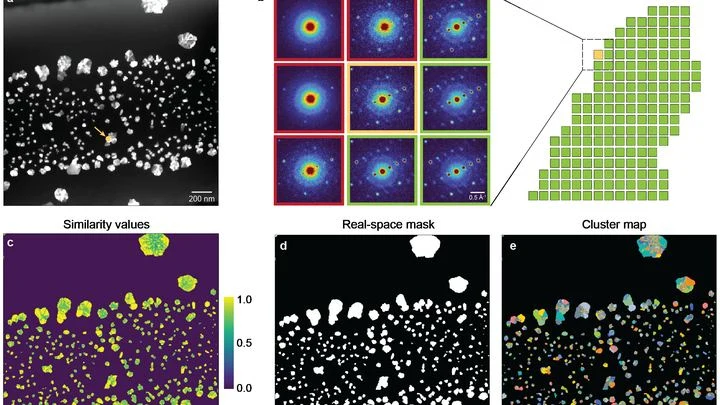
An electron microscope scans a sample and records how electrons scatter off atoms at each point. The result is a giant stack of images — one for every point. These images encode information about how atoms are arranged: in neat rows or with a tilt, the orientation of the crystal lattice, and whether there are internal strains.
The Universe is expanding, and galaxies are flying apart like raisins in rising dough. But since the late 1990s, we've known that this expansion is accelerating. What force is pushing galaxies apart faster and faster is one of physics' greatest mysteries. It's called dark energy, and it makes up about 70% of everything in the cosmos.
When light from a distant galaxy travels toward us, dark matter along the way bends the rays slightly, like imperfect glass. Astronomers measure these distortions to understand where the invisible mass lurks. But galaxies also have their own, "intrinsic" distortions: they align not randomly but along the invisible threads of the cosmic web.
Two black holes circle each other, and their dance isn't always a smooth waltz. If the holes spin on their own axes, their orbit can start to tumble, like a top that's been pushed and wobbles on its side while still spinning.
The collision of two neutron stars is a strike heard across the universe. Gravitational wave detectors pick up the ripples in spacetime, but the most interesting sound begins after the impact: the merger remnant, a rapidly spinning hypermassive neutron star, continues to vibrate, emitting waves for a few more…