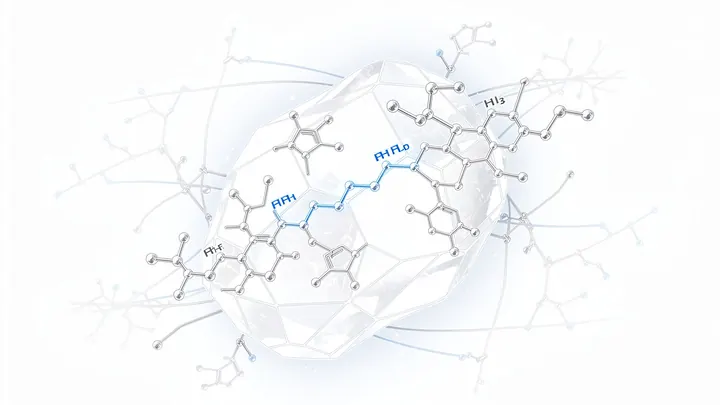
Interstellar dust consists of tiny solid particles, typically micrometers in size, scattered throughout the interstellar medium. These grains are composed of silicates, carbonaceous materials, and ices, and they play a crucial role in the chemistry of space. They serve as surfaces where atoms and molecules can meet and react, enabling the formation of complex molecules like methanol, sugars, and even prebiotic compounds. The dust also absorbs and scatters starlight, shaping our view of the cosmos and influencing the thermal balance of gas clouds.
History
The existence of interstellar dust was inferred in the early 20th century from the reddening of starlight, with key contributions by Robert Trumpler in the 1930s. The detailed study of dust chemistry accelerated with infrared astronomy in the 1970s and 1980s.
How it works
In cold, dense molecular clouds, atoms and simple molecules freeze onto dust grains, forming icy mantles. On these surfaces, chemical reactions proceed efficiently because reactants are held close together. Ultraviolet radiation or cosmic rays can energize the ices, driving reactions that produce larger molecules. When stars form nearby, the heat can evaporate these molecules, releasing them into the gas phase where they become detectable by telescopes like ALMA or JWST.
In practice
Understanding interstellar dust is essential for interpreting astronomical observations, modeling star formation, and investigating the origins of organic molecules that may seed life on planets.
Fun fact
Interstellar dust grains are so small that about 10,000 of them could fit across a human hair, yet they are responsible for blocking nearly half of all visible light from the center of our galaxy.
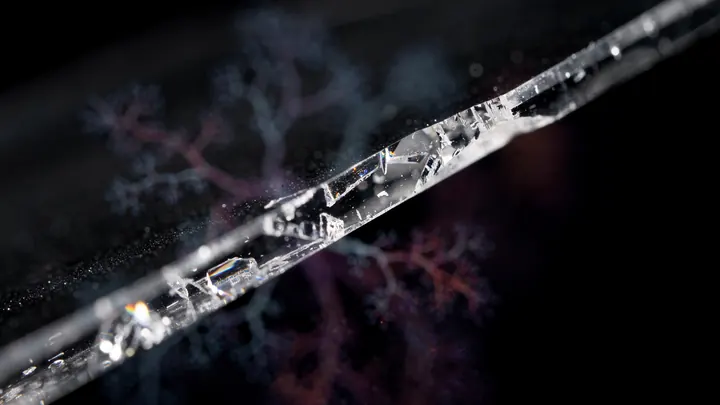
In the coldest, darkest corners of space, dust grains get covered in ice, like a window on a frosty day. This ice isn't just frozen water: it also contains carbon monoxide and carbon dioxide. From such ice, comets and planets may eventually assemble. But until now, it was unclear how the dust grain itself affects the ice that forms on it.
Every morning, a janitor sweeps leaves into a pile. The Sun, as it travels through the galaxy, does something similar: its gravity gathers diffuse interstellar gas into an invisible cone — a giant funnel.
In a dense molecular cloud, at the edge of glowing gas, an invisible assembly line is at work. It takes simple scraps — single atoms and light pairs — and glues them together step by step into long carbon chains and rings. The first piece of this assembly line has long eluded our eyes. Now it has been found.
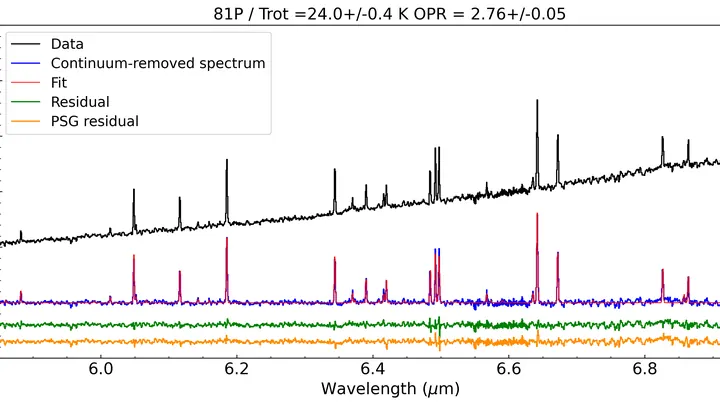
In March 2023, the James Webb Space Telescope pointed its instruments at the short-period comet 81P/Wild 2. This celestial body, about the size of a small town (nucleus radius around 1.77 km), is already familiar to scientists: in 2006, the Stardust probe flew through its tail and collected dust samples that were later studied in Earth laboratories.
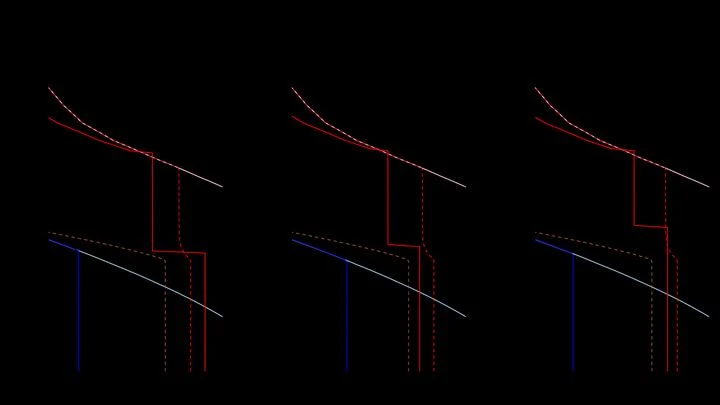
Jupiter's atmosphere resembles a layered cake, where each layer plays its role. Scientists took data from four instruments at once (VLT/MUSE, Cassini/VIMS, IRTF/SpeX, and Juno/JIRAM) and built a model of clouds and ammonia in the planet's equatorial zone, from 0.1 to 10 bar (pressure equivalent to hundreds of kilometers below Earth's…
One hundred forty parsecs, a distance light traverses in four and a half centuries, separate us from the Taurus molecular cloud. Within its depths hide dark condensations: prestellar cores, where gas and dust slowly contract under their own weight.
A speed of 7,5 kilometers per second is the threshold beyond which a cosmic collision turns dust grains into a chemical reactor. In the interstellar medium drift tiny cosmic dust grains — the legacy of dying stars.
When two neutron stars, the ultra-dense cores of dead stars, collide, a kilonova is born: an explosion a thousand times brighter than a typical nova. This is the universe's true smelting works. In the scorching cloud racing outward at near-light speeds, a furious flux of neutrons transmutes atomic nuclei into gold, platinum, osmium.
Tiny seeds of life can cross the black void on icy wanderers like comet 3I/ATLAS. The James Webb Space Telescope found water and methane on it for the first time, and light analysis revealed an unusual gas composition.
The Moon is a natural archive that has been collecting cosmic dust for billions of years. Among the microscopic grains that arrived from distant stars, there could be techno-specks — particles created by alien civilizations.
A fire hose blasts into a snowdrift. The water doesn't just shove the snow aside — at the point of impact, spray, steam, and a roar are born. That's roughly how jets behave: narrow streams of matter shooting out from around a black hole at enormous speeds.
In the heart of the Milky Way, in the cloud G+0.693, astronomers caught a sweet signal — emission lines of erythrulose, a simple sugar with four carbon atoms and four oxygen atoms.
Among the icy chunks hurtling through the void, there are special travelers — interstellar comets. They were born around distant stars and happened to wander into our neighborhood. One of them, 3I/ATLAS, came under the gaze of telescopes as it approached the Sun. Its material, frozen gases and refractory dust, began to evaporate, leaving a glowing tail behind.
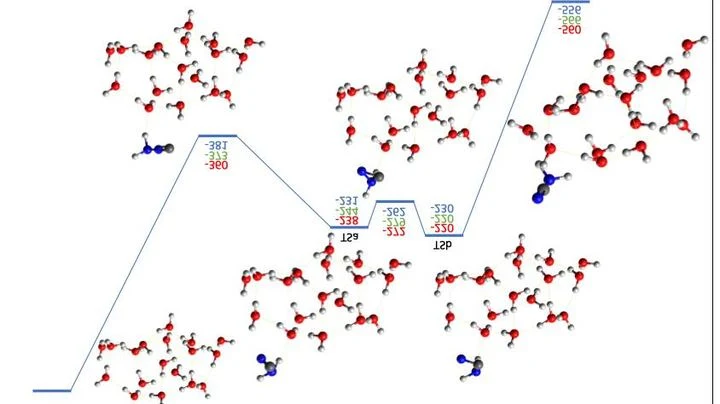
In cold clouds between the stars, dust grains are coated with ice, like windows covered with frost in winter. On this icy crust, chemical reactions take place that do not occur in gas. One such reaction is the encounter between a carbon atom and a nitrogen molecule.
When an exoplanet briefly eclipses its star, starlight passes through its air and absorbs its chemical taste. This technique, the transit method, is the core of how the James Webb telescope works.
Radio telescopes detected emissions from the celestial object G358.93-0.03 MM1 — a hot cocoon inside which a massive star is igniting. Within that glow, lines of glycolamide appeared, a delicate carbon molecule.
A distant galaxy birthing hundreds of stars should glow in oxygen. That's what astronomers thought: hot young stars heat the gas, which then emits a characteristic infrared glow at a wavelength of 63 microns. It's like steam rising from a boiling pot — a sure sign of vigorous activity.
In the dark cloud L43, where stars are born, dust grains twirl like tiny compasses. Light from a young star pushes them, while the magnetic field lines them up in a specific direction. When a grain is turned sideways to us, its heat reaches us polarized, like light passing through a narrow slit.
Inside cold clouds of gas and dust where new stars ignite, astronomers have spotted unexpectedly delicate structures. The ALMA telescope, working in the millimeter range, has revealed more than 323 ultra-thin dust filaments within 121 massive clumps.
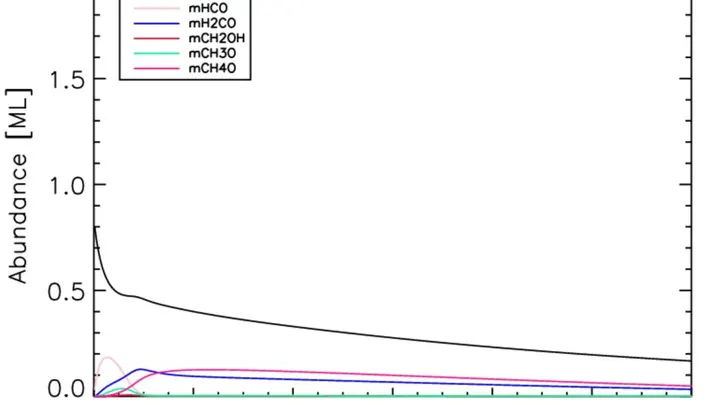
In a dark, cold cloud between the stars, a dust grain a thousandth of a millimeter across catches light molecules. Carbon monoxide and hydrogen stick to its surface like raindrops to glass and react. After a few steps, methanol is produced — the same alcohol found in windshield washer fluid.
In dark, cold clouds where stars are just beginning to form, dust grains put on icy coats. This ice is not just frozen water: it contains dissolved carbon dioxide, methanol, ammonia, and other molecules.
In the dark, cold clouds where stars are born, dust grains are covered with an icy crust. Across this crust, like on a winter road, individual atoms wander slowly. Calculations show that it is precisely these wandering oxygen and nitrogen atoms that kick off the assembly of the HNSO molecule — a compound of hydrogen, nitrogen, sulfur, and oxygen.
Astronomers using James Webb and spectroscopy (splitting light into colors) peered through dust into the center of galaxy IRAS 07251-0248. There they discovered benzene, acetylene, methane — the same hydrocarbons found in gasoline and plastics.
A boiling cauldron: steam rises, water churns, and the temperature varies from point to point. So it is in space: the gas clouds around young stars are not smooth spheres but a seething mixture with vortices and density fluctuations. Astronomers long treated such clouds as homogeneous, but this simplification can skew conclusions.
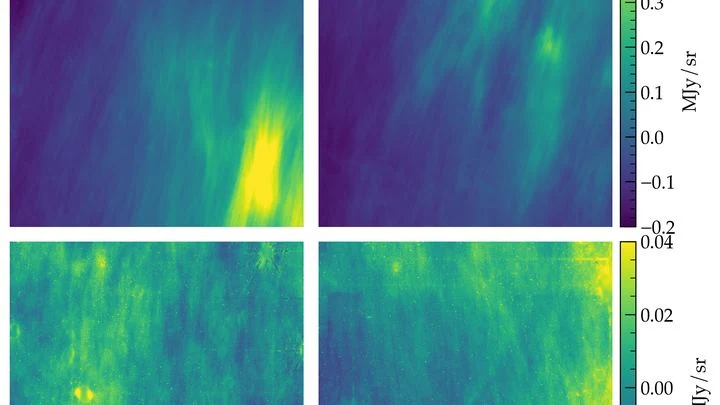
Images of the Pleiades nebula taken by the James Webb Space Telescope reveal a striking sight: clouds of interstellar dust glow unevenly, as if someone had stretched them in one direction.
In the Antennae Galaxies, which are crashing into each other, giant gas clouds collided at a speed of 50 kilometers per second. It's like two trains hurtling toward each other — the impact compressed the gas, and it ignited with new stars.
Two galaxies collided, and from their center an invisible fountain erupts. The ALMA and VLT telescopes peered into the heart of the IRAS20100-4156 system — where two stellar islands are merging. There, work is in full swing: hundreds of new suns are being born, and their heat drives a stream of cold gas outward.
This stream is like a giant's exhale.
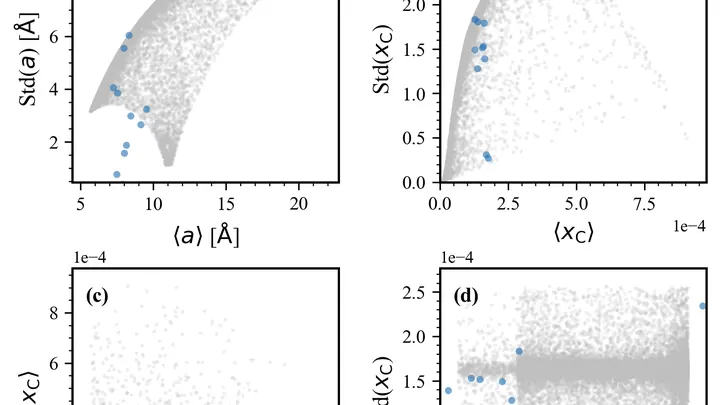
In cold clouds of interstellar gas, carbon hides inside carbon monoxide (CO) molecules, like sugar dissolved in tea. But near hot, massive stars, this 'tea' boils: harsh radiation tears the molecules apart, and carbon escapes as lone atoms or ions.
In a cold gas cloud right at the center of our Galaxy, designated G+0.693-0.027, hides a true chemical laboratory. There, far from stars, on the surfaces of tiny dust grains, about the size of smoke particles, atoms stick together into molecules, like dough on a kitchen counter.
At the center of our Galaxy lies a dense forest of dust and gas. Starlight barely penetrates this thicket, like a flashlight in fog. But it is precisely there, in this dense cloud, that new stars are born.
Scientists decided to look into this fog. They took light from 15 bright stars that shine through cold clouds.
Cosmic dust isn't dirt: it's tiny grains, like soot from a campfire, scattered between the stars. Some of them spin at breakneck speeds, millions of times per second, emitting faint radio waves. Astronomers call this anomalous microwave emission: it interferes with studies of the early universe, but it's also a mystery in its own right.
In the dark, cold clouds of space where stars are born, dust grains become coated with a thin layer of ice. This ice is not just frozen water but a mixture of different molecules: carbon monoxide, carbon dioxide, nitrogen, and others. For a long time, astronomers could not find nitrous oxide (N2O) in this ice — the very "laughing gas" used in medicine.