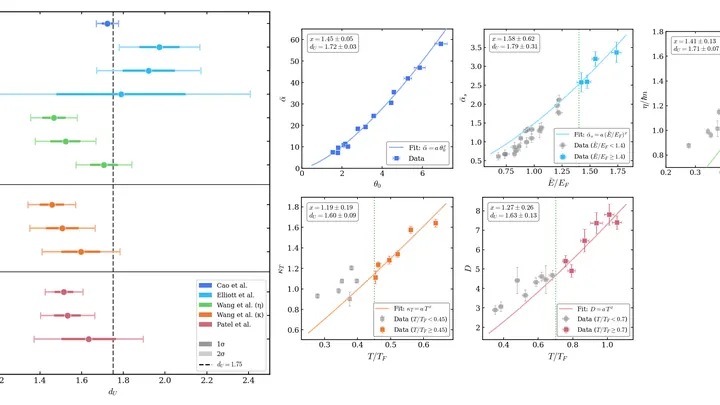
Scale invariance is a property of a system where its behavior remains unchanged under a rescaling of lengths or distances. This means that if you zoom in or out, the essential features—patterns, fluctuations, or physical laws—look the same. It appears across physics, from the fractal-like patterns of turbulence in wind gusts and water ripples to the distribution of snowdrifts and the large-scale structure of the universe. The concept helps explain why certain phenomena, like the intermittent intensity of rain or the sizes of animal bodies, follow power laws that lack a characteristic scale.
History
The concept gained prominence in the 1960s–70s through the work of Leo Kadanoff and Kenneth Wilson on the renormalization group, which formalized how scale invariance emerges at critical points. Earlier, the idea of self-similarity was explored by Benoît Mandelbrot in fractal geometry.
How it works
In a scale-invariant system, the equations governing its behavior do not contain any fixed length scale. When you multiply all distances by a factor, the system's properties either remain exactly the same (as in conformal field theories) or change in a predictable, self-similar way (as in critical phenomena). This often arises at phase transitions, where fluctuations occur at all sizes simultaneously, or in systems with long-range correlations, such as turbulence, where energy cascades from large to small eddies without a preferred size.
In practice
Scale invariance is used in image compression algorithms, in modeling financial market fluctuations, and in designing materials with self-similar structures, such as metamaterials for wave control.
Fun fact
The human lung's bronchial tree is scale-invariant over about 23 branching generations, with each branch splitting into smaller ones in a self-similar pattern.
Newton gave us a world where bodies move in a void and clocks tick the same for everyone. For three centuries, this picture worked flawlessly. But it relies on many invisible props: absolute position, the 'up-down' direction, and a single rhythm of time for the entire universe. We have never measured these directly — only through the relations between objects.
A choir where every singer hits the notes precisely sounds louder than you'd expect from a simple sum of voices. A hundred singers aren't just a hundred times louder than one: they're ten thousand times louder. In the world of atoms, something similar happens. In collective behavior discovered by Robert H.
A snowflake grows, an oil slick spreads, a crowd moves — each case has its own equations. But the end result is often the same: shape, speed, and pattern follow a simple scheme that repeats across scales. This is universality — when a common law hides behind the details.
The explosion of a distant supernova told us something hard to believe: the universe is expanding faster and faster. The engine of this acceleration is dark energy — nearly 70% of everything that exists.
A lump of sugar drops into hot tea, a spoon stirs a few times, and the sugar disappears. But how exactly does it spread through the churning liquid? Physicists have peered into this process with unprecedented detail: they simulated turbulence on a grid of 8192³ points. If you were to split every millimeter of the cup into a hundred cells, you'd get a similar resolution.
In particle physics, it has long been taken for granted that the forces of nature (electromagnetism, the weak and strong interactions) obey a strict symmetry called gauge symmetry. It's like a set of rules by which particles exchange force carriers. But where do the rules themselves come from?
A stone drops into a pond. Ripples spread, fade, and soon the surface is smooth again. But what if the pond has no shores, no bottom, and no characteristic ripple size? That is the world, a scale-free world, where quantum systems live when surrounded by an environment that picks out no particular length or energy.
A snowdrift grows by strict rules: falling snowflakes form bumps, those attract more snow, and the bumps amplify. The same mathematics describes city growth, patterns on bark, ripples on water, and clusters of cosmic dust. Physicists call this uniformity universality.
A stag beetle the size of a fingernail stands on the ground with its legs spread wider than its own height. An elephant as tall as a room, on the other hand, towers above the ground like a tower. Why is that? Both animals walk on the same ground, but they see it differently. For a beetle, each pebble is a boulder, while for an elephant, it's a grain of sand.
The wind blows steadily, but suddenly a gust hits, and leaves swirl up in a vortex. Inside such a gust, the air speed changes not smoothly but in jumps — sometimes sharply forward, sometimes sideways. These rare and strong bursts are called intermittency, and they are the main mystery of turbulence.
Rain doesn't fall just any old way. If you take records from nearly fifty thousand rain gauges scattered across the globe and compare how much water falls on a rainy day in different parts of the planet, you'll spot a surprising pattern.