A Comb of Light: How to Get Thousands of Precise Frequencies express
Light can be combed like hair. Instead of hair, we have frequencies; instead of a comb, a laser. The result is a comb made of thousands of even 'teeth'—frequencies. Such an optical comb helps study molecules and measure time with precision down to quadrillionths of a second.
The challenge is that in the terahertz range (between microwaves and infrared light), making such a comb is very difficult. The authors of the work took an infrared comb, cleaned it of frequency jitter, and transferred it to the terahertz region. For cleaning, they used the effect of self-focusing of light in an optical fiber: the light 'combs' itself, shifting frequencies and filtering out noise.
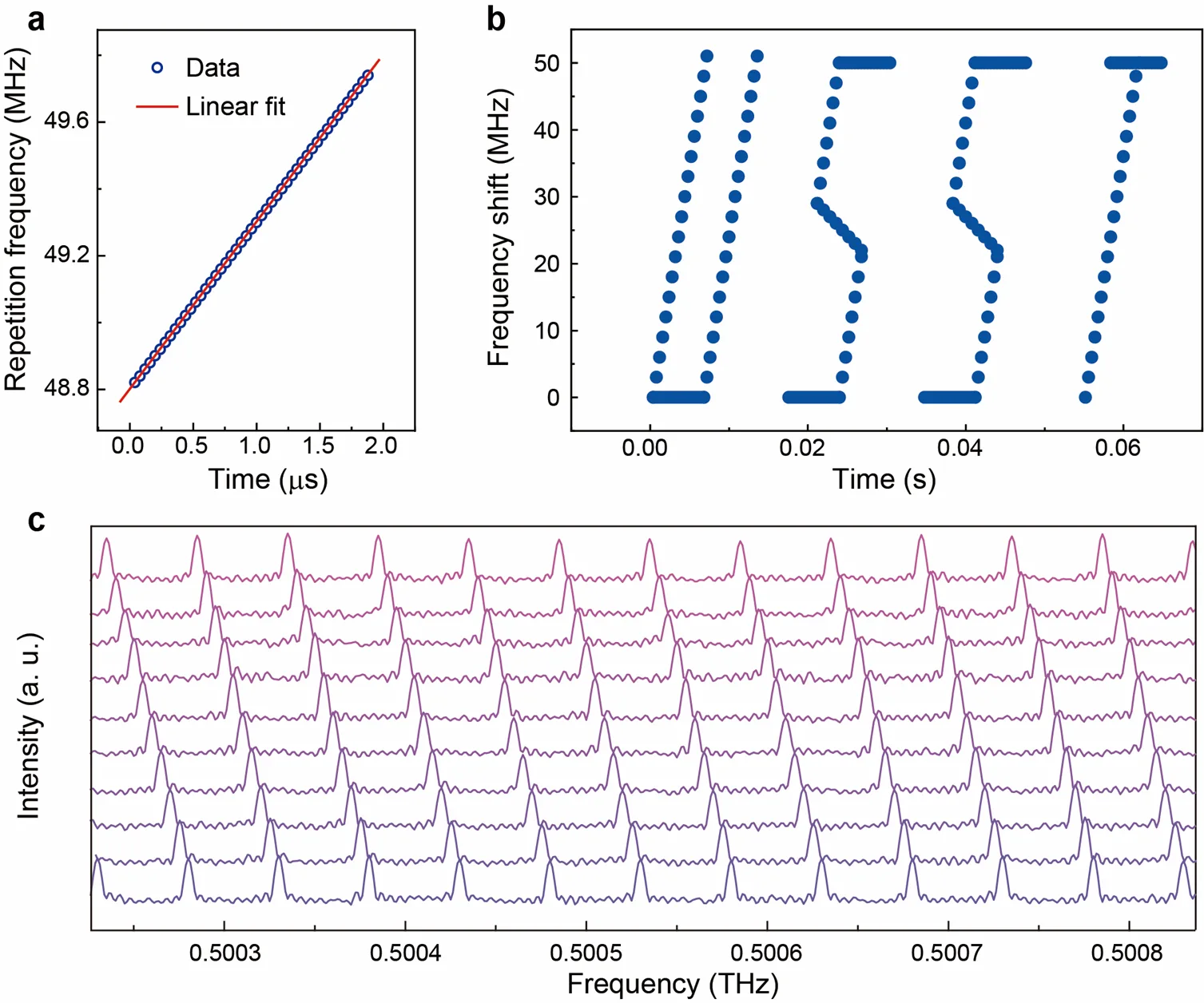
The result is a comb from 0.05 to 4 terahertz with a spacing of 50 megahertz and each tooth only 0.3 hertz wide. That's like having a comb with teeth a meter apart, each tooth thinner than a human hair. The frequencies don't jitter: the error over one second of measurement is 8.6×10⁻¹⁴, like a clock losing a second over 370,000 years.
Such a comb allows quick tuning of the spacing between teeth and is suitable for precise spectroscopy of molecules and time standards.
Original abstract
as written by the authors arXiv:2602.07337
Terahertz (THz) frequency combs are increasingly essential for spectroscopy, metrology, and quantum science. However, generating a dense array of evenly spaced ultra-narrow THz comb lines is challenging. Here, we demonstrate broadband THz comb generation using a photoconductive antenna that transfers a noise-suppressed near-infrared electro-optical (EO) comb into the THz domain. Our noise-suppression strategy, leveraging soliton self-frequency shift and spectral filtering, effectively suppresses EO comb phase noise without requiring active stabilization. The resulting THz comb exhibits broad spectral coverage (0.05-4 THz), narrow comb linewidths (0.3 Hz at the Fourier-transform limit), and excellent frequency stability (8.6*10^-14 at 1-second integration). We further demonstrate asynchronous THz time-domain spectroscopy, resolving ~36,000 comb lines with 50 MHz spacing. Crucially, the inherent frequency agility of the EO comb enables rapid and wide-range tuning of the THz comb line spacing. These attributes position our THz comb as a versatile tool for high-resolution molecular spectroscopy and precision THz metrology.
The width of each comb line is 0.3 hertz. If this were sound, its frequency would change by one tone over three seconds, not in a fraction of a second as with ordinary lasers.