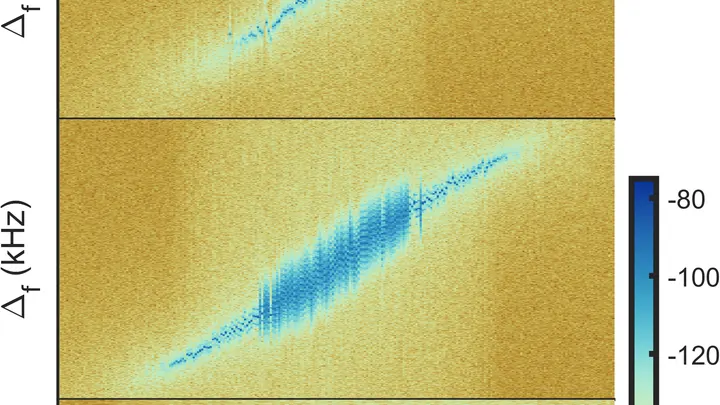
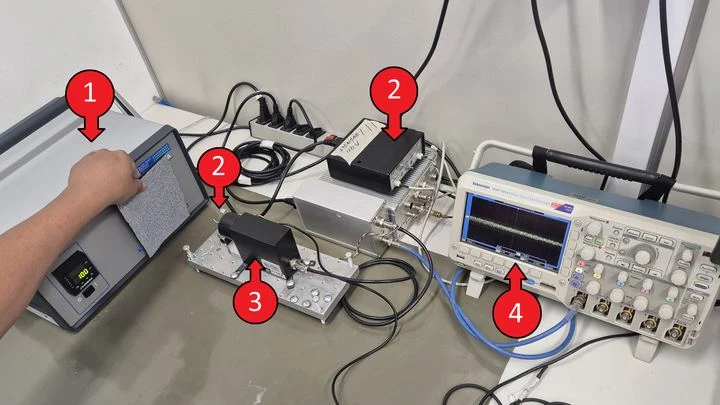
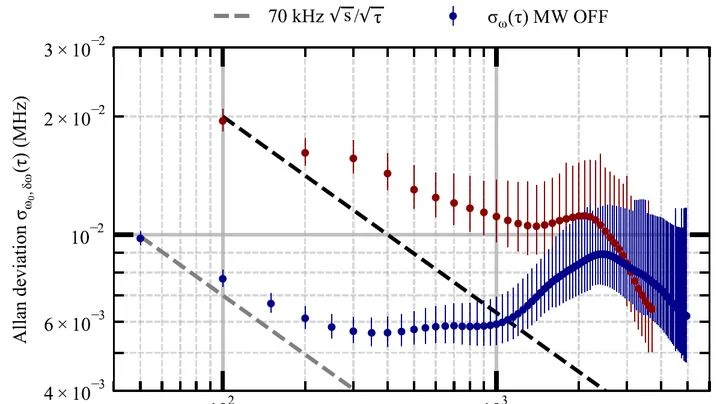
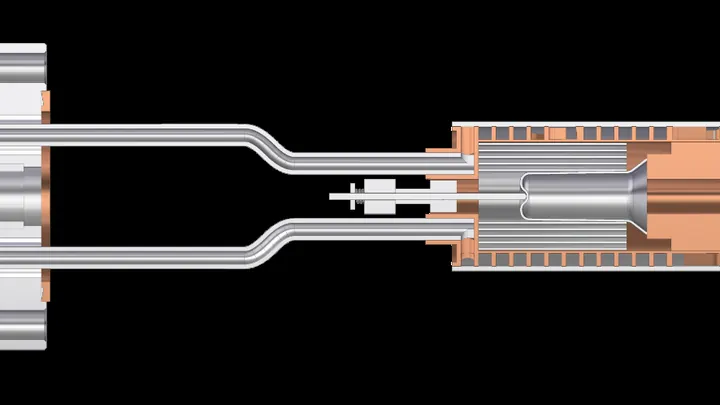
Temperature measurement via frequency combs is a technique that uses the precise, evenly spaced spectral lines of a frequency comb—a laser whose output consists of millions of discrete, equally spaced frequencies—to probe how atoms absorb light. The absorption spectrum of a gas or solid shifts and broadens with temperature because the thermal motion of atoms changes the Doppler effect and collision rates. By analyzing these subtle changes in the absorption pattern with the comb's ultra-high resolution, scientists can infer temperature with remarkable accuracy, often down to fractions of a kelvin.
History
The frequency comb technique was developed in the late 1990s, with key contributions from Theodor Hänsch and John Hall, who shared the 2005 Nobel Prize in Physics for their work. The application to thermometry emerged in the 2000s as comb technology matured.
How it works
A frequency comb acts as an optical ruler, providing a grid of known frequencies. When light from the comb passes through a sample, atoms absorb specific frequencies depending on their energy levels, which are influenced by temperature. The comb's precision allows researchers to measure the exact positions and widths of absorption lines. The Doppler broadening—the spread of frequencies due to atomic motion—is directly proportional to the square root of temperature, so measuring this width yields the temperature. Alternatively, the ratio of intensities of different absorption lines, which depends on the population of energy states, also gives temperature via the Boltzmann distribution.
In practice
This method is used in high-precision thermometry for scientific research, such as in metrology labs defining temperature standards, and in remote sensing of atmospheric temperature using comb-based LIDAR systems.
Fun fact
Frequency comb thermometry can measure temperature without physical contact, making it useful for extreme environments like inside combustion engines or plasma reactors.
Picture a guitar string stretched between two frets. When you pluck it, a standing wave forms: some points on the string oscillate strongly, while others, the nodes, remain almost still. The chromosphere, a layer of the solar atmosphere sandwiched between the photosphere and the corona, behaves in much the same way.
Miners took canaries underground not for their songs. The bird would fall off its perch before the miner noticed carbon monoxide. In ultrahigh vacuum, the canary's role is played by a cloud of one hundred thousand lithium or rubidium atoms.
An ordinary lamp shines steadily, while a lighthouse flashes. Scientists in London have made a tiny diamond work like a lighthouse, but not for light — for radio waves. To do this, they added a bit of nitrogen to the crystal and then shone a green laser on it.
A laser beam strikes a thin target hidden inside layers of another material. Within billionths of a second, the material is compressed to a density of 25 grams per cubic centimeter, as if a piece of lead became more than twice as heavy without moving an inch.
In the kitchen, when a pan heats up, your hand feels the heat before you even touch it. A solar telescope picks up similar invisible heat — only from a star, not a stove. The instrument, called HATS, captures radiation in the terahertz range, which was previously little studied due to technical difficulties.
A radio receiver the size of a palm can measure signal power more accurately than expensive lab benches. Inside, there are no coils or antennas, just a glass head and a cloud of rubidium atoms cooled to near absolute zero.
Low-frequency radio waves (from 30 to 300 kilohertz) carry information through water and earth. But catching them with an ordinary antenna is hard: the wavelength reaches several kilometers, and a small receiver barely feels such a field.
In a room, air touches the skin, and we feel its temperature. But if your body suddenly accelerated at a colossal rate, heat would come even from absolute emptiness. This is not fiction but a strict consequence of quantum field theory: for an accelerating observer, the vacuum becomes a warm bath.
The cosmic microwave background is the afterglow of the Big Bang, which we see at millimeter wavelengths. But it also has a long-wavelength tail extending into the radio range.
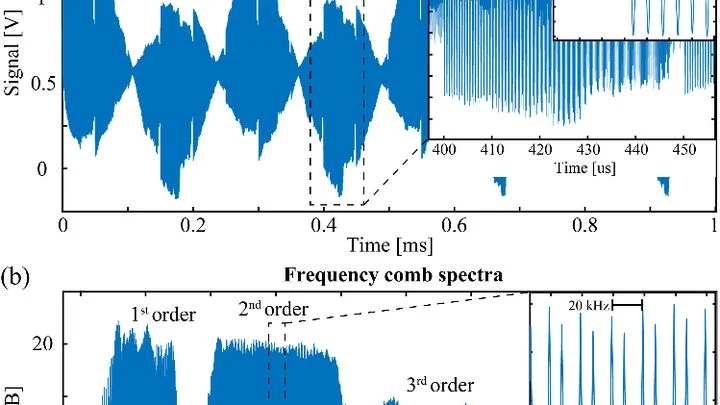
Light can be more than just a beam: it can be a precision ruler. If you take very short pulses, shorter than a fly's wingbeat, and fire them one after another, you get an optical comb: a set of colors spaced at exactly equal intervals, like the teeth of a comb. This rainbow lets you measure distances, time, and the composition of materials with unimaginable accuracy.
A typical atom trap works like a funnel: laser light and a magnetic field slow atoms down and gather them at the center. But the funnel has a limit: it only catches atoms moving within a certain speed range.
An ordinary aluminum pot on a stove doesn't emit molecules you can catch with light. But if you take aluminum and an aluminum salt, heat them together in a small oven, you get a stream of aluminum fluoride molecules, like steam from a kettle's spout, except instead of water droplets, tiny particles fly out.
A security guard needs to check five rooms but can't go inside. He knocks on the door and listens: silence means someone is inside, while an echo means the room is empty.
Any cook knows: whether dough sticks to a pan depends on what happens at the interface between two media. For molten metals, that interface long remained invisible — temperatures above 200 °C made it impossible to resolve individual atoms.
An ordinary antenna picks up radio waves, but there are fields it barely feels. We're talking about slow electric fields: those that change once a second or less. For them, physicists built a sensor from a beam of rubidium atoms.
Gas is nearly invisible, but it has a temperature, and you can read it from how the gas 'shadows' the thermal background. In the experiment, a camera looks at a warm screen through a jet of carbon dioxide. If the gas is cooler than the background, it appears as a dark spot; if warmer, it appears bright.
A standard laser rangefinder works like a stopwatch on a 100-meter dash: it times how long light takes to run to the target and back. But such a stopwatch has a limit: it ticks in steps of tens of picoseconds (trillionths of a second). In that step, light travels about a centimeter, so finer details are invisible.
Two laser beams, like two pencils, draw an invisible scale on the wall. One tip moves slightly faster than the other, and by the way their strokes alternately coincide and diverge, you can calculate the distance to the wall with an accuracy down to the thickness of a spider's thread.
In the new work, physicists made these two beams work continuously, without pauses.
Ordinary white light is a jumble of all colors at once, like the noise of a crowd where everyone speaks at their own frequency. But scientists need light where frequencies are aligned with ruler-like precision, like piano keys, where each note sounds distinct and exact.
The laser in question is not a thin beam but a whole running track for light. Inside the optical fiber, two ultrashort pulses race: one clockwise, the other counterclockwise. Each pulse is a single flash lasting billionths of a second.
An ordinary comb parts hair into even strands. A laser 'comb' does the same to light: it emits not one color but thousands, spaced at exactly equal frequency steps. Such a tool has already helped measure time to billionths of a second and peer inside atoms.
An ordinary laser emits a single color, like a single note on a piano. But to find molecules in the air, you need an instrument that quickly sweeps across many colors, like a musician playing a scale. Such a laser is called tunable, and the faster it changes color, the faster you can 'sniff' the air.
Light can be combed like hair. Instead of hair, we have frequencies; instead of a comb, a laser. The result is a comb made of thousands of even 'teeth'—frequencies. Such an optical comb helps study molecules and measure time with precision down to quadrillionths of a second.
An ordinary comb has teeth spaced evenly apart.
Waves in magnets resemble the vibrations of a string: if you pluck a string, it sounds a single note, but with a strong pluck, overtones appear — sounds at multiple frequencies.
Light in a microscope doesn't arrive as a steady stream but like buckshot from a bag: sometimes more photons, sometimes fewer. This random scatter is the shot noise. It sets a limit: faint signals from tiny objects get lost in the ripple.
Scientists have found a way to calm this buckshot.
A laser beam passes through a glass cell containing rubidium vapor, and by how the atoms absorb light, you can determine their temperature. This is like measuring the speed of cars by the blur in a photograph: the faster the atoms move, the wider the absorption line becomes.