6G is the sixth generation of wireless communication technology, expected to succeed 5G and operate at higher frequencies, such as terahertz bands, to achieve vastly greater data rates, lower latency, and more reliable connectivity. It is envisioned to enable applications like real-time holographic communication, ubiquitous sensing, and the integration of communication with artificial intelligence. The technology is still in its research and development phase, with standardization expected around 2030.
History
The term '6G' began appearing in research discussions around 2018, following the initial deployment of 5G. The International Telecommunication Union (ITU) initiated its 'IMT-2030' framework in 2020 to define the vision for 6G, with global research efforts accelerating since then.
How it works
6G will likely leverage frequencies from 100 GHz to 1 THz, which offer enormous bandwidth but suffer from high atmospheric absorption and short range. To overcome these challenges, it will use advanced antenna technologies, such as massive MIMO (multiple-input multiple-output) and reconfigurable intelligent surfaces, which can steer and focus signals. Additionally, 6G is expected to incorporate AI-driven network management and sensing capabilities, allowing the network to adapt dynamically to its environment.
In practice
6G is expected to enable autonomous vehicles with real-time coordination, remote surgery with haptic feedback, and smart environments that can sense and respond to human presence.
Fun fact
Terahertz waves, a key candidate for 6G, are also used in security scanners at airports because they can penetrate clothing but not skin, revealing hidden objects without harmful radiation.
Radio waves, high-frequency electromagnetic oscillations, are powerless against the Earth's bulk: they attenuate, being almost completely absorbed within a couple of meters of depth. But a low-frequency magnetic field, governed by the equations of electrodynamics, behaves differently.
A mirror can direct a reflected beam onto one spot, even as it rotates. Engineers borrowed this trick for radio waves, building a smart mirror on a drone. It cancels out shakes and vibrations on the fly: it anticipates the drone's movements and instantly re-aims to keep the signal crisp.
Wireless communication for robots is like a conversation in a noisy workshop, where every word can get lost in the din or arrive too late. In this mess, entropy of the channel, robots fail to yield in time, and coordination breaks down.
Communicating with a satellite is like trying to hear a whisper in a storm: the signal drowns in noise. Engineers have created an AI algorithm that runs directly on the satellite and, with minimal power consumption, detects distortions more accurately than previous methods.
Next-generation radars handle both communication and object tracking. Their constant vigilance quickly drains batteries. Engineers took a cue from astronomy: hunting for exoplanets via the transit method only needs a telescope when a planet crosses its star's disk.
Throw a stone into water: right at the point of impact, the waves are chaotic — that's the near field. Farther out, they spread in smooth circles — the far field. This same principle governs antennas for terahertz communications — the future of super-fast internet.
The transmitter sends only a rough sketch of the message — like an artist drawing contours without details. At the receiving end, the AI, like an experienced restorer, reconstructs the full picture, cleaning it of interference. This is how LiTCom technology works, changing the game in future 6G networks.
When a glass of water is full, pouring more is pointless waste. Cloud gaming often does the same with video data: encoders push the stream to maximum, even though the eye stops noticing improvements long before the limit. This overconsumption means extra traffic and entropy in the network — useless noise clogging the channel.
Data on the internet travels at the speed of light through fiber optics. In classical networks, delays aren't critical, but for quantum communication, perfect synchronization is essential: particles of light with encoded information must converge at the detector in the same instant.
Searching for extraterrestrial signals is like trying to hear a whisper at a roaring stadium. The Green Bank Telescope listened to 70,000 stars, but 100 million bursts turned out to be earthly noise — from phones, satellites, microwave ovens.
Light in an optical fiber is a stream of photons, and quantum communication requires single photons that can be sent one at a time. But making them emerge quickly while remaining indistinguishable from one another is a tough challenge.
A laser flash hits a one-atom-thick layer of silver sitting on bilayer graphene, and within quadrillionths of a second, a gap opens in graphene's electronic structure where none existed before. It's as if an ordinary wire momentarily became a semiconductor: electrons stop flowing freely, and a band gap appears.
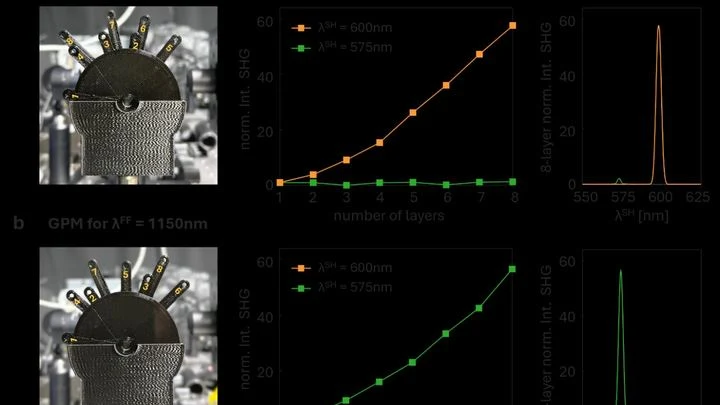
When two light beams meet in a crystal, they can generate a third beam with a different frequency. For this process to be efficient, the waves need to stay in step, like two people walking side by side without breaking stride. Previously, two old tricks were used: either picking a crystal with the right properties, or slicing it into thin layers.
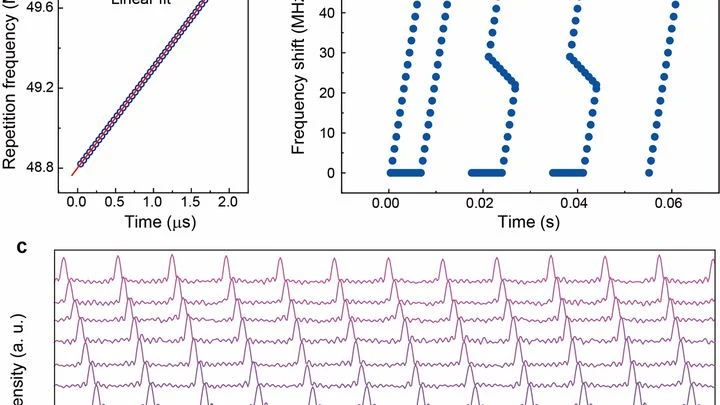
Light can be combed like hair. Instead of hair, we have frequencies; instead of a comb, a laser. The result is a comb made of thousands of even 'teeth'—frequencies. Such an optical comb helps study molecules and measure time with precision down to quadrillionths of a second.
An ordinary comb has teeth spaced evenly apart.
A beam of visible light enters a cloud of billions of rubidium atoms cooled to near absolute zero, and emerges on the other side already in the telecom range.