Terahertz radiation is electromagnetic radiation with frequencies between roughly 0.1 and 30 terahertz, sitting in the gap between microwaves and infraredlight. It is often called 'T-rays' and has unique properties: it passes through many non-metallic materials like clothing, paper, and plastics, but is absorbed by water and metals. This makes it useful for imaging and spectroscopy in fields ranging from security screening to medical diagnostics.
History
The terahertz gap was first explored in the 1970s with the development of far-infrared spectroscopy, but practical sources and detectors became widely available only in the 1990s with advances in ultrafast lasers and semiconductor technology.
How it works
Terahertz waves are generated by accelerating electrons in semiconductor devices or by optical methods like difference-frequency mixing of two lasers. They interact with molecular vibrations and rotations, so different materials leave distinct spectral fingerprints. Detection typically uses photoconductive antennas or electro-optic crystals that convert the terahertz field into a measurable electrical or optical signal.
In practice
Terahertz scanners are used at airports for security screening, and terahertz spectroscopy helps identify pharmaceutical polymorphs and detect defects in semiconductor chips.
Fun fact
Terahertz radiation can reveal hidden layers in paintings without damaging them, helping art conservators see under the surface.
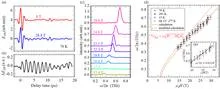
A taut string sounds higher when you pull it tighter. Magnetization in an antiferromagnet behaves similarly: the stronger the external field, the faster it oscillates. But in chromium oxide crystals, something goes awry.
In fields from 20 to 30 tesla, the resonance frequency grows more slowly than it should.
The night sky is full of rings and bubbles, but in the radio band they look different. In data from the Australian radio telescope ASKAP, a structure has surfaced that resembles two soap bubbles blown from the same straw.
A shooter aims at a target, pulls the trigger, and hears two shots: one loud, one quiet. That's how the new setup works, except instead of bullets, there's an electron bunch, and instead of shots, there are two flashes of light. One flash is X-ray, the other is terahertz. They fly to the same point with perfect timing.
Throw a stone into water: right at the point of impact, the waves are chaotic — that's the near field. Farther out, they spread in smooth circles — the far field. This same principle governs antennas for terahertz communications — the future of super-fast internet.
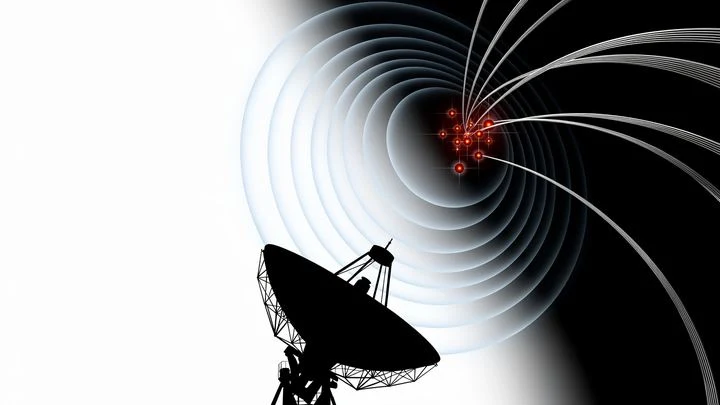
Fast radio bursts — millisecond radio pulses arriving from distant galaxies — long remained a puzzle. Their colossal energy, compressed into instants, pointed to cataclysms on neutron stars, perhaps pulsars or magnetars.
A neat stack of atomic layers lies on a substrate. An invisible beam of terahertz light shines down on it, with a magnetic field applied from the side. After reflection, the beam's polarization rotates slightly.
An ordinary laser emits narrow lines, like a string that sounds only one note. For spectroscopy, this is inconvenient: if a substance absorbs light between the lines, you might miss it.
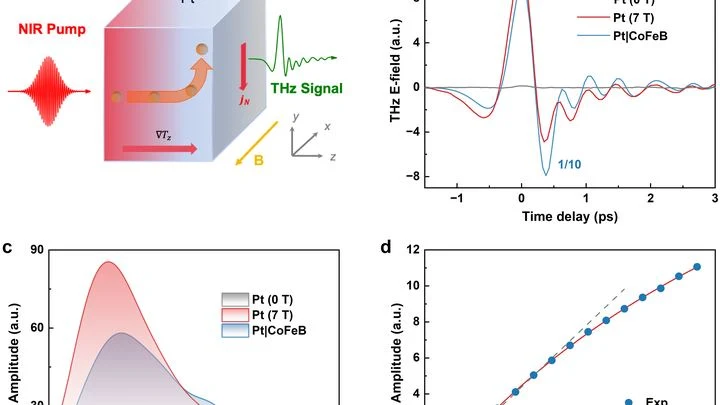
Usually, to generate terahertz waves (light between microwaves and infrared), researchers build a sandwich of different metals. One layer acts as the source, another as the receiver of charges. In such designs, platinum was assigned the role of a simple conductor. But it turns out it can work alone.
Light hits a thin film, and an electric current instantly appears in it. This is how a pair of two materials works: molybdenum disulfide and cobalt. The first is a semiconductor, the second is a magnet. Between them, as it turns out, an invisible intermediary layer is born.
The crystal Ca2RuO4 resembles a stack of thin sheets. Inside each sheet, the electron spins are arranged in strict order, like rows of soldiers on a parade ground. The bonds between the sheets are weak, and their sign can be flipped by slightly pulling the crystal apart.
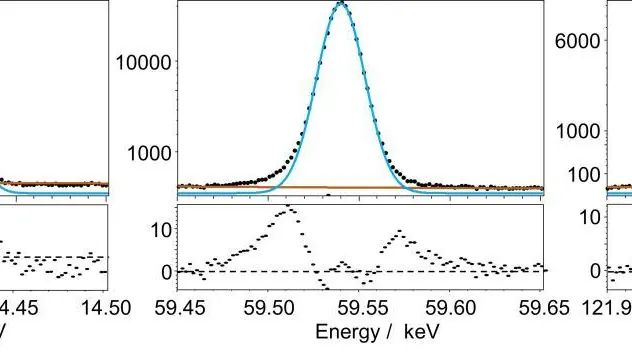
Gamma rays are the most energetic flashes of light born deep within atoms. Their energies are like fingerprints: each radioactive element has its own pattern. But measuring that pattern with high precision is like weighing a grain of sand on a scale sitting on a vibrating truck.
The new setup works like an ultra-sensitive thermometer.
A sheet of graphene is a lattice of carbon atoms arranged like a honeycomb. Electrons in it zip around so fast they seem to have no mass, just like light. When a powerful laser pulse hits such a sheet, the electrons get a kick and start accelerating. Their path can be compared to a road with occasional barriers — the forbidden zones.
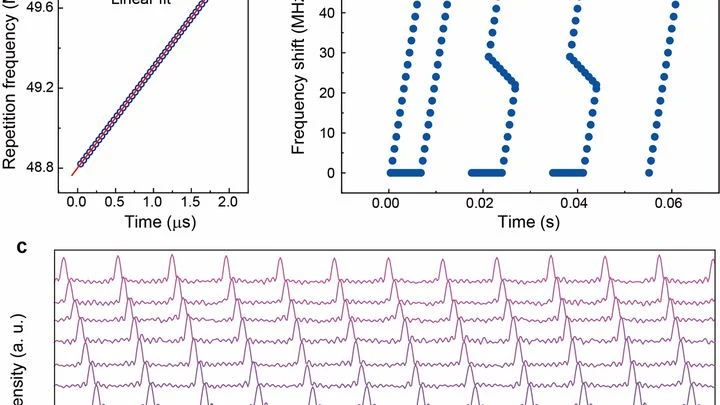
Light can be combed like hair. Instead of hair, we have frequencies; instead of a comb, a laser. The result is a comb made of thousands of even 'teeth'—frequencies. Such an optical comb helps study molecules and measure time with precision down to quadrillionths of a second.
An ordinary comb has teeth spaced evenly apart.
Terahertz radiation sits between microwaves and infrared light. It passes through clothing, paper, and plastic but is blocked by water and metal. That's why these waves are used in security scanners and for quality control of materials.
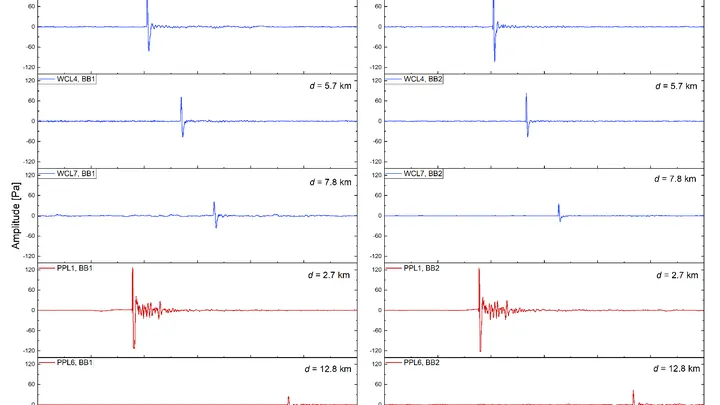
The same explosion can sound different: it all depends on which way the wind is blowing. In 2024, researchers set off charges equivalent to ten tons of TNT twice and recorded the sound with a network of 31 microphones spread over a radius of 23 kilometers. The source was identical, but the acoustic pictures turned out to be quite different.
Terahertz radiation sits between microwaves and infrared light. It passes through clothing, paper, and plastic, but not through metal or water. That's why it's used in security scanners and medical imaging. To see the polarization of such radiation, you need a detector.
A warm cup or a human hand emits invisible light — mid-infrared radiation. Every substance absorbs this light in its own way, leaving a unique 'fingerprint'. From this fingerprint, you can tell what an object is made of without touching it.
Previously, seeing this fingerprint required huge lasers that fired very short pulses. They were expensive and complex.
Magnetic resonance is like a tuning fork that rings only at its own note. Each molecule has its own frequency, and from that you can tell what the molecule is and what state it's in. But previously, this tuning fork was listened to through a thick wall: the signal was blurred, and you couldn't make out the exact note.
Terahertz waves sit between microwaves and infrared light. They pass through paper, plastic, and fabric, but not through metal or water. That makes them handy for inspecting packages without opening them or scanning luggage at the airport. But receivers for these waves have so far been made from pricey materials like gallium arsenide.
The electron is a tiny particle, but inside a crystal it behaves as if it had a different mass. Physicists call this the effective mass. To measure it, they make electrons run in circles in a magnetic field, like a speed skater on an ice rink who is kept from leaving the orbit.
There is a region of light that has long remained a blind spot: from 5 to 15 terahertz. It is not radio waves, nor infrared heat, but something in between, where molecules vibrate in particularly characteristic ways. Scientists from Germany have built a setup that finally peers into this 'new terahertz gap' and even beyond — past 25 terahertz.
The secret lies in a crystal with the long name BNA.
A quantum computer is like an orchestra that can only perform in complete silence. The slightest noise, and the delicate melody falls apart. For quantum devices, heat is that noise: even faint infrared radiation from nearby components heats up the qubits and erases their quantum states.
The RATAN-600 radio telescope is a ring of hundreds of aluminum panels on a mountainside in Karachay-Cherkessia. In the spring of 2018, its mirror caught radio waves from sixteen red dwarfs — small, dim, but very long-lived stars.