Why Blood Pressure Won't Drop: Loops in the Vessels express
Water in a circular hose, pumped around by a pump, won't stop even if you pinch one section: the flow finds a detour and keeps going around. That's roughly how some parts of our circulatory system are arranged — not as single pipes but as closed loops.
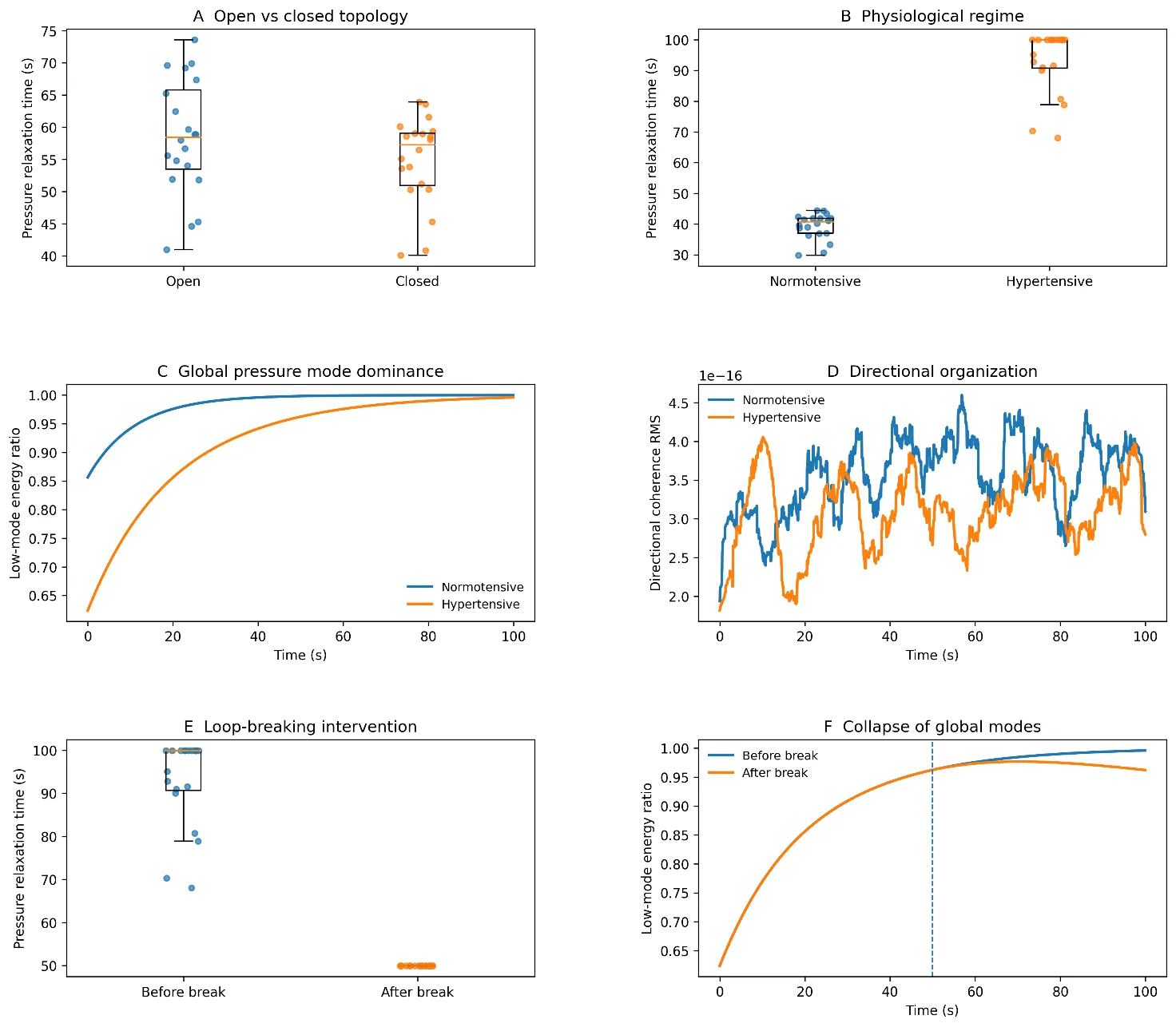
Scientists built a computer model of blood flow and compared two scenarios: an open vessel and a closed loop. In an open vessel, pressure drops quickly and remains only near the point of impact. But in a loop, pressure can keep circling even if resistance increases at one spot.
This explains the mystery of resistant hypertension: drugs lower pressure in one area, but the loop redistributes flow and maintains the overall level. When the loop is broken (due to thrombosis, surgery, or embolization) pressure changes dramatically across the entire system. So vascular topology (how vessels are connected) turns out to be just as important as their tone.
Original abstract
as written by the authors arXiv:2602.10011
Blood pressure regulation is commonly addressed in terms of local mechanisms such as vascular resistance, compliance and neurohumoral control. However, the human vasculature encompasses multiple quasi-closed flow loops under both physiological and pathological conditions. To test whether these loops could influence pressure dynamics beyond local control, we address the role of vascular topology in blood pressure regulation. Using one dimensional flow simulation models, we compared pressure dynamics in open vascular segments and closed vascular loops. We found that in open segments pressure fades away and remains spatially localized, whereas in closed loops pressure can keep circulating around the loop even if resistance in one spot is modified. Since parallel pathways within loops are dynamically coupled rather than independent, pressure changes in one place can affect the entire closed loop, allowing system level pressure patterns to emerge. Also, we assessed the temporal evolution of pressure fluctuations within closed vascular loops in normotensive and hypertensive parameter regimes, before and after loop breaking intervention. This topological approach helps clarifying why drugs or local interventions may fail to lower blood pressure in looped vascular architectures, providing a theoretical interpretation of some forms of resistant hypertension. Because disrupting a loop restores pressure relaxation, it may also help explain the disproportionate pressure changes observed after topology altering events like thrombosis, vascular surgery or embolization of arteriovenous malformations and shunts. Therefore, vascular topology can influence cardiovascular physiology by coupling local pressure flow relations to global constraints on blood pressure regulation, with physiological, pathological and clinical implications.
Humans have several natural vascular loops, such as the circle of Willis in the brain — a ring of arteries that protects against stroke if one branch gets blocked.