Why Blood Pressure Won't Drop: Loops in the Vessels express
Water in a circular hose, pumped around by a pump, won't stop even if you pinch one section: the flow finds a detour and keeps going around. That's roughly how some parts of our circulatory system are arranged — not as single pipes but as closed loops.
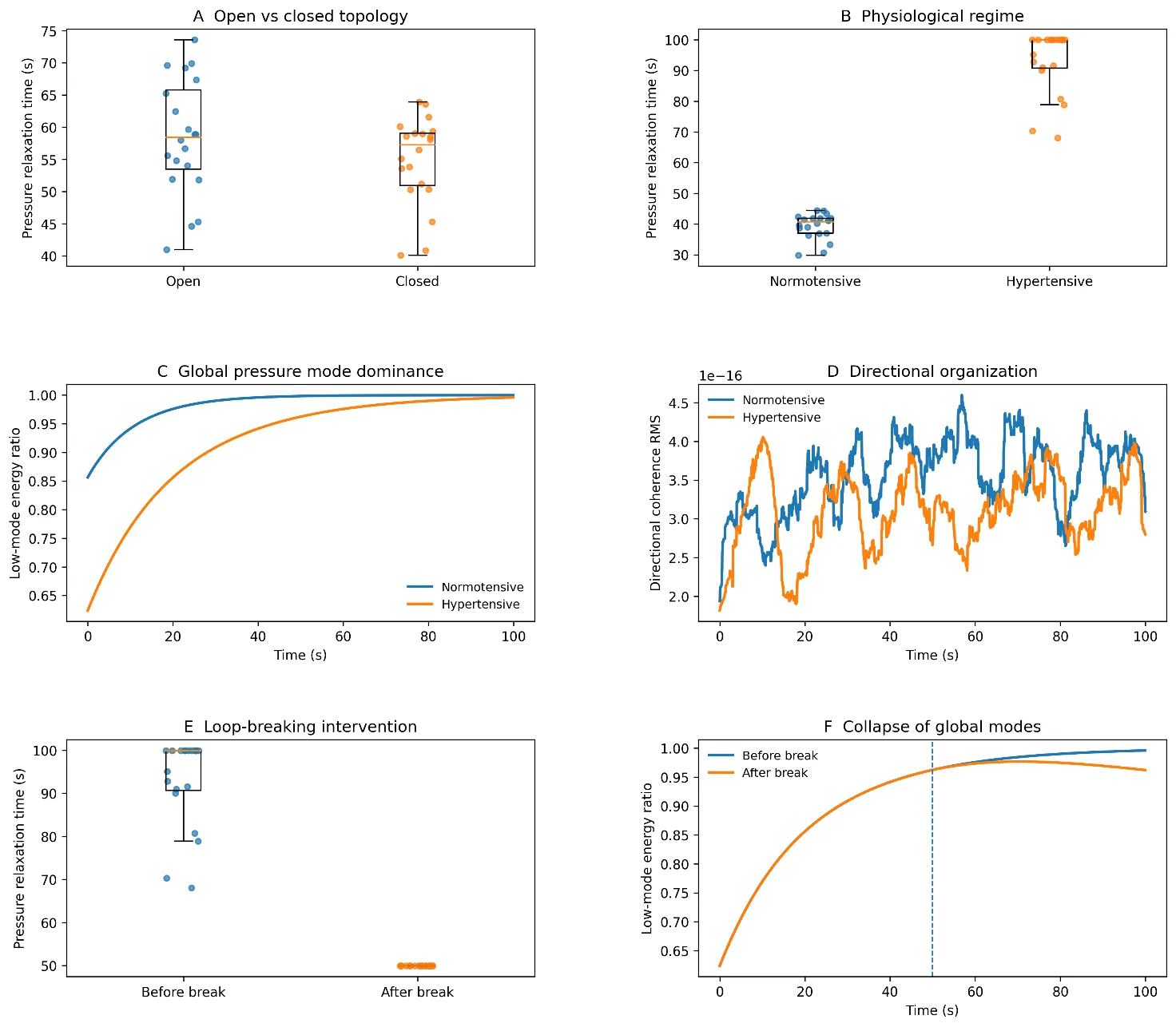
Scientists built a computer model of blood flow and compared two scenarios: an open vessel and a closed loop. In an open vessel, pressure drops quickly and remains only near the point of impact. But in a loop, pressure can keep circling even if resistance increases at one spot.
This explains the mystery of resistant hypertension: drugs lower pressure in one area, but the loop redistributes flow and maintains the overall level. When the loop is broken (due to thrombosis, surgery, or embolization) pressure changes dramatically across the entire system. So vascular topology (how vessels are connected) turns out to be just as important as their tone.
Humans have several natural vascular loops, such as the circle of Willis in the brain — a ring of arteries that protects against stroke if one branch gets blocked.