Topological transport refers to the movement of particles or energy that is protected by the global, topological properties of the system, making it remarkably robust against disorder and perturbations. Unlike ordinary transport, which is easily disrupted by impurities, topological transport is governed by invariants that cannot change smoothly — like the number of holes in a doughnut. This means that even if the material is full of defects, certain edge states or bulk currents will continue to flow without scattering.
History
The concept emerged from the discovery of the quantum Hall effect in 1980 by Klaus von Klitzing, and was later generalized to topological insulators in the 2000s by Charles Kane, Eugene Mele, and others.
How it works
In a topological material, the quantum wavefunctions have a nontrivial 'twist' that is characterized by a topological invariant, such as the Chern number. This invariant dictates that there must be conducting states at the boundaries of the material, even if the bulk is insulating. These edge states are chiral — they travel in only one direction — so they cannot backscatter, because that would require a change in the topological invariant. This makes the transport completely immune to disorder, as long as the topology remains intact.
In practice
Topological insulators are being explored for spintronics and quantum computing, where their robust edge states could carry information without dissipation.
Fun fact
The 2016 Nobel Prize in Physics was awarded for theoretical discoveries of topological phasetransitions and topological phases of matter.
Graphene, a sheet of carbon just one atom thick, can change its magnetic properties the way water changes shape: sometimes flowing, sometimes freezing into ice. In a new study, physicists peered inside this process for the first time using a sensor the size of a needle tip.
In an ultracold cloud of atoms cooled to near absolute zero, regions with different spin orientations emerge, like patches with different magnetization. The boundaries between them are called domain walls. Usually they are stationary, but in this experiment the walls started moving on their own.
Why do some systems, from gene networks to air travel, preserve imprints of the past longer than others? For a long time, network science blamed topology: the number of connections, modularity, spectrum. But two networks with the same skeleton can remember and forget in completely different ways.
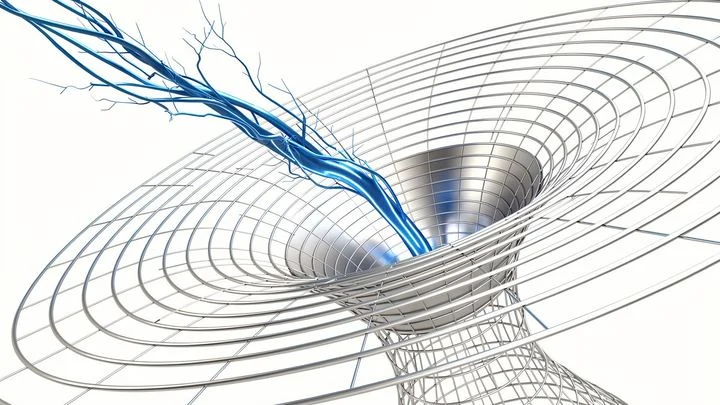
At the heart of a warp drive lies Einstein's idea that massive bodies curve spacetime — the very stage on which all cosmic events unfold. Picture a bubble of such curved spacetime. Inside it, the ship floats without any G-forces, like a passenger in an airplane cabin who doesn't feel the headwind.
A thrown stone follows a smooth arc: its path is easy to predict. But if the stone skips across water, the trajectory becomes jagged and far more interesting. Quantum particles behave much the same way when their state is not a calm wave with fixed energy but a turbulent mix of several waves at once.
A tightly stretched sheet lies on a table for days. Outwardly it's still, but the fabric fibers retain tension — loosen one edge slightly, and wrinkles will run across it, rearranging the whole pattern. That's roughly how a layer of epithelial cells behaves at rest. It doesn't just freeze; it accumulates mechanical stress — a kind of cellular memory of past movements.
Since time immemorial, physicists have dreamed of tunnels piercing the cosmos — wormholes, capable of connecting far-flung corners of the Universe in an instant.
When you squeeze ketchup out of a bottle, you're battling its stubbornness: it sits still at first, then suddenly shoots out in a blob. That's typical non-Newtonian behavior — resistance to flow changes with how hard you push. But the authors of a new study found a way to almost completely eliminate that resistance.
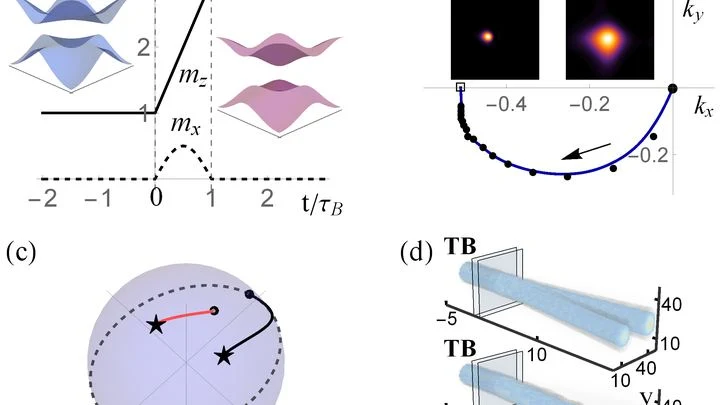
A stone falls into a pond, and ripples spread across the water. They reflect off the shore, overlap, and die out. All this motion unfolds in space. But what if the pond itself changed its depth or density for an instant — not at one point, but everywhere at once? A temporal boundary is exactly such a jump in properties over time, not space.
In a pot of boiling soup, churning currents carry heat to the walls, and the soup cools. In a tokamak, a huge magnetic bottle for plasma, the same thing happens: turbulent eddies carry energy outward, hindering the ignition of a fusion reaction. But sometimes the plasma seems to find a way to calm itself.
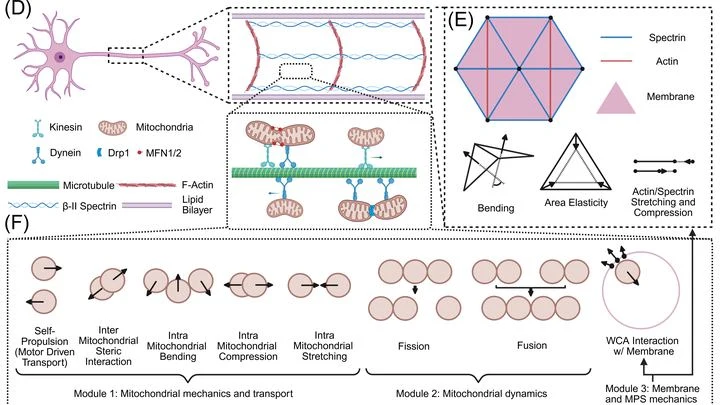
Inside every neuron, there's a long, thin channel, the axon, through which signals travel from the cell body to other cells. To keep this channel working, mitochondria constantly shuttle along it. These tiny organelles produce energy and move in both directions, like cars on a narrow road.
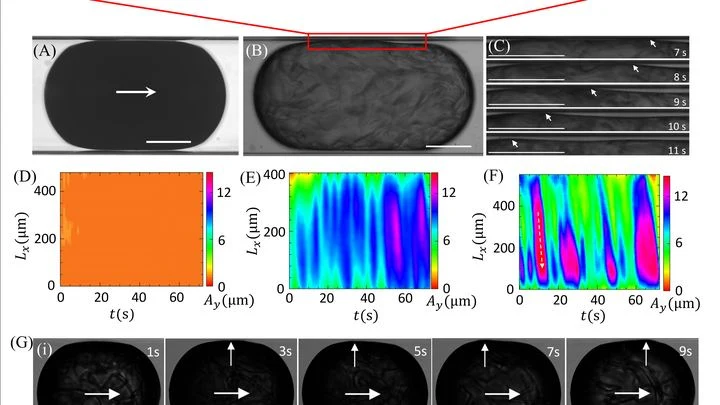
A tiny oil drop squeezes through a water channel narrower than itself. In pure water, it crawls along calmly, like a round bead. But add a little soap to the water, and the drop begins to bend, like a caterpillar.
Gas falls onto a neutron star — the ultra-dense remnant of an exploded star. This gas accumulates at the magnetic poles and forms a mountain. But a mountain on a neutron star is not like one on Earth: it is held not by rock but by magnetic field lines, like iron filings on a magnet.
When there is too much gas, the mountain begins to break apart.
Lymphatic vessels are one-way streets. Through them, fluid flows only forward thanks to tiny flap valves. These valves open in just one direction, creating asymmetry, directionality, without which the flow would stop.
In the lab, scientists modeled a vessel and sent compression waves along it, like a parade of gentle nudges.
An optical tweezer is a beam of light that holds and moves tiny objects like bacteria or dust grains. If you need to carry a particle from point A to point B, you could simply pull it straight there. But that would consume more energy than a cleverly chosen detour.
An active particle is a microscopic object that propels itself forward, like a tiny swimmer.
In a metal crystal, atoms line up in neat rows like bricks in a wall. Knock out a single brick, and you're left with a void — what scientists call a vacancy. Under irradiation, these voids multiply and start merging into large holes, sapping the metal's strength. It's like holes in a brick wall joining up into a gaping breach.
Polymers are long threads of carbon and hydrogen atoms. In living cells, they encounter streams of chemical signals that pulse like the surf. Long chains and closed rings behave like skilled surfers: they catch the wave and glide with it. Short fragments and tight coils, counterintuitively, move strictly against it.
An ordinary door swings both ways, but the physicists rigged a one-way door for atoms — enter at will, but leaving is off-limits. The atoms were cooled nearly to absolute zero — in such deep cold, they merge into a single cloud. This cloud was placed in a neat lattice of laser beams, adding a tiny irregularity, like a step at the threshold.
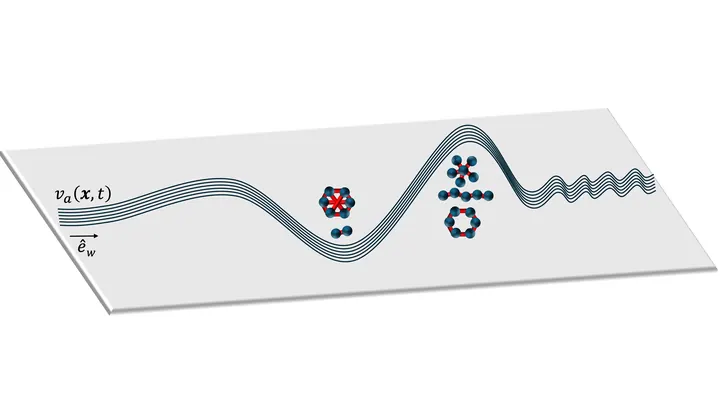
A thin wire made of a special material, a topological insulator, behaves like a city street: the interior is empty, and all traffic runs along the edges. Electrons in such a wire move only along the surface, like pedestrians on a sidewalk, never stepping onto the roadway.
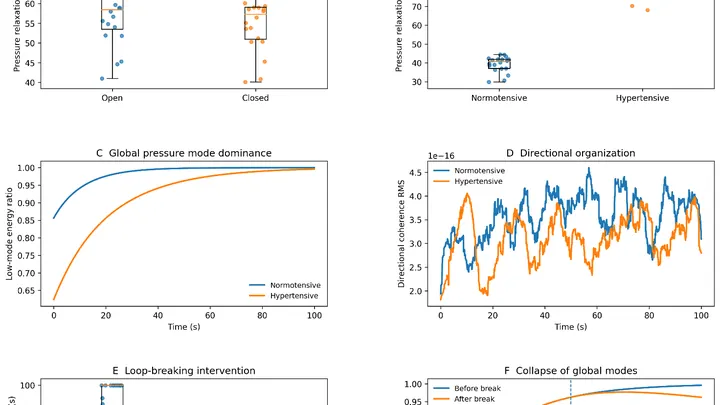
Water in a circular hose, pumped around by a pump, won't stop even if you pinch one section: the flow finds a detour and keeps going around. That's roughly how some parts of our circulatory system are arranged — not as single pipes but as closed loops.
Scientists built a computer model of blood flow and compared two scenarios: an open vessel and a closed loop.
In a tokamak, plasma is like a crowd on a narrow street: once someone starts running, everyone takes off at once. In a stellarator with a non-circular cross-section, the street is winding, with dead ends and pockets. The crowd can't gather into a single wave — people get stuck in different corners.
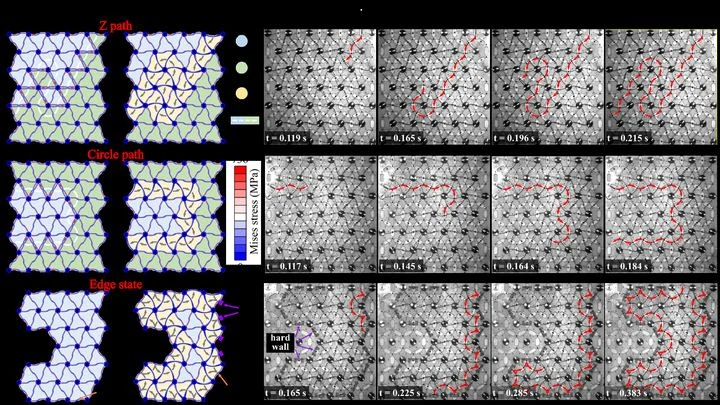
The popping lid of a jam jar is the hero of this story. Press it, and with a loud click it flips from a convex to a concave shape. Exactly the same happens with a hinged beam inside each cell of a new mechanical lattice.
Scientists assembled these snapping beams into a hexagonal grid, like honeycomb, but made of elastic plates. When one beam is sharply compressed, it snaps and pushes its neighbor.
A crowd of people in a subway station moves slower than individuals: everyone gets in everyone else's way. A similar picture emerges in a dense cloud of magnetic atoms exchanging energy. Previously, it was thought that the transfer rate depended only on the atoms' own properties.
In disordered materials, such as organic semiconductors or inks made from two-dimensional materials, electrons don't move smoothly like water through a pipe. Instead, they hop from one spot to another, like a ball bouncing across a rough surface. This kind of motion is called hopping transport.
Paraglider, hang glider, and glider — three different wings, but in the sky they behave the same. Pilots catch invisible warm air currents, rise on them, then glide to the next. Such flight is like a game of hopscotch: a jump upward, then a glide forward, and again a search for a place to jump.
Scientists analyzed thousands of real routes and found a common law.