Two New Worlds Around Young Stars express
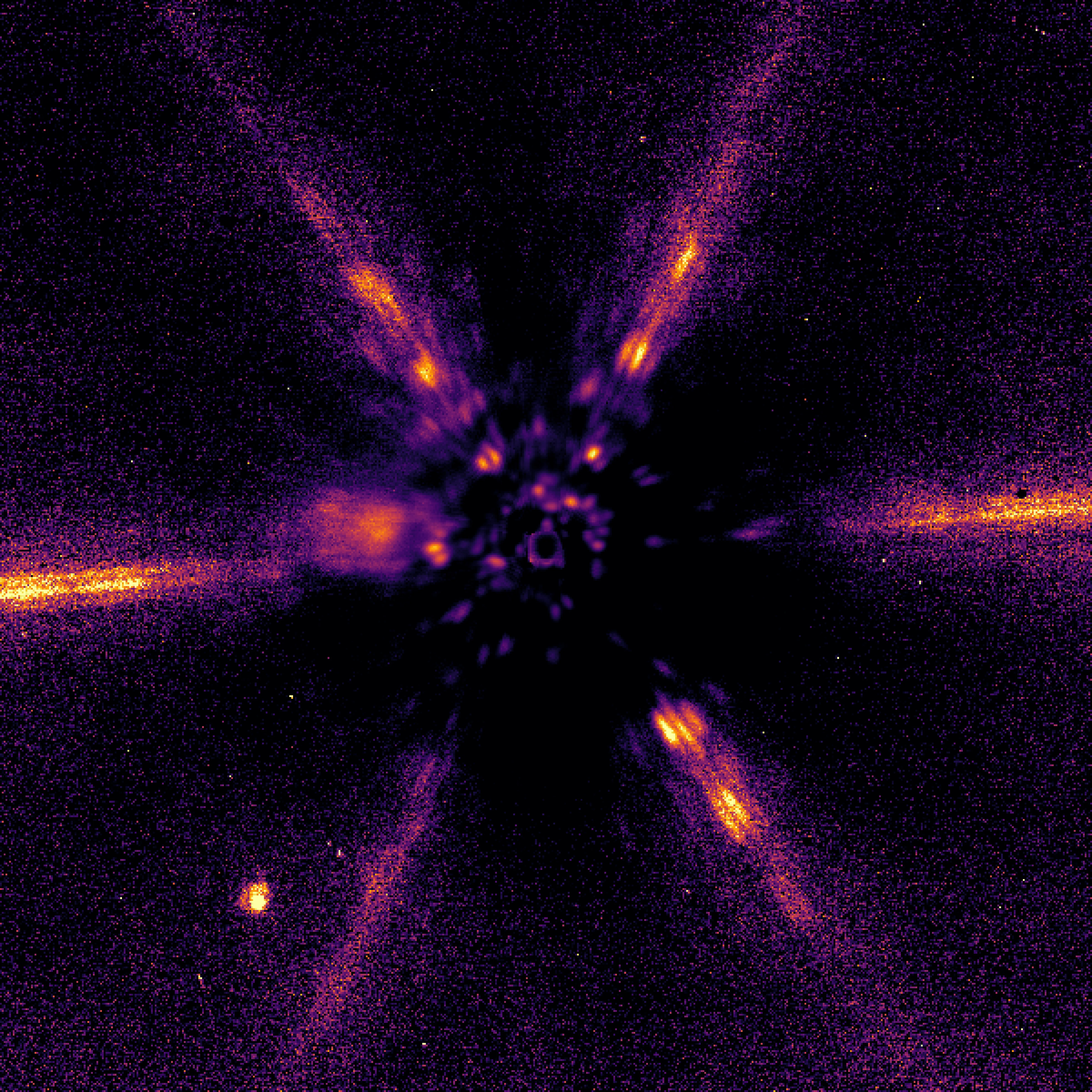
In the dark clouds of gas and dust where new stars are just igniting, the Keck Telescope in Hawaii picked out two faint points of light next to young stellar objects. These aren't stars but their companions — too light to shine on their own. One of them, KOINTREAU-3b, circles the star ISO-Oph 96 at a staggering distance—340 times farther than Earth is from the Sun. If it were in our solar system, it would lie far beyond Neptune's orbit.
The second companion, KOINTREAU-4b, stays closer to its star, 2MASS J16262785-2625152, at a distance of 180 astronomical units (one astronomical unit is the Earth–Sun distance). Its mass is estimated at 11–15 Jupiter masses. This is a borderline zone: a bit lighter, and it's a giant planet; a bit heavier, and it's a brown dwarf — an object that failed to become a star because thermonuclear fusion never kicked in its core.
To spot these faint companions next to brilliant young stars, astronomers used adaptive optics — a system that cancels out atmospheric blur, as if the telescope were peering from space. This allowed them to see objects hundreds of times fainter than their stars. The discovery adds to the known exoplanets and brown dwarfs in active star-forming regions, where planets are still taking shape.
Original abstract
as written by the authors arXiv:2602.10198
We present the second set of discoveries from Keck Observations in the INfrared of Taurus and $$\rho$$ Oph Exoplanets And Ultracool dwarfs (KOINTREAU), an adaptive optics survey of young stars in the Taurus and $$\rho$$ Oph star-forming regions using Keck/NIRC2 in conjunction with the Keck infrared pyramid wavefront sensor. We have discovered two faint comoving companions to young stars ISO-Oph 96 and 2MASS J16262785-2625152. The companion to ISO-Oph 96, KOINTREAU-3b, is at a projected separation of 340 au (2.49"). Using our NIRC2 photometry and evolutionary models, and assuming that the companion has the same extinction as its host star, we infer that KOINTREAU-3b has a mass of $$3.4\pm0.7$$ M$$_{\rm Jup}$$. The companion to 2MASS J16262785-2625152, KOINTREAU-4b, has a projected separation of 180 au (1.25") and could have a mass of either $$11.5^{+1.2}_{-1.6}$$ M$$_{\rm Jup}$$ or $$15.3^{+0.7}_{-0.8}$$ M$$_{\rm Jup}$$, depending on whether the host star is a member of $$\rho$$ Oph or Upper Sco.
The distance from KOINTREAU-3b to its star is 11 times greater than from Neptune to the Sun. A year on such a planet would last hundreds of thousands of Earth years.