Brown dwarfs fill the gap between giant planets and true stars. Their masses range roughly from 13 to 75 Jupiter masses. Unlike planets, they can briefly fuse deuterium early in life, but hydrogen fusion is beyond their reach. The atmospheres of these objects are quite cool (300 to 2500 K), where dust grains of silicates and iron condense. Spectra divide them into classes from L (hot, with metal lines and dust) to T (cooler, with methane bands) and further Y—the faintest, with temperatures below 500 K.
History
The theoretical prediction was made by Shiv Kumar in 1963, who introduced the term 'black dwarf' for objects with mass less than 0.07 M_⊙. In 1975, Jill Tarter proposed the name 'brown dwarf.' The first confirmed discovery took place in 1995: Tad Owen and colleagues detected Gliese 229 B at the Palomar Observatory. Later, Subrahmanyan Chandrasekhar made a fundamental contribution by calculating the limiting mass for degenerate bodies—the Chandrasekhar limit, which, although higher than brown dwarf masses, laid the foundation for describing their internal structure.
How it works
The object forms like a star, from the fragmentation of a molecular cloud and accretion. As it contracts, the core temperature rises; if the mass is below the threshold, electron degeneracy sets in before the pp-chain temperature (~3×10⁶ K) is reached. Further contraction is slowed by the pressure of degenerate electrons. Any thermonuclear reactions ignited during the deuterium or lithium phase quickly deplete their fuel because the temperature drops as the core expands. Thereafter, the object's luminosity is sustained only by the release of gravitational energy and gradual cooling. Cooling curves are described by solutions of the stellar structure equations with a degenerate equation of state; the characteristic cooling time is tens of billions of years.
In practice
Brown dwarfs serve as natural laboratories for studying the atmospheres of giant planets and stars—they have intermediate temperatures and the same molecules: methane, water vapor, carbon monoxide.
Fun fact
The first discovered brown dwarf, Gliese 229 B, has a temperature of only about 950 K—cooler than a candle flame, though it shines not in visible light but in infrared.
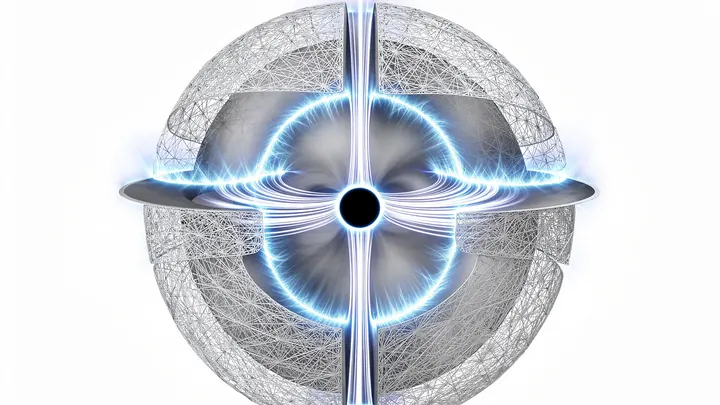
At the center of an ultra-compact dwarf galaxy, a very dense stellar system spanning tens of light-years, there is a vacuum cleaner at work. But instead of dust, it sucks in gas shed by dying stars. This gas does not fly off in all directions; instead, it spirals into a funnel, a rotating disk that gradually settles onto the black hole.
Forty light-years away lives a star that went unnoticed for a long time: TRAPPIST-1 emits two thousand times less light than the Sun. But it turned out to have seven Earth-sized planets, three of which orbit in the zone where water could remain liquid. Yet little was known about the star itself, about its chemical kitchen.
A star blinks every 38 seconds. This is no random twinkle: inside the white dwarf WD 0158−160, steady oscillations run like the beats of an invisible metronome. From the rhythm of those beats and the star's precise distance, astronomers have computed its mass and temperature — without ever looking at its spectrum.
The JWST space telescope aimed its lens at the scorching rocky world 55 Cancri e, and spotted a dense gas envelope. But the cooler TRAPPIST-1 b, which orbits a dim red dwarf, showed no envelope: just bare rock. The picture came out upside down: hot planets hold onto atmospheres, while cooler ones lose them.
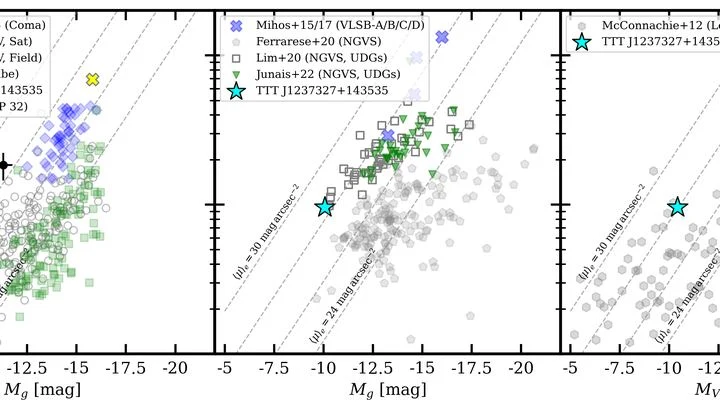
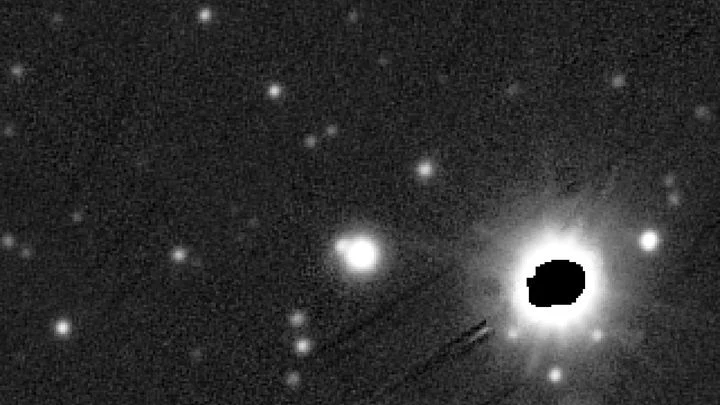
The night sky only looks black: telescopes reveal millions of galaxies, but some are so dim they blend into the background. Astronomers caught just such a "nearly invisible" one by chance while observing the Virgo Cluster with the two-meter telescope at Teide Observatory.
The galaxy is named TTT J1237327+143535.
The night sky seems unchanging, but galaxies constantly exchange matter. The Milky Way, like a great river, absorbs smaller streams — dwarf galaxies. Along with their stars, planets may also come to us.
Two spinning tops whirl so close they nearly touch. One is scorching blue, the other dim white. Together they complete a full orbit in twenty hours. This is the pair Feige 64: a blue star with a mass of just a third of the Sun's, and a white dwarf, the cooled core of a former star, one and a half times heavier than our Sun.
The blue star seems too hot for its mass.
Two spinning tops whirl so close they nearly touch. One is scorching blue, the other dim white. Together they complete a full orbit in twenty hours. This is the pair Feige 64: a blue star with a mass of just a third of the Sun's, and a white dwarf, the cooled core of a former star, one and a half times heavier than our Sun.
The blue star seems too hot for its mass.
A white dwarf is the former core of a star like the Sun, squeezed down to the size of Earth. A teaspoon of its material would weigh several tons. A neutron star is an even denser remnant: a city the size of Manhattan, but with more mass than the Sun.
A lighthouse that blinks not every second but once every few minutes or even hours. That is exactly how long-period radio transients behave — cosmic sources discovered only recently.
A balloon that lets out air in bursts zips around the room — the jet blasts first one way, then another. A dying star behaves the same way as it sheds its bloated shell. Only instead of air, it's superheated gas, and instead of a balloon, it's a future white dwarf (the dense stellar remnant about the size of Earth).
A distant light in the fog looks tiny and reddish: you'd think it's miles away. But then the light shifts sideways, and it becomes clear: it's a cyclist twenty steps away, just with a nearly dead rear light. That's how, in 2025, astronomers stumbled upon 'Capotauro'—a compact red source in images from the James Webb Space Telescope.
A white dwarf is the cooling core of a Sun-like star. Its fate hinges on mass: there's a strict Chandrasekhar limit (about 1.4 solar masses) beyond which the star collapses further.
Light from the very beginning of the cosmos has been traveling toward us for 13.8 billion years. During that time, its polarization, the direction of its oscillations, might have been twisted, like a compass needle that someone quietly nudged. Physicists call this phenomenon cosmic birefringence.
A star wrapped in an invisible blanket warms up more than it should. That's exactly how ten red dwarfs look, which astronomers from the Hephaistos project have been monitoring. These stars lie within 300 parsecs (about 1000 light-years) of us and emit far more infrared energy than their modest sizes can explain.
In a distant galaxy about 290 million light-years away, the object HLX-1 lies hidden. It once flared brighter than hundreds of billions of suns, but now it has quieted down. From 2018 to 2022, the Hubble, Chandra, and Swift space telescopes tracked its fading.
A star's radius drops by a thousand kilometers. Not because its mass increased, but because its own magnetic field squeezed the crust like an invisible corset.
10¹⁵ Gauss — that's the magnetic field found on some white dwarfs. It is billions of times stronger than what a compass shows on Earth. A white dwarf is not a star in the usual sense, but a cooled core the size of a planet. Inside, gravity opposes the pressure of degenerate electrons.
Two hundred and eighty-nine days: that's how long one rotation of the white dwarf white dwarf WD 1532+129 takes. This is not just a record: on its surface, near the magnetic poles, scars of iron and other metals appear — silent testimony to planets it has devoured.
Radio astronomy began with the mysterious noise caught by the antenna of Karl Jansky and the rhythmic pulses that Jocelyn Bell Burnell playfully called 'little green men'.
On August 6, 1181, Chinese astronomers spotted a new star in the constellation Cassiopeia. It shone for 185 days, slowly fading, and then vanished, leaving only a record in the chronicles. Today, at its location, there is a hot white dwarf — a compressed stellar core with no nuclear reactions, heated to tens of thousands of degrees.
Radio astronomy began with the mysterious noise caught by the antenna of Karl Jansky and the rhythmic pulses that Jocelyn Bell Burnell playfully called 'little green men'.
The star AB Aur is young, about 4 million years old. Around it swirls a dense disk of gas and dust. Recently, a long gas stream, a flow of material from the surrounding cloud, crashed into it.
Ten billion years ago, the universe was speckled with strange crimson sparks. The JWST spotted them in images at distant redshifts — compact sources blazing like entire galaxies yet no larger than a tiny central region. Astronomers nicknamed them “little red dots.” Their nature long defied explanation.
It takes the stellar pair J05+50 nearly two months to complete one orbit around their common center. From Earth, it appears as a faint point in the constellation Hercules — 4625 parsecs away. Photometry of the binary star only captures a steady flicker of brightness, like the pulse of a giant heart.
Among the scorching exoplanets that circle perilously close to their stars lies the secret of their birth. Nearly three decades ago, Michel Mayor and Didier Queloz discovered the first such world, and since then astronomers have been tormented by the question: how does a gas giant end up pressed against…
In 2024, the team led by David Charbonneau pointed the Magellan telescope with the WINERED spectrograph at LHS 1140. During transit, high-resolution spectroscopy caught the absorption line of metastable helium at 10833 Å.
Dark matter remains the inaudible bass line of the cosmic symphony — it emits no light, but its gravitational pull shapes galaxies. Vera Rubin first caught this rhythm in the 1970s by observing the rotation of stars.
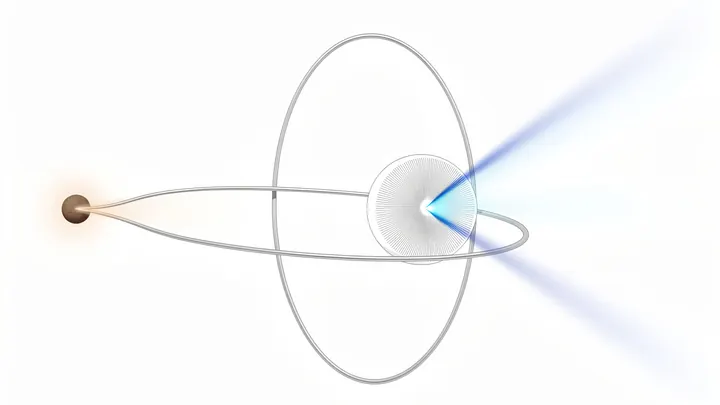
A quarter-century ago, Michel Mayor and Didier Queloz discovered the first hot Jupiter, and shattered all the rules of planet formation. A gas giant on a days-long orbit couldn't have formed next to the star: it's far too hot and lacks building material. So, it must have been born far away and then migrated.
In 2024, the Hephaestus project sifted through millions of stars and flagged a few dozen suspicious ones: they shone brighter in the mid-infrared than a normal red dwarf should. Two of these candidates, labeled D and E, looked especially tantalizing, as if an invisible heater were working next to the star.
The James Webb Space Telescope peered into an era when the universe was less than a billion years old and spotted strange objects—'little red dots.' These are black holes with masses of millions of suns, but in very compact, chemically pristine galaxies. Standard scenarios can't grow such heavyweights that early.
Forget the familiar images of planetary cores — a sharp boundary between rock and gas is a thing of the past. The Juno probe, diving into Jupiter’s gravitational field, and Cassini, into the embrace of Saturn, discovered that heavy elements are not gathered at the center but smeared over a vast region, as if someone carelessly shook a cocktail.
The gravitational dances of celestial bodies long remained silent to astronomers. We learned to catch the shadows of planets against stars with the transit method — a breakthrough that delivered thousands of worlds thanks to William Borucki and his Kepler telescope.
Like an exquisite clockwork mechanism, a multi-planet system responds sensitively to the slightest nudge. And when the star at the heart of this mechanism dies, shedding its envelope and turning into a white dwarf, even a modest kick at a speed of 0.75 km/s can trigger a cascade of events, flinging entire worlds into interstellar emptiness.
When a star dies, it turns into a white dwarf — a dense ball of carbon and oxygen the size of Earth. Predicted by Subrahmanyan Chandrasekhar, these objects were long thought to be lifeless graveyards.
The James Webb Space Telescope has peered into a strange binary world. Here, a dead star, a white dwarf, slowly roasts its companion, a brown dwarf. The object, named ZTFJ0038+2030, completes a full orbit in just a few hours. One side of the brown dwarf always faces the white dwarf, much like the Moon faces Earth.
A neutron star is a city squeezed to the size of a metropolis, where matter is packed to the limit. At the very center of such a city, a redevelopment may begin: familiar neutrons and protons give way to quark plasma — free quarks, the building blocks of almost everything around us.
When JWST peered into the young universe at redshifts of 6–10, it revealed a scattering of mysterious 'little red dots' (LRDs). These objects combined features of galaxies and active nuclei, but their spectra refused to fit into familiar patterns.
Long-period radio transients (LPTs) are a mysterious class discovered only recently. Their pulses last minutes or hours, and their nature was completely unknown. ASKAP J1745-5051, caught by the Australian telescope ASKAP, became the first to get a full explanation.
Some 158 light-years away, around the dim star TOI-6894, a red dwarf, a planet moves leisurely. Its year lasts less than two Earth days, yet it is a cool world with an equilibrium temperature around 420 K, just a bit warmer than a sauna.