How Light Is Born on Command express
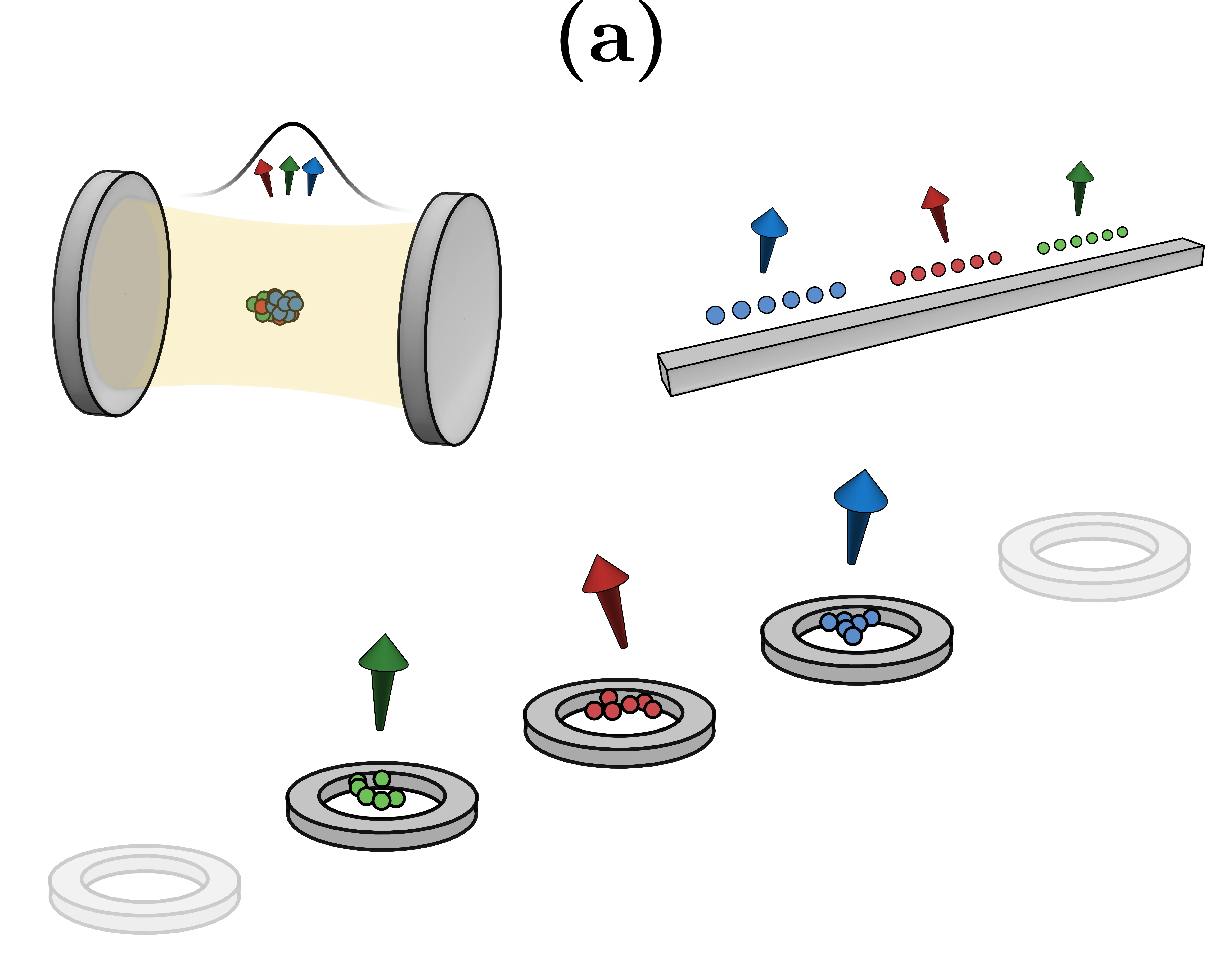
A hundred fireflies in a jar blink out of sync, but once they synchronize, their flashes merge into a bright pulse. Quantum emitters, individual atoms or artificial particles that can emit photons, behave in much the same way. When there are many of them and they interact, calculating their collective behavior is no easy task. Conventional methods are either too slow or lose important quantum effects.
The authors of the new study built on an approximation called the truncated Wigner. It turns a complex quantum problem into a set of random trajectories on the Bloch sphere — an imaginary surface where each point describes the state of an emitter. The trajectories are computed independently and then averaged. It turns out that for large ensembles, this method yields very accurate results, including nonclassical features that usually require a full quantum calculation.
After testing the method on benchmarks, the scientists applied it to a chain of hundreds of interacting ensembles. They found that when energy is pumped into such a system, spatial coherence spontaneously emerges: the emitters start emitting light in concert, like an orchestra coming in at the conductor's baton. Moreover, the emission becomes directional — photons predominantly go in one direction, even though the chain was initially symmetric. This resembles how a crowd at a stadium suddenly starts a wave running around the stands.
This approach opens the door to modeling extended systems where light and matter are tightly intertwined. It bridges microscopic models of individual emitters with the collective behavior of large ensembles. In the long run, it could help design quantum light sources, amplifiers, and other devices where the coordinated action of many particles is crucial.
The Bloch sphere is a way to visually represent the state of any quantum bit: if you place a point on the globe, its position fully describes how the two basis states are mixed.
In the series 'The Expanse,' the protomolecule controls the collective behavior of particles, creating structures that cannot be predicted from individual elements — much like the directional emission that emerges in a chain of emitters.