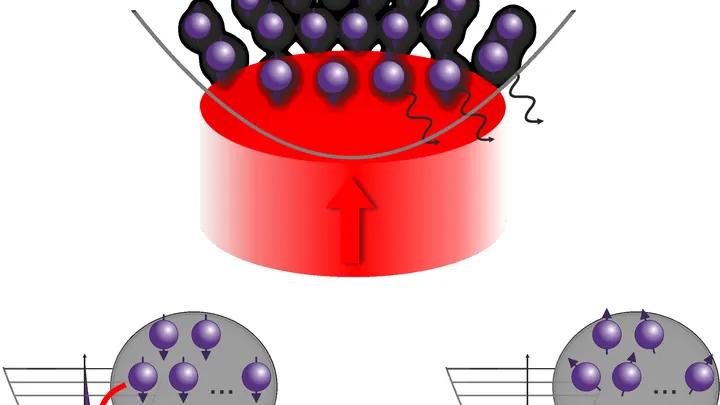
In quantum physics, an ensemble is a large collection of identical quantum systems prepared in the same state, used together to store or process information. Because individual quantum systems are fragile and difficult to measure without disturbing them, ensembles provide a practical way to amplify signals and protect quantum states. For example, a cloud of nitrogen-vacancy centers in diamond can act as a quantum memory, where the collective spin state of many defects stores information robustly.
History
The concept of an ensemble in quantum mechanics dates back to the statistical interpretation of quantum theory developed by Einstein and others in the early 20th century. The use of ensembles for quantum memory was proposed in the 1990s, with the first experimental demonstrations in atomic gases and solid-state systems around 2000.
How it works
The key idea is that while a single quantum system might be easily destroyed by noise, an ensemble of many identical systems can be manipulated collectively. The quantum state is encoded in the collective excitation of the ensemble, such as the total spin or the number of excited atoms. Measurements on the ensemble yield stronger signals, and the redundancy helps correct errors, making the storage more reliable than with a single particle.
In a quantum ensemble, the collective state can be so well-defined that it behaves like a single 'super-atom', emitting light coherently in a process called superradiance.
At night on a volcano summit, six telescopes stare at the same speck of light. Each catches its own copy of the wave, and if you combine their signals, you get an image that no single instrument could produce alone. But there's a catch: light captured by different stations cannot simply be added like photographs.
Usually, the complexity of systems, from satellite motions to heart rhythms, is assessed with averaged entropy (a measure of unpredictability, as understood by Boltzmann). But that's like evaluating the ocean only by wave height: the average figure hides the full richness of underwater currents.
Quantum devices are no longer lab curiosities. They are assembled, tuned, and repaired like ordinary hardware — except inside them, it's not just current but intricate tangles of particles that can exist in multiple states at once. Engineers draw schematics, programmers write code, physicists calculate effects.
Crystals fascinate us with their perfect spatial order: atoms frozen at lattice points, like beads on an invisible string. But what if the same symmetry unfolds in time? Time crystals are systems that, without any external cue, start repeating their states cyclically — clocks wound by nature itself. Inside this tireless rhythm, disorder seems to have no place.
A tiny crystal of charged atoms, trapped in a trap, trembles with heat. Each ion oscillates like a ball on a spring, and these vibrations hinder using the crystal for precise quantum operations. Usually, excess energy is removed with a laser — the beam hits the ions and slows their motion, like a stream of air damping a pendulum.
In the world of atoms and particles, everything tends toward rest: particles lose energy, just as a swing slows down due to energy loss (friction). But many devices — from hydrogen masers to atomic clocks — live by repetitive cycles.
Trying to count people in a dark room by the sound of their breathing hits a wall of background noise — individual breaths are inaudible. Scientists working with quantum spins in solids face a similar challenge. Each spin (the electron's magnetic moment) has its own "voice," but it is drowned out by the technical noise of the instruments.
Neutrinos are often compared to a radio broadcast picked up by different receivers. One station sends a signal, but antennas in Japan, Antarctica, and at the bottom of the Mediterranean Sea hear it differently — due to distance, interference, and antenna orientation.
Imagine a library where instead of books, you have every conceivable combination of a few dozen quantum particles. The number of combinations grows like a snowball: add one particle, and the volume doubles. For fifty particles, there are more shelves than atoms in the visible universe.
Picture a crowded hall where each person is a molecule, and their private conversation is the motion of electrons within it. Normally, everyone talks to themselves, and the overall buzz is chaotic. But if a bright spotlight is turned on in the center, it begins to conduct the crowd: people synchronize their movements, even though the light merely reflects off the walls.
Steam rising from hot metal is a familiar sight in the kitchen. But if you use rubidium instead of water, that cloud becomes a battery. It doesn't run on chemical reactions but on the quantum coordination of atoms.
A crowd of people suddenly starts moving as one. In physics, this happens with atomic spins — tiny magnetic arrows. When many spins come together and interact through a shared medium, they form one big magnet, or a macrospin. This macrospin doesn't just point in one direction; it can get stuck in several positions, like an ice cube that refuses to melt even when it's warm.
Inside an exploding star, neutrinos race so densely that they start to influence each other. Their quantum states become entangled, like threads in a tight ball where you can no longer tell which is which. Ordinary computers struggle with this task, as the number of possible states grows avalanche-like.
Water in a cup cools down in minutes. Gas in a room spreads evenly in seconds. But if you trap atoms in a tube as thin as a laser beam and give them a good kick, they will take several seconds to "cool" toward equilibrium — an eternity by atomic standards.
A ring of magnetic atoms resembles a round dance where each participant holds hands with their neighbors. In ordinary magnets, each atom has its own permanent magnetic moment, and they interact like little arrows striving to align opposite to each other.
Hot tea normally takes longer to cool than warm tea, but water sometimes breaks this rule: back in the 1960s, schoolboy Erasto Mpemba noticed that hot ice cream freezes faster than cold. This paradox has moved into the quantum world: a collection of particles can settle down faster if it was initially more excited.
Physicists took 28 quantum tops, particles with intrinsic spin, and ran a cyclic process on a quantum computer predicted by Werner Heisenberg nearly a century ago. At first, each top spun however it pleased.
Quantum sensors are like an orchestra where musicians play in unison: their entangled states let them pick up signals that ordinary instruments can't. But as soon as you start accumulating the signal, the nonlinear interaction, like a conductor who suddenly starts beating time erratically, ruins the music.
The quantum world is full of surprises: even simply observing a particle changes its behavior. In a new study, physicists showed that continuously measuring energy can make quantum chaos more pronounced. They used a quantity that indicates how long a quantum state remains similar to itself under repeated measurements.
A single light source in a thin layer of boron nitride flashes on and off in a couple of nanoseconds. You can create many such sources in the material, but each one used to work on its own. In the new work, they were made to glow together, like musicians playing in unison.
The magnetic field you want to measure is like a melody played in a noisy hall. A quantum sensor is a microphone that can pick up the faintest notes, but it also hears more than just the music: rustles, creaks, the breathing of neighbors. All of that mixes into the signal and spoils the recording.
A conductor leads an orchestra of billions of musicians while still hearing each one individually. That's roughly the challenge physicists face when trying to make light and electron spins in solids work together.
An orchestra of a hundred musicians plays without a conductor. As long as the score is familiar, each player confidently follows their part, and together they sound harmonious. But when the composer changes the rhythm, discord creeps in: some instruments keep playing the old tune, others try to adapt, and a few fall silent.
The Mpemba paradox, hot water sometimes freezes faster than cold, has gained a quantum sequel. In the microworld, a particle pushed farther from the finish line gets there first. Experimenters demonstrated this on a single spin: like a racer, they pushed it farther from equilibrium, and it reached it faster than after a weak nudge.
Everything tends toward equilibrium: tea cools, a pendulum swings to rest. The measure of this movement is entropy — growing disorder. But sometimes hot water freezes before warm. The Mpemba effect isn't just a curiosity: it shows up in the quantum world too. Scientists have devised a way to control this paradox.
On an ordinary optical table, amid lasers and mirrors, a cloud of a hundred strontium-87 atoms begins to live by the laws of curved spacetime. Half a second later, its quantum interference fades: gravitational time dilation destroys the superposition.
A crowd of thirty-one quantum sensors whispers within a diamond slab. Previously, this whisper was drowned out by the roar of floodlights: the random photon bursts used to read out the spin states masked the ensemble's own quantum noise. Now physicists have learned to switch off the floodlights and listen to the crowd itself.
A beam of visible light enters a cloud of billions of rubidium atoms cooled to near absolute zero, and emerges on the other side already in the telecom range.
A quantum computer is like an orchestra where strings and brass play in different languages. Superconducting processors operate with microwave photons in centimeter-scale circuits, while spin qubits, such as nitrogen-vacancy centers, store…
Inside a diamond, you sometimes find tiny flaws — a spot where a carbon atom is replaced by nitrogen, with a vacancy right next to it. Physicists call this an NV center (a nitrogen-vacancy defect). Such a defect acts like a magnetic needle that can store information in its spin.
A tiny diamond with defects, nitrogen atoms that replaced carbon, hides an unusual feature. Around each defect, an extra electron spins like a top that can be tilted by radio pulses. On its own, this top is too quiet to reach a superconducting qubit — an artificial atom operating at temperatures colder than outer space.
Hidden within the bulk of a diamond are tiny flaws — places where a carbon atom is replaced by nitrogen, with a vacancy gaping nearby. These defects, like beacons, can store and transmit quantum information. But around them rages a magnetic storm: the nuclei of atoms in the crystal jostle, creating interference.