Quantum emitterspectroscopy studies the emission of light from quantum systems — such as single atoms, molecules, or quantum dots — focusing on collective effects like superradiance, where multiple emitters synchronize to produce a burst of coherent light. It also investigates enhancement of emission through engineered environments like optical cavities or metamaterials. This field bridges quantum optics and materials science, revealing how quantum coherence emerges in many-body systems.
History
The theoretical basis was laid by Robert Dicke in 1954 with his prediction of superradiance, but experimental studies of single quantum emitters became possible only in the late 20th century with advanced microscopy and single-photon detectors.
How it works
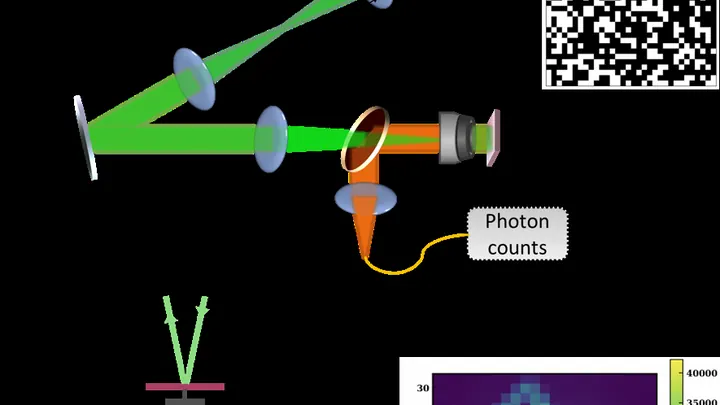
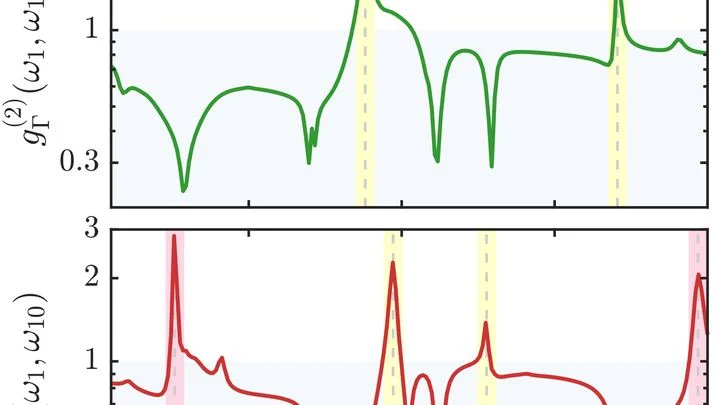
A sample containing quantum emitters is excited with a laser, and the emitted photons are collected and analyzed for statistics (e.g., photon bunching or antibunching), spectra, and temporal dynamics. By varying the excitation intensity or tuning the environment (e.g., placing emitters near a metasurface), researchers observe changes in emission rate, directionality, and coherence. Correlations between emitted photons reveal collective quantum behavior.
On the table lies a layered cake of hexagonal boron nitride flakes, a material similar to graphite but made of boron and nitrogen atoms. One flake is carefully transferred onto another, and at the spot where they overlap, after heating in oxygen, bright single light sources are born.
The electron beam of a microscope usually flies through emptiness, like a courier on an empty highway. Any air molecule is a bump that makes it bounce and lose direction. So before, to examine a sample, you had to freeze it, dry it, or coat it with metal—and still you could only look in a vacuum.
The blue glow in water around a nuclear reactor is light born when a charged particle outruns light in that medium. The effect was discovered by Pavel Cherenkov in 1934, with the theory provided by Igor Tamm and Ilya Frank.
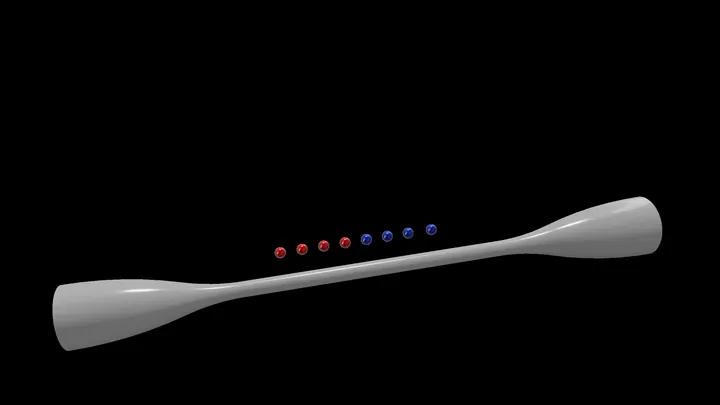
An orchestra without a conductor, where musicians hear each other through a shared wall. That's roughly how the new type of laser works: a few atoms (emitters) sit along a waveguide — a thin track for light on a chip. Light from each atom runs along this track and affects its neighbors.
A black hole is a cosmic pocket into which everything, even light, falls. But the pioneering work of John Wheeler, Stephen Hawking, and Roger Penrose showed: sometimes, due to the colossal spacetime curvature, the pocket turns inside out.
When many excited atoms are gathered together, they often fire light in concert, like a crowd clapping in rhythm. This well-known phenomenon is called Dicke superradiance. But the authors of the new study asked: what happens if the atoms are not identical and each one feels its neighbors?
Hunting for a single glowing spot in a dark sample is like trying to find a needle in a haystack: the microscope beam crawls line by line, wasting time and light. Physicists replaced this slow sweep with random light patterns. The sample is illuminated with a broad field, but each time with a new pattern of bright and dark patches, as if random shadows from a grid were projected onto it.
The light an atom emits is not just a flash. It carries an imprint of the atom's state at the moment of emission. Physicists took a superconducting qubit, an artificial atom the size of a microchip, and made it glow into an open waveguide, like a bulb in a long corridor.
In a dark room, an atom and light are locked together in a mirrored box. The box is so small that the atom cannot simply release light: they constantly exchange energy, like two dancers who never let go of each other's hands.
Laser light is like a perfectly aligned row of soldiers on parade: all waves oscillate in the same plane. Such light is called polarized. In a new study, physicists have for the first time produced polarized gamma rays by colliding electrons with a powerful laser pulse.
A regular laser is like a choir where everyone sings their own part — the sound is loud, but with inevitable roughness. In the new quantum laser, the singers hear each other and harmonize their voices.
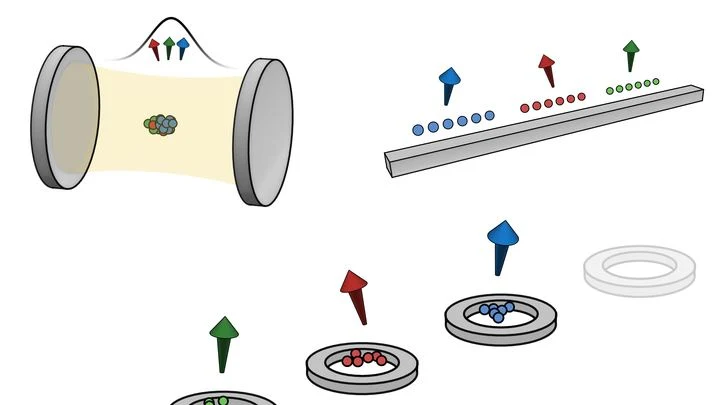
A hundred fireflies in a jar blink out of sync, but once they synchronize, their flashes merge into a bright pulse. Quantum emitters, individual atoms or artificial particles that can emit photons, behave in much the same way. When there are many of them and they interact, calculating their collective behavior is no easy task.
Imagine a vast field of fireflies, each flashing alone rather than in a swarm: that's what the new automated setup is hunting for. It sweeps a laser across the sample like a flashlight and records the color and brightness of the glow at every spot.
Light from many tiny emitters — atoms or artificial "quantum dots"—usually scatters in all directions, like a crowd where everyone shouts on their own. But if you make them "sing in chorus," the flash becomes many times brighter.
A single light source in a thin layer of boron nitride flashes on and off in a couple of nanoseconds. You can create many such sources in the material, but each one used to work on its own. In the new work, they were made to glow together, like musicians playing in unison.