A quantum emitter is a single quantum system — such as an atom, molecule, or quantum dot — that can emit photons one at a time, on demand. Unlike a laser or an LED, which emit streams of many photons, a quantum emitter produces single photons with well-defined quantum states. This makes it a fundamental building block for quantum technologies, including quantum cryptography, quantum computing, and quantum communication.
History
The concept of single-photon emission from a single quantum system was demonstrated in the 1970s with single atoms in traps, and later with single molecules and quantum dots in the 1990s.
How it works
A quantum emitter works by exciting the system into a higher energy state (e.g., by optical pumping or electrical injection), then allowing it to relax to a lower state by emitting a single photon. The emitted photon carries information about the emitter's state, and because the system is quantum, the photon can be entangled with the emitter or with other photons. The key requirement is that the emitter must be isolated enough to maintain its quantum coherence.
An assembly line spits out parts one by one per cycle. If the cycle is short and defects are few, the line runs fast. In quantum optics, a single-photon source plays the role of such a line: it must emit exactly one quantum of light per cycle, and the more cycles per second, the more photons go into the fiber.
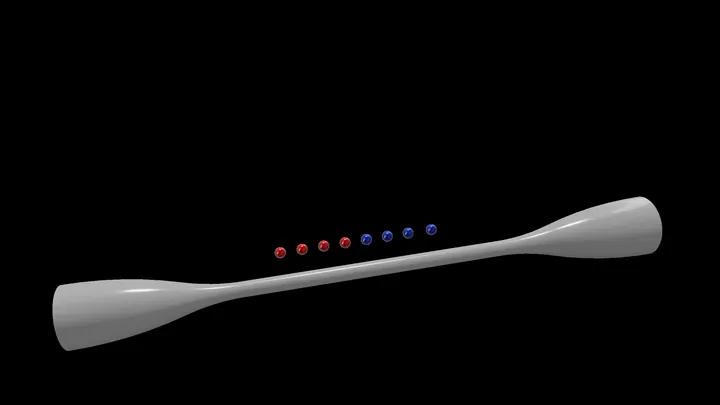
An orchestra without a conductor, where musicians hear each other through a shared wall. That's roughly how the new type of laser works: a few atoms (emitters) sit along a waveguide — a thin track for light on a chip. Light from each atom runs along this track and affects its neighbors.
A quantum computer is like an orchestra where every musician-qubit must play in perfect silence. But when you have many such orchestras that want to perform together, they need a reliable conductor-communicator.
A light bulb that shines not in a steady stream but in individual drops — photons. Such 'droplet' sources are called single-photon emitters. They are needed for quantum communication, where each photon carries a bit of information, and for ultra-precise measurements.
A conventional antenna array is like a choir: many voices singing in unison, with the sound amplified in only one direction. To catch a signal from another side, you have to rearrange the whole choir. Now imagine a single voice that can change its timbre so that the sound itself focuses in the desired direction.
A regular laser is a light amplifier in which atoms, after receiving energy, collectively emit waves of a single frequency. A maser does the same thing, but for microwaves — the invisible radiation that heats food in a microwave oven and carries signals in phones.
The tip of a scanning tunneling microscope approaches a crystal surface so closely that an electric current jumps between them. Electrons from the needle are injected into a layered semiconductor and land in an atomic vacancy — a spot where one atom is missing from the lattice. This void acts as a tiny trap for charge.
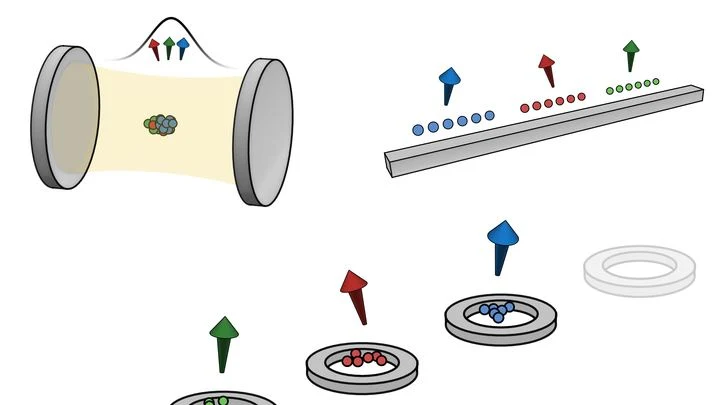
A hundred fireflies in a jar blink out of sync, but once they synchronize, their flashes merge into a bright pulse. Quantum emitters, individual atoms or artificial particles that can emit photons, behave in much the same way. When there are many of them and they interact, calculating their collective behavior is no easy task.
Light from many tiny emitters — atoms or artificial "quantum dots"—usually scatters in all directions, like a crowd where everyone shouts on their own. But if you make them "sing in chorus," the flash becomes many times brighter.
A single light source in a thin layer of boron nitride flashes on and off in a couple of nanoseconds. You can create many such sources in the material, but each one used to work on its own. In the new work, they were made to glow together, like musicians playing in unison.
Quantum devices usually live inside cryostats — giant thermoses where temperatures are colder than deep space. An erbium ion trapped in a tiny well on a silicon chip breaks that mold.
A drop of ink falls into a glass of water, and instead of a flat stain, a ring is born that immediately starts to spin. That's roughly what the birth of a skyrmion looks like: light emitted by a tiny source twists into a stable vortex. Until now, such vortices could only be produced by large lasers.
The laser clicks ten million times per second, and each click kicks exactly one photon out of a polystyrene film. Not a beam, not a burst, just a single particle of light, neatly packaged in space and time. The source is a molecule you can order from a chemical supply catalog: C60 fullerene, sixty carbon atoms folded into a soccer ball.