Quantum chip brings order to the colors of light express
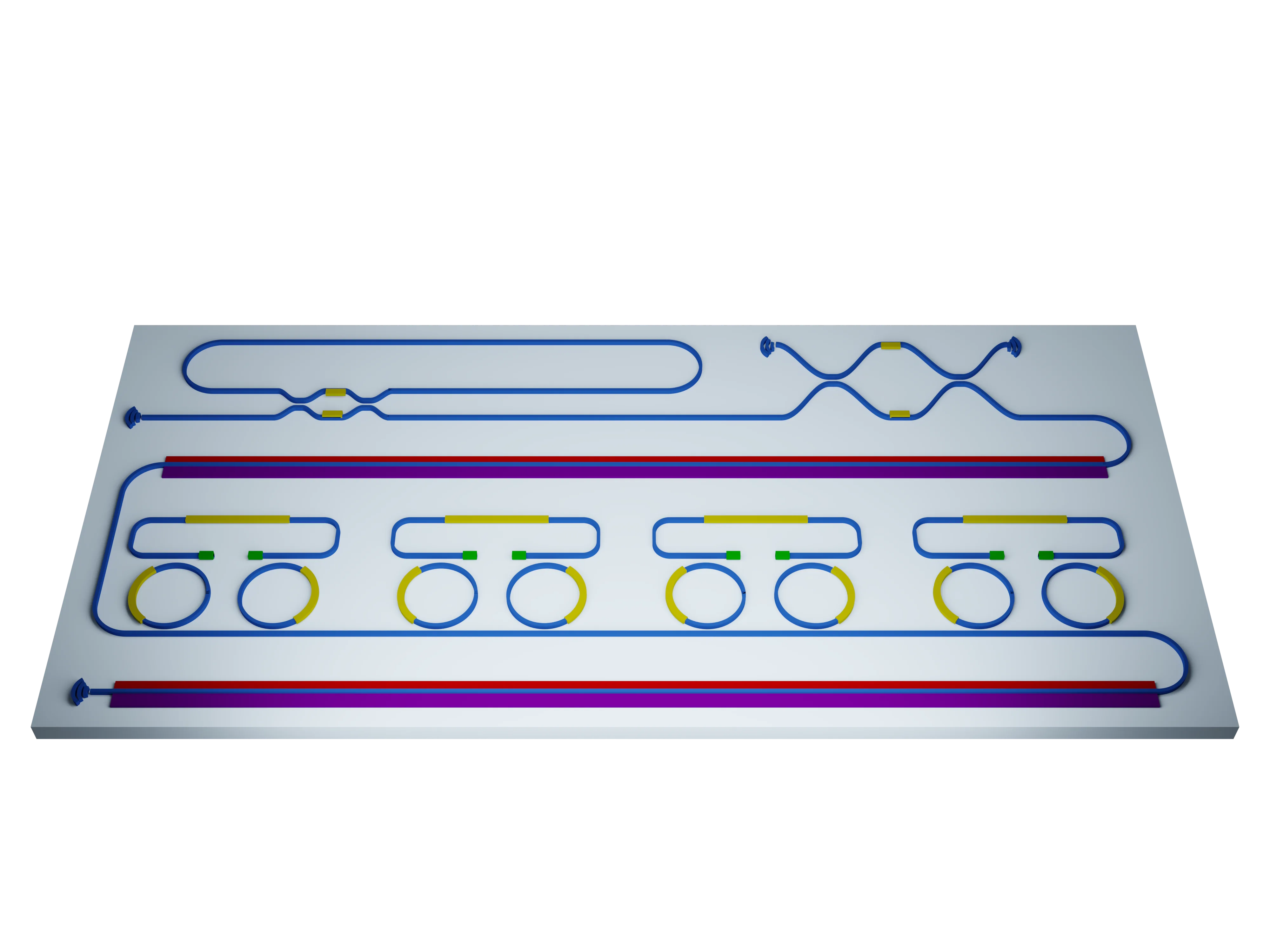
Quantum technologies often use light, but not just as a light bulb — rather as a carrier of information. One approach is to encode data in frequency: each 'color' of a photon can be a separate memory cell. The problem is that working with such color states requires a whole lab: a photon source, filters, modulators, detectors. All of that is bulky and inconvenient.
This new work, for the first time, brings all these instruments together on a single silicon chip measuring 4 by 7 millimeters. The chip itself generates pairs of photons that are linked by quantum entanglement, filters out unwanted light, changes frequencies, and measures the outcome. It's as if an orchestra, its conductor, and the concert hall all fit inside a matchbox.
The authors put the chip to the test: it acts as a switch between colors with accuracy above 99.9%, and it can also create more complex quantum gates. On the chip, they managed to produce an entangled state of two photons and measure it precisely, so-called tomography showed a fidelity of 95.7%. This means the chip isn't just performing tricks; it delivers predictable and repeatable results.
Such a chip is an important step toward practical quantum devices. It could become the foundation for quantum communications and computing that don't require bulky optical tables. Perhaps soon quantum processors will look like ordinary microchips rather than scientific apparatus.
A silicon chip the size of a fingernail replaced an optical table several meters long that is usually needed for such experiments.
In the series 'The Expanse', quantum communicators use entangled particles for instantaneous communication — chips like this could make such communication compact.