quantity

purity

The probability that a detected event corresponds to a true single photon, not multiple.
48 related articles

Description

In quantum optics, purity is a measure of how confidently a detected signal corresponds to a single photon rather than multiple photons arriving together. When a detector clicks, it could be because one photon arrived, or because two or more photons arrived simultaneously and triggered the same response. Purity quantifies the probability that the click was caused by exactly one photon. This matters because many quantum technologies — from secure communication to quantum computing — rely on single photons as information carriers. If a source emits multiple photons when you wanted one, the security or fidelity of the protocol degrades.

History

The concept of photon antibunching and the g²(0) criterion were introduced in the 1970s, with the first experimental demonstration of antibunching by H. Jeff Kimble, Mario Dagenais, and Leonard Mandel in 1977 using sodium atoms.

How it works

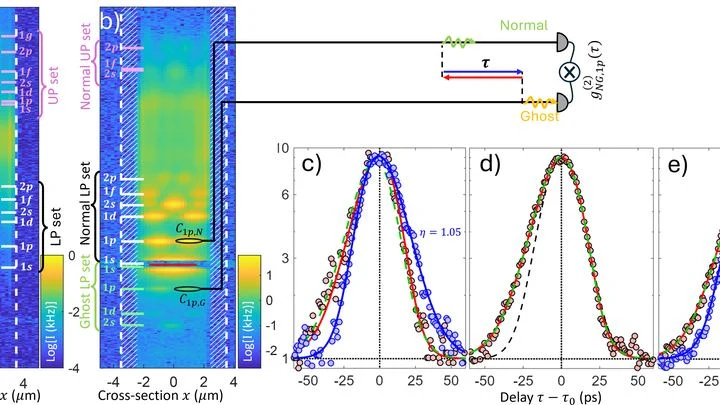
Purity is typically measured using correlation experiments, such as the Hanbury Brown–Twiss setup, where a beam is split and sent to two detectors. By measuring the rate of coincidences (both detectors clicking at the same time) versus single detections, one can extract the second-order correlation function g²(0). For an ideal single-photon source, g²(0) = 0, meaning no coincidences. In practice, a source is considered good if g²(0) is well below 0.5, which indicates that the probability of multi-photon events is low. The purity is then related to this value: the closer g²(0) is to zero, the higher the purity.

In practice

Purity is the key quality metric for single-photon sources used in quantum key distribution, quantum random number generation, and linear optical quantum computing.

Fun fact

A perfect single-photon source would have g²(0) = 0, but even the best current sources achieve values around 0.0001, meaning that out of ten thousand emissions, only one contains two photons.


Concept graph →

Related articles · 48

Light Flows Without Friction: Three Ways to Measure the Limit
In a Paris laboratory, light was made to flow around an obstacle the way water flows around a rock in a stream. But this water is special: it feels no friction.
Atomic Physics2026-08-162 minarXiv:2608.15637express
50 Rubidium Atoms on a Chip: A Conveyor Belt of Single Photons
A single photon is like a perfectly smooth brick from which quantum technologies can be built. But to build a house, you need thousands of identical bricks. Rubidium atoms are natural emitters: each atom emits photons of exactly one wavelength, like a tuning fork that always produces a single note.
Quantum Physics2026-07-312 minarXiv:2608.00162express
Quantum Pump: Light from the Void
An empty resonator isn't truly empty. Even in an absolute vacuum, where not a single photon exists, quantum fluctuations persist. They resemble ripples on water in a dead calm: the surface appears smooth, but molecules keep jittering. Physicists have learned to turn this jitter into real waves.
Quantum Physics2026-07-261 minarXiv:2607.23773express
How to Tell a Tangled Ball from a Thread
The quantum world is full of strange connections. Two particles can become “entangled”: the state of one instantly affects the other, even if they are kilometers apart. But how do you know if they are truly entangled? It's like a ball of yarn: at first glance, you can't tell whether it's a single tangled ball or just a mess of loose threads.
Quantum Physics2026-06-191 minarXiv:2606.21768express
Quantum Twins and the Secret of the Common Cause
Twins enter a room from different doors. Each gets a box with a button, and each time they press it, either a red or a green light flashes. If the twins are perfectly identical, you'd expect their lights to follow the same internal rules. But what if the rules differ even though the twins are exact copies? That's precisely the scenario the authors explored.
Quantum Physics2026-06-021 minarXiv:2606.03914express
Quantum Eraser Captures Two Pictures in One Snap
A single camera shot stores both a normal picture and a hidden map of how light rippled through the scene. Quantum entanglement makes this possible. Pairs of linked photons are generated: one visits the object, its twin takes a detour. Later, measuring the twin one way pulls out the brightness information.
Quantum Physics2026-05-313 minarXiv:2606.01341express
Counting Light to Ten Thousand
You're pouring water into a glass, but you want exactly one million drops — not approximately, but exactly. An ordinary faucet pours a stream where the number of drops always varies. In the quantum world, photons have the same problem: a laser emits light where the number of particles fluctuates like a crowd in a square.
Quantum Physics2026-05-211 minarXiv:2605.21942express
How to Create the Perfect Single Photon
A typical photon source can be likened to a club entrance with a single bouncer. He tries to let people in one at a time, but occasionally couples sneak past. Physicists call this the purity problem: photons must arrive strictly solo, otherwise quantum computing breaks down.
Quantum Physics2026-05-201 minarXiv:2605.21206express
How Motion Teaches a Detector to Distinguish Directions
An ordinary photometry detector can't tell a left photon from a right one. But let it start moving, and everything changes. Imagine a rower moving between two flutists playing the same note. His ear is perfectly tuned to that note and ignores all others. As he moves, the pitch from the flutist ahead sounds higher, and from the one behind sounds lower.
Quantum Physics2026-05-181 minarXiv:2605.18525express
Quantum Physics2026-05-173 minarXiv:2605.17418express
The Platypus Paradox: When Two Channels Beat One
Two simultaneous interpreters sit in the same booth. The first translates from English into Russian but swallows half the words. The second goes from Russian into French, and also loses half. If you put them together, you'd expect a mess: the losses would add up, and only a quarter of the meaning would reach the listener. But what if they start correcting each other?
Quantum Physics2026-05-111 minarXiv:2605.10077express
Lone Molecule Bridges Spin and Light
Quantum networks need a mediator between storage — spin — and carrier — light. No single molecule had ever pulled off such a feat. But now physicists have found a solution. They placed a carbene molecule into a crystal and cooled it to -269°C.
Quantum Physics2026-05-051 minarXiv:2605.04162express
A Light Chip as a Quantum Pinball Machine
A glass chip, threaded with 128 optical waveguides, has been turned into a kind of quantum pinball machine. The role of balls is played by photons — quanta of light, and instead of mechanical flippers, microheaters control the routes, instantly altering the optical paths.
Mesoscale2026-04-301 minarXiv:2604.27331express
Giant 'atom' brings order to the crystal
A big sticky ball thrown onto a dusty shelf bounces off and kicks up a cloud of dust, but if you roll it slowly, it picks up every bit. Rydberg excitons behave just like that — they're giant 'atoms' inside a crystal, named after Johannes Rydberg.
Quantum Physics2026-04-302 minarXiv:2604.27761express
Counting Light, Drop by Drop
An ordinary rain gauge collects water in a bucket and shows the total volume of precipitation. But the new device is like a sensitive palm that feels every falling drop and keeps count, even when the drops number in the thousands. That's exactly what physicists have built.
Quantum Physics2026-04-281 minarXiv:2604.25615express
Two Photon Factories Strike a Chord in Unison
Two musicians in separate rooms play the same note. The sound must be so identical that a listener can't tell who is playing. In the quantum world, these musicians are single-photon sources — particles of light that must be indistinguishable from one another.
Quantum Physics2026-04-141 minarXiv:2604.13158express
Five Helpers Speed Up Quantum Counting
A neutral-atom quantum computer is like a library where books not only need to be read but also quickly returned to the shelf. Slow readout of results is like a sluggish librarian holding up the entire queue. Scientists have found a way to speed up this process by adding helpers.
Quantum Physics2026-04-071 minarXiv:2604.05422express
Loss Creates Order: The Quantum Dance of Photons
Two pendulums on a stable table swing independently. If you place them on a shaky surface, vibrations synchronize their motion. The same principle worked on a silicon chip with photons. Scientists created two sources of light that emit pairs of particles.
Quantum Physics2026-04-061 minarXiv:2604.04691express
One Photon Checks Five
A security guard needs to check five rooms but can't go inside. He knocks on the door and listens: silence means someone is inside, while an echo means the room is empty.
Quantum Physics2026-03-302 minarXiv:2603.28433express
Quantum Imprint in Light
The light an atom emits is not just a flash. It carries an imprint of the atom's state at the moment of emission. Physicists took a superconducting qubit, an artificial atom the size of a microchip, and made it glow into an open waveguide, like a bulb in a long corridor.
Mesoscale2026-03-271 minarXiv:2603.26651express
Single photons at 2.5 billion per second
Light in an optical fiber is a stream of photons, and quantum communication requires single photons that can be sent one at a time. But making them emerge quickly while remaining indistinguishable from one another is a tough challenge.
Quantum Physics2026-03-211 minarXiv:2603.20813express
Entangled Photons from a Quantum Dot
A quantum dot the size of a virus, squeezed between mirrors, gives birth to two photons in a short flash of light. These photons fly out as a pair, and their polarizations, the directions of wave oscillation, are linked such that knowing one instantly tells you the other.
Quantum Physics2026-03-152 minarXiv:2603.14201express
The Light That Gives Away Symmetry
In a dark room, an atom and light are locked together in a mirrored box. The box is so small that the atom cannot simply release light: they constantly exchange energy, like two dancers who never let go of each other's hands.
Quantum Physics2026-03-081 minarXiv:2603.07538express
A Click Before Its Time
In quantum communication, a secret key is transmitted using single photons. Eavesdropping on such a channel is supposedly impossible: any interception attempt disturbs the particle and leaves a trace. But the idea has a weak spot — the real hardware, which sometimes behaves differently than theory dictates.
Quantum Physics2026-02-282 minarXiv:2603.00401express
Randomness Without Trust
A coin toss seems random, but in reality, physics decides everything: the force of the throw, air resistance, the surface's elasticity. If you knew all the details, you could predict the outcome. True randomness lives deeper — in the quantum world.
Mesoscale2026-02-271 minarXiv:2602.23931express
Light from an Atomic Gap
The tip of a scanning tunneling microscope approaches a crystal surface so closely that an electric current jumps between them. Electrons from the needle are injected into a layered semiconductor and land in an atomic vacancy — a spot where one atom is missing from the lattice. This void acts as a tiny trap for charge.
Quantum Physics2026-02-201 minarXiv:2602.18096express
A Point in a Crystal That Lights Up on Command
Inside a boron nitride crystal, defects sometimes occur — places where atoms are knocked out or sit where they shouldn't. One such defect, the B-center, can emit light: it absorbs energy and releases it as a single photon. It's like a tiny light bulb that only lights up when asked, without any stray glow.
Quantum Physics2026-02-151 minarXiv:2602.14240express
Quantum chip brings order to the colors of light
Quantum technologies often use light, but not just as a light bulb — rather as a carrier of information. One approach is to encode data in frequency: each 'color' of a photon can be a separate memory cell. The problem is that working with such color states requires a whole lab: a photon source, filters, modulators, detectors.
Mesoscale2026-02-112 minarXiv:2602.11385express
The Dark State of a Quantum Dot Turns Out to Be Cleaner Than the Bright One
A quantum dot the size of a few thousand atoms blinks like a faulty light bulb. It flashes brightly, then almost goes dark. Previously, it was thought that in dark moments it emits not only single photons but also extra pairs — a defect for quantum communication.
Quantum Physics2026-02-101 minarXiv:2602.10317express
Twin Photons for Quantum Networks
Two photons fly out of a tiny box, and behave like twins who always wear matching outfits. Turn one, and the other instantly turns the same way, even if they are kilometers apart. This is no magic trick but quantum entanglement: a connection between particles that defies distance. Researchers have built a compact source of such pairs.
Optics2026-02-041 minarXiv:2602.04505express
A microscope hunts for single photons
Imagine a vast field of fireflies, each flashing alone rather than in a swarm: that's what the new automated setup is hunting for. It sweeps a laser across the sample like a flashlight and records the color and brightness of the glow at every spot.
Quantum Physics2026-02-041 minarXiv:2602.04646express
Single Photons from an Optical Cavity
A laser pulse enters a tiny cavity made of a transparent crystal. Inside, light bounces between mirrors, and occasionally one photon splits into a pair: one goes one way, the other goes another. One becomes the signal, and the other acts as a 'bell' announcing that a single photon is ready.
Quantum Physics2026-01-232 minarXiv:2601.16875express
An ion in a trap weaves a pair of entangled photons
A single calcium ion hovers in a vacuum trap, held by electric fields like a pea in an invisible bowl. Around it are two mirrors forming an optical cavity: light bounces between them, amplifying the interaction with the ion.
Quantum Physics2026-01-201 minarXiv:2601.13617express
Quantum Light for Satellites
A light beam sent from Earth to a satellite scatters in the atmosphere, like a flashlight in fog. To keep the signal intact, you need short-wavelength light that spreads less. Such light is born in special crystals, but shrinking them to chip size is tough.
Quantum Physics2026-01-201 minarXiv:2601.13869express
A Dimmer as a Tool for Unveiling the Quantum Nature of Light
Light, regardless of its source, consists of photons — elementary particles, quanta of the electromagnetic field. The simplest light detector, such as a photometric illuminance meter, operates in a binary mode: it merely registers whether photons hit it or not, giving a 'yes/no' answer.
Quantum Physics2026-01-191 minarXiv:2601.13420express
Atom in a Mirror Trap: A Step Toward the Quantum Internet
A grain-of-sand-sized device: a tiny mirror-dish holds a single rubidium atom and collects the glow it emits under a laser beam. The trapped light particles are sent into an optical fiber — the whole setup is precise and stays aligned even when shaken.
Quantum Physics2026-01-122 minarXiv:2601.07678express
Photons Entangled in Time
A light pulse can be sliced into short time bins, like a train into carriages. If two photons are born together and their carriages are tightly linked, the arrival of one in a specific bin guarantees that the other arrives in the paired bin, this connection is called time-bin entanglement.
Quantum Gases2026-01-102 minarXiv:2601.06468express
Twin Photons in a Light Cavity
Inside a tiny mirrored cavity, smaller than the thickness of a hair, light is trapped and bounces off the walls many times. If you place a material that can absorb and emit light inside, the light particles (photons) start to 'dress' in excitations of the material — this is how polariton modes are born.
Quantum Physics2026-01-022 minarXiv:2601.00966express
Four Photons in One Spot
Light from a single source can be made to 'meet' itself, and then fringes appear on the screen, like ripples from two pebbles dropped into water. Physicists have long known how to do this with two photons, but making four particles of light merge at once was tricky: single-photon sources lost too many particles along the way.
Quantum Physics2025-12-211 minarXiv:2512.18801express
Universal AI Key to Light States
Usually, to understand a quantum state of light, you need to perform dozens of complex measurements, like trying all the keys on a keychain. The new AI model works differently: it's a universal key that, after a slight adjustment, opens many 'locks'—simple and the most tricky states.