A single-photon source is a device that emits light one quantum at a time, on demand. Unlike a laser or an LED, which produce a continuous stream or a coherent beam of many photons, a single-photon source delivers exactly one photon per trigger pulse. This is a fundamental requirement for quantum optics experiments and quantum information technologies, where individual photons serve as carriers of quantum bits (qubits) or as probes for fundamental tests of quantum mechanics.
History
The concept emerged in the 1980s with experiments on single atoms in cavities. The first solid-state single-photon sources based on single molecules were demonstrated in the late 1990s, followed by quantum dots in the early 2000s.
How it works
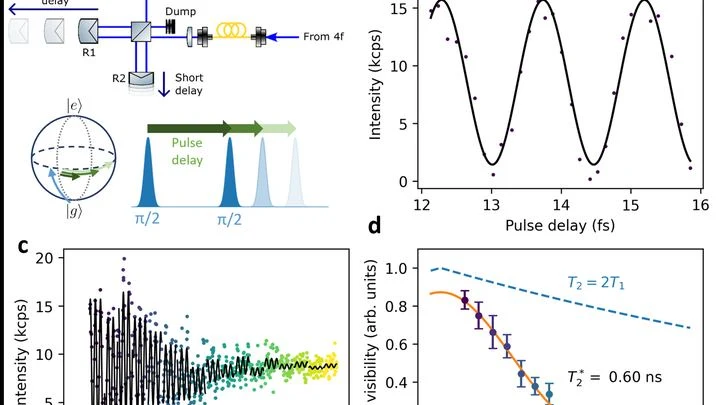
The key is to create a system that can be excited to a higher energy state and then relax by emitting exactly one photon, after which it must be reset before it can emit again. Common implementations use a single quantum emitter, such as an atom, ion, or a defect in a crystal (like a nitrogen-vacancy center in diamond), or a quantum dot. The emitter is placed inside an optical cavity that enhances the emission into a specific mode, making the process efficient and directional. The 'single-photon' nature is guaranteed by the fact that the emitter can only be in one excited state at a time, so it can only emit one photon per excitation cycle.
The Sun itself can act as a single-photon source when its light is filtered to extremely low intensity, as demonstrated in experiments that used sunlight to create quantum entanglement.
An assembly line spits out parts one by one per cycle. If the cycle is short and defects are few, the line runs fast. In quantum optics, a single-photon source plays the role of such a line: it must emit exactly one quantum of light per cycle, and the more cycles per second, the more photons go into the fiber.
An assembly line spits out parts one by one per cycle. If the cycle is short and defects are few, the line runs fast. In quantum optics, a single-photon source plays the role of such a line: it must emit exactly one quantum of light per cycle, and the more cycles per second, the more photons go into the fiber.
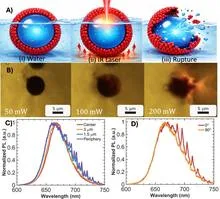
A tiny capsule, like a soap bubble but with a shell of glowing crystals, behaves like a laser. While its wall is intact, light circulates, amplifies, and escapes as a narrow, bright beam. Once the wall bursts, the beam turns into a dim spot. Such a capsule is a colloidosome, and it can change its glow on command.
A courtroom interpreter must relay every word without being distracted by noise in the room. In the quantum world, a superconducting resonator plays that role, losing photons on schedule without straying into spurious effects.
Light passing by a tiny structure changes direction. If the structure is smaller than the wavelength of the light, it acts like a lens and focuses the light into a spot smaller than the wave itself.
When a laser beam hits a gas, it tears electrons from atoms and accelerates them to nearly the speed of light. As these electrons fly through the plasma, they emit X-rays, like a glowing trail from a fast particle. In the new work, physicists made a single laser pulse create not one but two such trails in succession.
A single photon is like a perfectly smooth brick from which quantum technologies can be built. But to build a house, you need thousands of identical bricks. Rubidium atoms are natural emitters: each atom emits photons of exactly one wavelength, like a tuning fork that always produces a single note.
Two pebbles drop into water at a distance. The waves from them run toward each other and at certain spots they cancel out — the water becomes smooth, even though each stone alone would create ripples. Much the same happens with a pair of photons (light particles) born in a single crystal and flying off in different directions.
An empty resonator isn't truly empty. Even in an absolute vacuum, where not a single photon exists, quantum fluctuations persist. They resemble ripples on water in a dead calm: the surface appears smooth, but molecules keep jittering. Physicists have learned to turn this jitter into real waves.
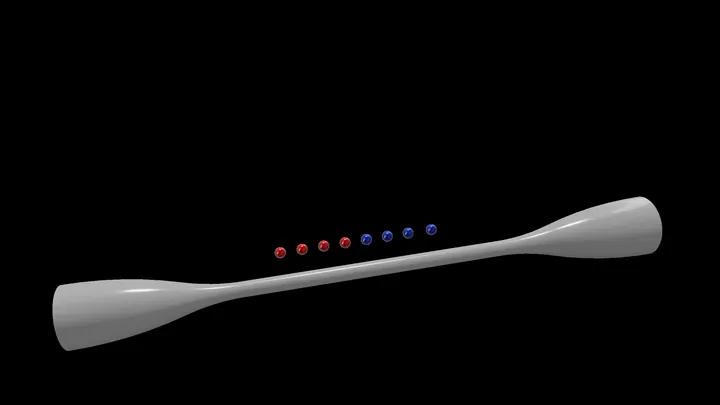
An orchestra without a conductor, where musicians hear each other through a shared wall. That's roughly how the new type of laser works: a few atoms (emitters) sit along a waveguide — a thin track for light on a chip. Light from each atom runs along this track and affects its neighbors.
A living cell constantly emits faint magnetic signals, as if whispering. Scientists eavesdrop on this whisper with two microscopic 'microphones'—magnetic field sensors.
A laser isn't just about light. If you make a particle oscillate like a pendulum and those oscillations sustain themselves, you get a phonon laser. Sounds complicated, but the idea is simple: instead of light waves, the device emits orderly waves of mechanical vibrations — phonons.
A typical photon source can be likened to a club entrance with a single bouncer. He tries to let people in one at a time, but occasionally couples sneak past. Physicists call this the purity problem: photons must arrive strictly solo, otherwise quantum computing breaks down.
Light can be more than just a beam: it can be a precision ruler. If you take very short pulses, shorter than a fly's wingbeat, and fire them one after another, you get an optical comb: a set of colors spaced at exactly equal intervals, like the teeth of a comb. This rainbow lets you measure distances, time, and the composition of materials with unimaginable accuracy.
An orchestra where every musician plays their own part, yet together they weave a complex melody: that's what a cloud of atoms looks like when their spins (intrinsic rotations, like tiny tops) oscillate in sync. Usually, these tops behave independently.
A quantum computer is like an orchestra where every musician-qubit must play in perfect silence. But when you have many such orchestras that want to perform together, they need a reliable conductor-communicator.
Quantum networks need a mediator between storage — spin — and carrier — light. No single molecule had ever pulled off such a feat. But now physicists have found a solution. They placed a carbene molecule into a crystal and cooled it to -269°C.
Before assembling a huge puzzle, you need to stamp out the pieces — otherwise the picture won't come together. In fusion-based quantum computers, the role of such pieces is played by tiny clumps of light — photonic resource states. They are collided and measured to gradually grow the computational fabric.
A glass chip, threaded with 128 optical waveguides, has been turned into a kind of quantum pinball machine. The role of balls is played by photons — quanta of light, and instead of mechanical flippers, microheaters control the routes, instantly altering the optical paths.
Two musicians in separate rooms play the same note. The sound must be so identical that a listener can't tell who is playing. In the quantum world, these musicians are single-photon sources — particles of light that must be indistinguishable from one another.
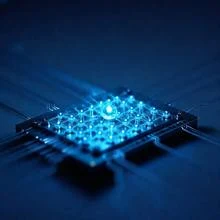
Tiny semiconductor islands grown right on silicon fire off single photons, like a machine gun that shoots exactly one bullet at a time. These islands are called quantum dots. They can emit light in discrete packets, which is needed for secure information in quantum networks.
A typical computer shuttles electricity along copper traces, and every operation is a queue: first one thing, then another. Light works differently. In a single beam, you can mix dozens of signals without them interfering, like different voices in a choir, singing at once but each heard distinctly.
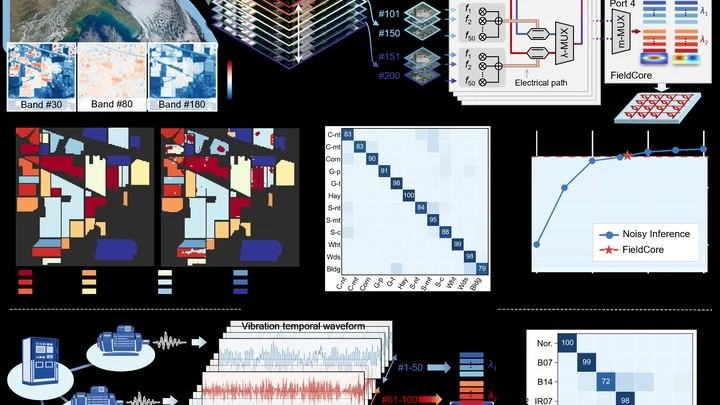
The new FieldCore chip uses five such "voices" at once.
An ordinary camera flash lasts thousandths of a second. An attosecond pulse is a trillion times shorter — in the time it takes, light travels a distance smaller than the size of an atom. Such flashes act as an ultra-high-speed shutter: they freeze the motion of electrons, letting us see them jump between orbitals or take part in a chemical reaction.
A light bulb that shines not in a steady stream but in individual drops — photons. Such 'droplet' sources are called single-photon emitters. They are needed for quantum communication, where each photon carries a bit of information, and for ultra-precise measurements.
An ordinary camera flash lingers for hundredths of a second, but for atoms, that's an eternity. Inside molecules, electrons jump in attoseconds: billionths of a billionth of a second. To capture that, you need a light pulse shorter than the event itself.
Physicists take an electron beam in a linear accelerator and compress it so that individual bunches become thinner than a hair — in time.
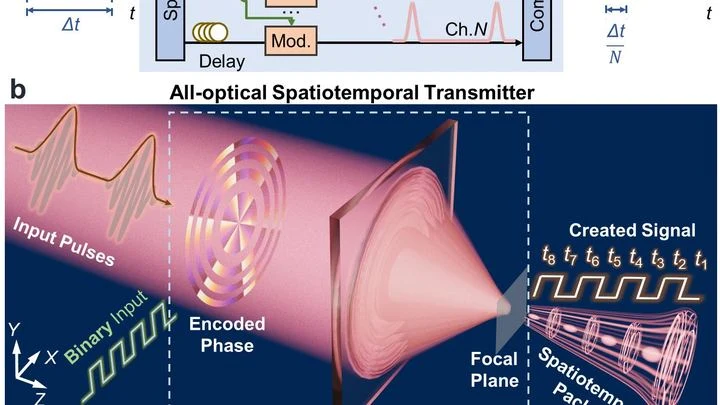
Light can carry information faster than any electronics. But usually, between a computer and a laser sits a digital-to-analog converter — a device that turns zeros and ones into electrical signals. It's the bottleneck.
The new transmitter does away with this middleman.
The light an atom emits is not just a flash. It carries an imprint of the atom's state at the moment of emission. Physicists took a superconducting qubit, an artificial atom the size of a microchip, and made it glow into an open waveguide, like a bulb in a long corridor.
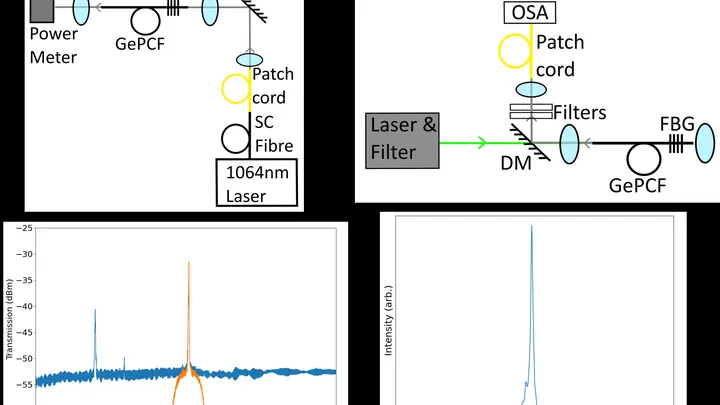
Two laser beams of different colors strike a crystal, and inside it, triplets of light particles are occasionally born, like three coins popping out of the same vending machine slot. For the first time, this process has been made efficient enough: 11.6 triplets per second.
The beams were green and invisible infrared.
A quantum computer is like an orchestra, where each qubit is a musician playing their part. But every now and then, a cosmic ray bursts into the hall, and the violinist flinches, losing the rhythm. These particles from deep space pierce the chip, knock out extra electrons, and spoil the delicate quantum music.
An ordinary lamp scatters light in all directions, and it is impossible to predict when the next photon will fly out. Quantum technologies, however, need a completely different kind of light — single photons that appear strictly one at a time, like letters slipping through a mail slot.
In quantum communication, a secret key is transmitted using single photons. Eavesdropping on such a channel is supposedly impossible: any interception attempt disturbs the particle and leaves a trace. But the idea has a weak spot — the real hardware, which sometimes behaves differently than theory dictates.
The tip of a scanning tunneling microscope approaches a crystal surface so closely that an electric current jumps between them. Electrons from the needle are injected into a layered semiconductor and land in an atomic vacancy — a spot where one atom is missing from the lattice. This void acts as a tiny trap for charge.
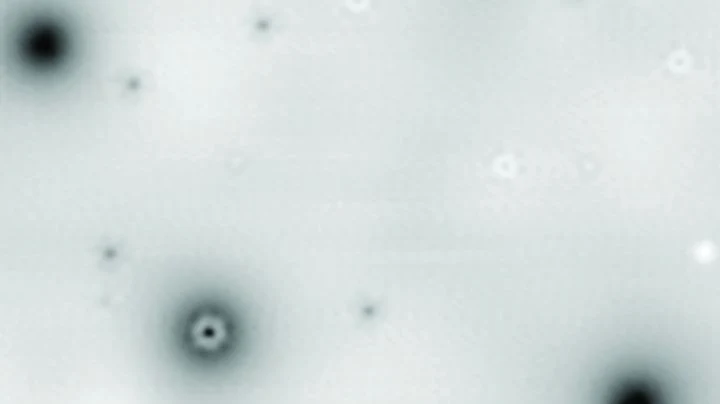
Glowing spots on a dark background: that's what single-molecule images from MINFLUX look like. This microscope can reveal details smaller than five nanometers: roughly ten thousand times thinner than a human hair.
Inside a boron nitride crystal, defects sometimes occur — places where atoms are knocked out or sit where they shouldn't. One such defect, the B-center, can emit light: it absorbs energy and releases it as a single photon. It's like a tiny light bulb that only lights up when asked, without any stray glow.
A regular laser is like a choir where everyone sings their own part — the sound is loud, but with inevitable roughness. In the new quantum laser, the singers hear each other and harmonize their voices.
Quantum technologies often use light, but not just as a light bulb — rather as a carrier of information. One approach is to encode data in frequency: each 'color' of a photon can be a separate memory cell. The problem is that working with such color states requires a whole lab: a photon source, filters, modulators, detectors.
A quantum dot the size of a few thousand atoms blinks like a faulty light bulb. It flashes brightly, then almost goes dark. Previously, it was thought that in dark moments it emits not only single photons but also extra pairs — a defect for quantum communication.
Ordinary messages can be intercepted without anyone noticing. Physicists have come up with a way to create a shared secret that instantly breaks if someone so much as glances at it. Instead of paper, they use single particles of light. This quantum communication exploits a rule: any measurement changes a quantum object.
Light from tiny perovskite crystals is like a choir performance, where voices sound sometimes solo, sometimes in a tight duet. Previously, such a duet could only be heard under extreme cooling, nearly to the chill of outer space. Now the choir sings at room temperature.
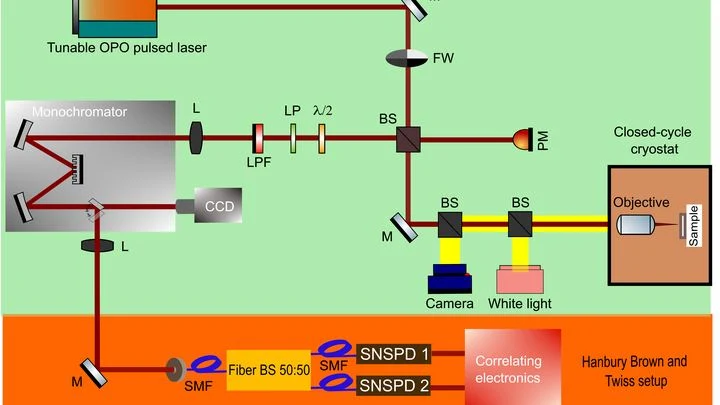
Imagine a vast field of fireflies, each flashing alone rather than in a swarm: that's what the new automated setup is hunting for. It sweeps a laser across the sample like a flashlight and records the color and brightness of the glow at every spot.