A modulator is a device that alters one or more properties of a light beam—such as its intensity, phase, polarization, or direction—in response to an electrical signal. This allows information to be encoded onto light for transmission or measurement. Modulators are essential in optical communication, where they convert electrical data into optical signals, and in scientific instruments like lidar and laser displays.
History
The first practical electro-optic modulators were developed in the 1960s, following the discovery of the linear electro-optic effect in crystals like potassium dihydrogen phosphate (KDP). The development of integrated optical modulators on silicon chips accelerated in the 2000s.
How it works
Most modulators rely on materials whose optical properties change when an electric field is applied. In an electro-optic modulator, the refractive index of a crystal (like lithium niobate) changes with voltage, altering the phase of light passing through. By placing the crystal in an interferometer, phase changes can be converted into intensity changes. Another common type is the acousto-optic modulator, which uses sound waves to create a diffraction grating that deflects or shifts the frequency of light.
In practice
Modulators are used in fiber-optic networks to encode data at speeds up to hundreds of gigabits per second, in laser printers to control beam intensity, and in quantum optics experiments to manipulate photon states.
Fun fact
Some modulators can operate at speeds exceeding 100 gigahertz, fast enough to encode a high-definition movie in a fraction of a millisecond.
Light in an optical fiber is like a stream: it flows inside a glass thread and doesn't spill out. A thick thread carries many streams at once, a thin one only one. Astronomers often need to pour light from a thick fiber into several thin ones to split it into colors.
A regular laser beam travels straight, like the light from a flashlight. But light can be twisted into a spiral, like the thread of a corkscrew. Such a beam carries orbital angular momentum: it doesn't just illuminate, it also spins anything it encounters.
Usually, light does not turn an insulator into a conductor: that requires powerful laser pulses that break the material's structure. But in twisted bilayer graphene at the magic angle, things are different.
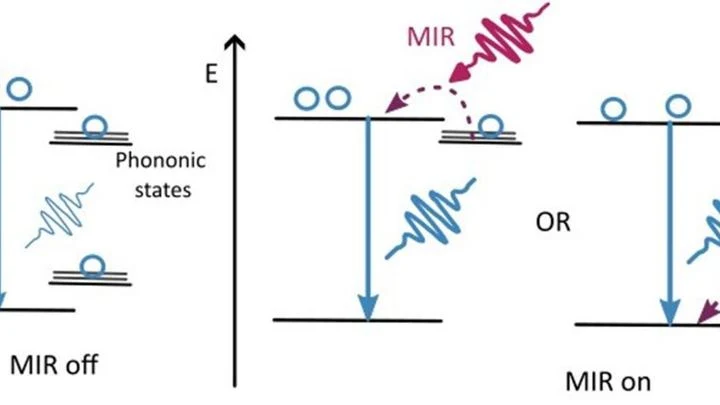
A guitar string is stretched between two mirrors. A beam of light bounces back and forth between them, and the string shudders at every touch. Sometimes the light loses energy — the string takes it and dissipates it as heat, like a fading sound. Other times, the string shifts the pitch of the light itself, changing its color but barely dimming it.
An ordinary photometry detector can't tell a left photon from a right one. But let it start moving, and everything changes.
Imagine a rower moving between two flutists playing the same note. His ear is perfectly tuned to that note and ignores all others. As he moves, the pitch from the flutist ahead sounds higher, and from the one behind sounds lower.
Heat flows through matter like water through pipes: sometimes fast, sometimes barely. Engineers seek materials that almost don't let heat pass — like clogged pipes. Such insulators are vital for energy saving and devices that turn heat into electricity. The neural network KappaFormer quickly evaluates the "throughput" of an atomic structure.
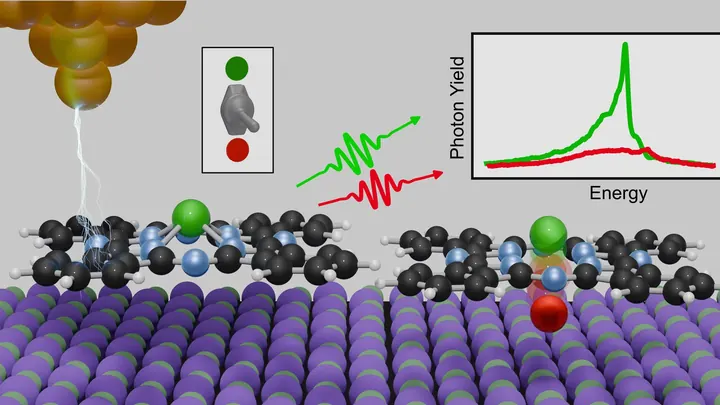
In a molecule resembling chlorophyll and built from carbon, a metal atom at the center acts as a toggle. Shifting it by fractions of a nanometer can make the molecule glow, quench, or boost its brightness a hundredfold.
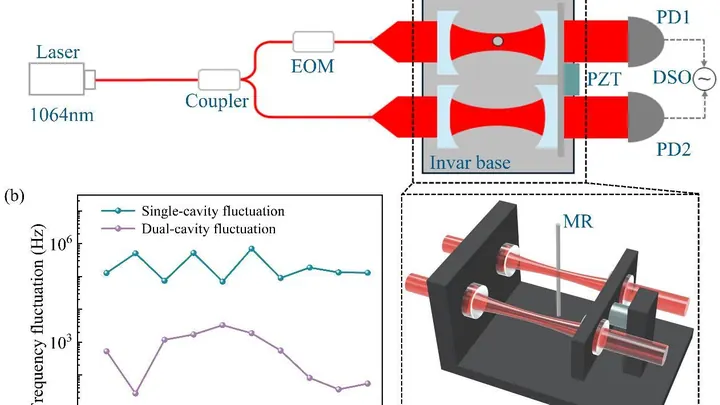
A steady laser beam is like a taut string: if it vibrates even a little, the music turns into cacophony. In a quantum computer, the laser holds atoms in a trap, and any frequency jitter ruins the computation. That's why laser setups used to occupy entire tables, and tuning took weeks.
A typical accelerator is like an assembly line where electrons are the workpieces. To get the desired X-ray pulse, the workpiece is fine-tuned after it's already on the line: squeezed, filtered, corrected. In the new work, engineers decided to take a different approach — shaping the workpiece before it even hits the conveyor.
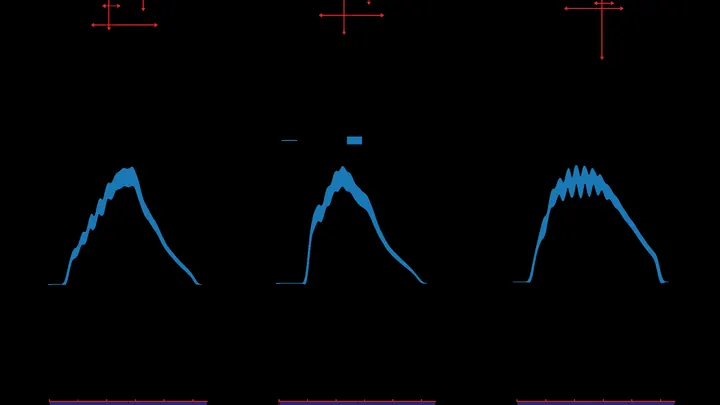
At LCLS-II, electrons are knocked out of a metal by a short laser pulse.
A green flashlight beam dives into a pool and reaches the bottom with barely any loss. Water is transparent to green light, which is why it's used for underwater communication. But to send video or sensor data, the light needs to be switched on and off very quickly — billions of times per second. Ordinary lasers are too slow and unstable for this.
A glowing spot on a crystal is like a firefly that you can wake not only with a flashlight but also with the warmth of your palm. Such spots, single-photon sources, can emit light one particle at a time, which is essential for quantum communication and computing.
A glowing dot the size of a molecule. Run a current through it, and it flashes like a tiny lightbulb. That's what the experiment with dye molecules on a thin salt film looks like.
When current enters a molecule, one electron hands it energy. The molecule immediately gives that energy back, as light. It's like a swing: give it one push, and it rocks and then stills.
Light passing through a thin crystal can change color and the direction of its oscillations. In a molybdenum disulfide flake just hundreds of atoms thick, an infrared beam turns green, and its polarization, the way the light wave oscillates, obeys the crystal's geometry.
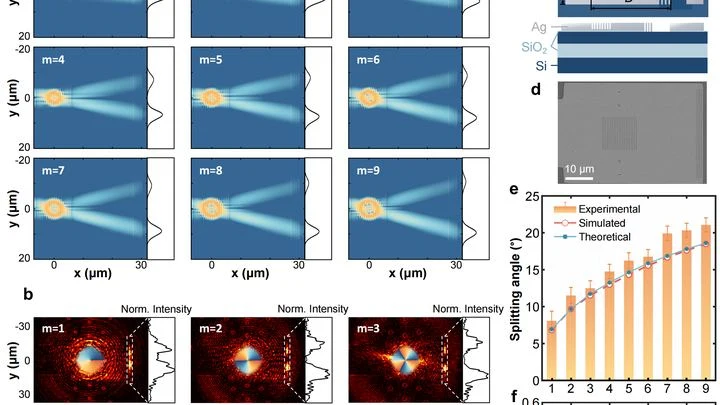
A light beam passing through a piece of glass usually just bends slightly. But if you engrave ultra-fine patterns inside the glass with a laser, you can make the light split into separate beams, much like white light fans out into a rainbow after rain.
A tiny vanadium oxide particle behaves like a window with adjustable transparency: in one state it lets infrared light through, and in another it starts absorbing it. The switch doesn't happen abruptly but smoothly, like turning a dimmer knob to adjust a lamp's brightness.
A silicon wafer is like cookie dough. Heat it in an oven, and tiny raisins appear inside — defects in the crystal lattice that can emit single photons. These "raisins" are called color centers, and they are needed for quantum computers and secure communication.
Light doesn't always travel in a straight line. Its wave can be twisted into a spiral, like a stream of water from a rapidly rotating hose. This twist is called orbital angular momentum, and it can hide information: each turn acts as a separate communication channel. The problem was that only bulky setups of lenses and mirrors could recognize these twists.
Light is like a many-voiced choir: color, direction of oscillation, and instantaneous changes all intertwine. An ordinary camera hears only one voice, while the rest are lost. Scientists have built a camera that listens to the entire choir at once, and from a single image understands what is happening.
In the air of factory floors and laboratories, invisible solvent molecules drift. One of them, acetonitrile, has a faint smell, but at high concentrations it can harm health. Typical sensors for it are bulky and expensive, but here we have a thin crystalline film that responds on its own to the presence of vapor.
Two voices in a molecular duet can sound in unison or cancel each other into silence. In physics, such silence is called a dark state: a quantum excitation that does not interact with light and therefore lives unusually long.