Lonely Dwarfs: How Astronomers Found 44 Isolated Galaxies express
A population census, but instead of houses (galaxies, and instead of residents) stars. Astronomers set out to count the smallest and faintest "homesteads" in our cosmic neighborhood: dwarf galaxies. They are thousands of times fainter than the Milky Way, and spotting them in images is as hard as picking out a firefly in front of a spotlight.
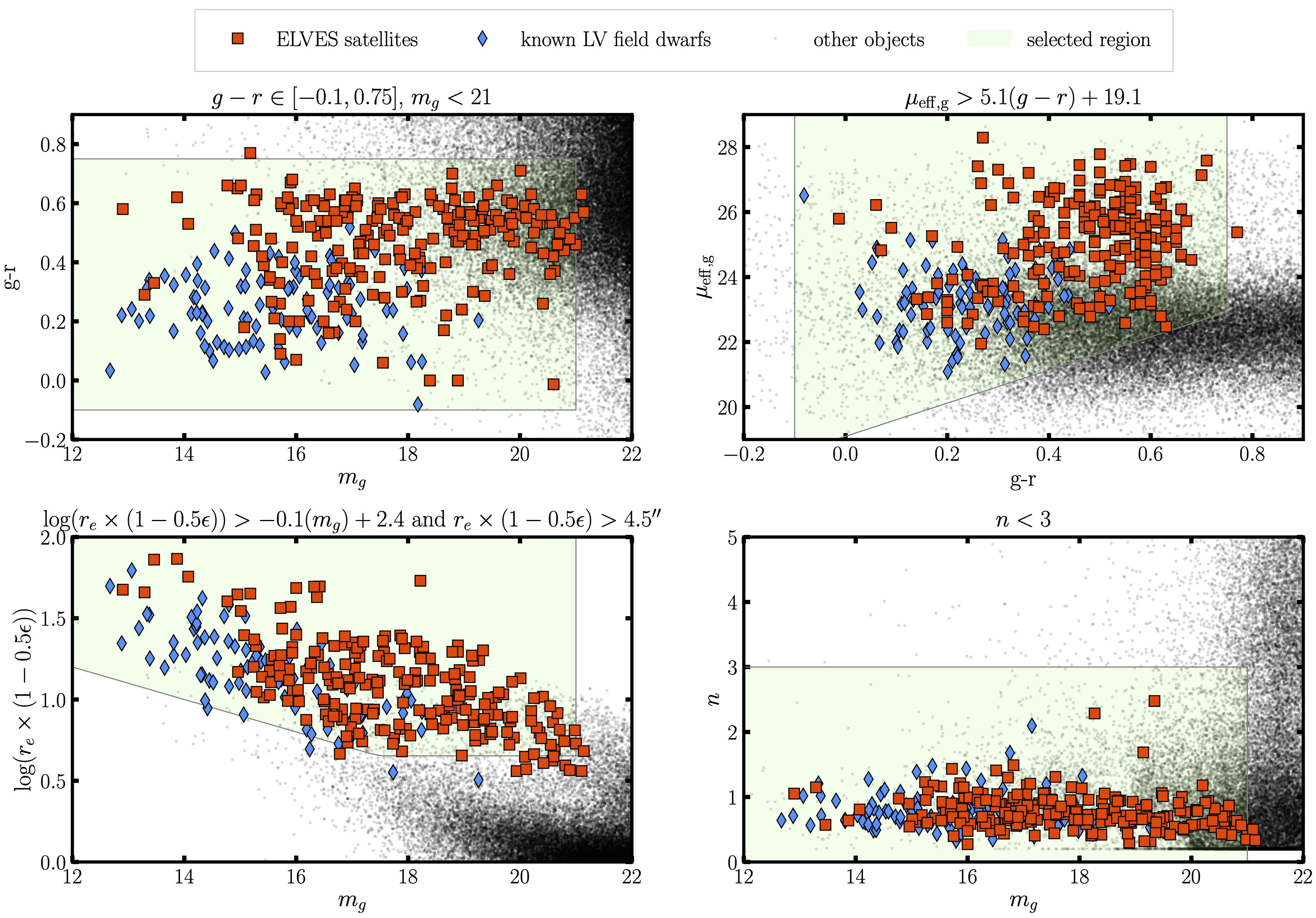
For the search, they used a special algorithm that scans images for barely visible clumps of light. To test how well it works, they artificially added fake galaxies to the images and checked how many the algorithm could detect. It turned out to reliably find half of the dwarfs with a mass of about a million suns, like finding a person of below-average height in a crowd if they're standing in a dark corner.
But it's not enough to spot a faint smudge: you need to confirm it's truly a nearby dwarf galaxy, not a distant bright object that only appears faint. To do this, distances were measured in three ways: by redshift (how fast the galaxy is receding), by the brightness of its oldest stars, and by characteristic fluctuations in surface brightness. In the end, they confirmed 95 genuine dwarfs within 30 million light-years of us.
The most interesting finding concerns the loners. Of the 95 galaxies, 44 turned out to be completely isolated — with no large neighbor for millions of light-years around. That's a rare stroke of luck: previously, such objects were found one at a time, but now there's a whole collection. By comparing their masses, astronomers built a "population census" of dwarfs and found that in the high-mass range it matches the predictions of the IllustrisTNG computer model of the universe remarkably well. This means our understanding of how small galaxies are born and live is essentially correct.
Now these lonely dwarfs will serve as a testing ground for theories: how the absence of neighbors affects star formation, shape, and the fate of a galaxy. Because even in space, loneliness changes a lot.
Original abstract
as written by the authors arXiv:2602.16766
We present the results of the Exploration of Local VolumE Survey - Field (ELVES-Field), a survey of the dwarf galaxies in the Local Volume (LV; $$D<10$$ Mpc) over roughly $$3,000$$ square degrees, focusing on the field dwarf population. Candidates are detected using a semi-automated algorithm tailored for low surface brightness dwarfs. Using tests with injected galaxies, we show the detection is $$50\%$$ complete to $$m_g\sim20$$ mag and $$M_\star \sim 10^6$$ $$M_\odot$$. Candidates are confirmed to be true nearby dwarfs through distance measurements including redshift, tip of the red giant branch, and surface brightness fluctuations. We identify isolated, field dwarfs using various environmental criteria. Over the survey footprint, we detect and confirm 95 LV dwarfs, 44 of which we consider isolated. Using this sample, we infer the field dwarf mass function and find good agreement at the high-mass end with previous redshift surveys and with the predictions of the IllustrisTNG simulation. This sample of isolated, field dwarfs represents a powerful dataset to investigate aspects of small-scale structure and the effect of environment on dwarf galaxy evolution.
The faintest galaxy found shines less brightly than a single giant star in the Milky Way, yet it contains millions of stars.
In Isaac Asimov's novel "The Gods Themselves," isolated worlds become the key to interstellar communication — somewhat like how lonely dwarfs help us understand the structure of the universe.