Surface brightness is a measure of how much light an astronomical object emits per unit area of its apparent size on the sky. Unlike total brightness (luminosity), which depends on both the object's intrinsic brightness and its distance, surface brightness is largely independent of distance. This makes it a crucial tool for studying faint, extended structures like galaxy halos, nebulae, and the diffuse glow of cosmic backgrounds.
History
The concept was formalized in the early 20th century as astronomers began to systematically catalog nebulae and galaxies. It became a standard tool in extragalactic astronomy with the work of Edwin Hubble and others in the 1920s and 1930s.
How it works
Surface brightness is calculated by dividing the total flux of an object by its angular area. In practice, astronomers measure it in units like magnitudes per square arcsecond. Because the light from a distant galaxy spreads over a larger area as distance increases, the total flux decreases, but the surface brightness remains constant—this is the 'distance independence' that makes it so useful.
In practice
Surface brightness is used to map the faint outskirts of galaxies, detect tidal streams from galactic mergers, and calibrate observations of the cosmic microwave background.
Fun fact
The human eye's sensitivity to surface brightness is why the Milky Way's faint glow is visible to the naked eye, but the Andromeda galaxy's much larger but equally faint surface brightness is harder to see without dark skies.
Units by system: SI: wm2 · CGS: ergscm2 · Planck: wm2 · natural: evsm2
In astrophysics, some numbers seem random yet recur with the persistence of a spell. One such number is the ratio of X-ray brightness to H-alpha hydrogen emission in turbulent gas tails. From galactic winds to ‘jellyfish’ slicing through clusters, this ratio steadily holds at around three.
Interstellar space is not a cosmic desert, but a super-fast highway. Trillions of asteroids and comets from other systems race past us, yet camera-telescopes only catch a few. Imagine a night highway: the headlights of a distant car flash brightly, but if it zooms by too fast, the camera shutter can't click in time.
Edwin Hubble and Georges Lemaître discovered the expansion of the Universe nearly a century ago. One way to test it is the surface brightness test: in an expanding cosmos, the light of a distant galaxy should fade like a pattern on a stretching film.
At the edge of the solar system, far beyond Neptune, hundreds of icy chunks circle the Sun. Some of them move as if an invisible hand had aligned their orbits like compass needles. Ten years ago, this led astronomers to suspect that a massive planet, about ten times heavier than Earth, is hiding there.
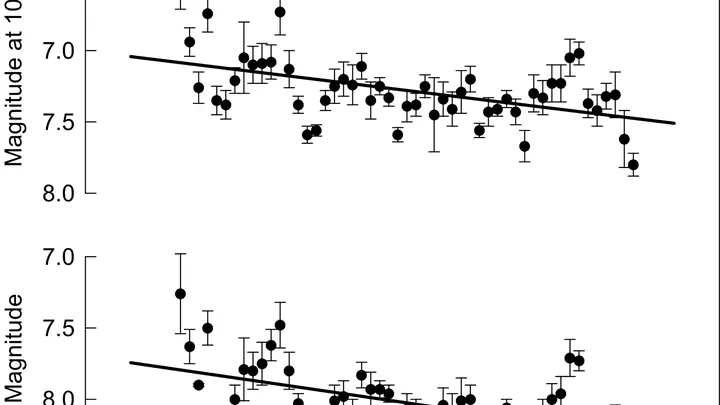
For five consecutive years, the automated MMT9 observatory measured the brightness of Starlink and OneWeb satellites using photometry (precise light measurement). The results were surprising: VisorSats, equipped with visors to reduce glare, became brighter by 0.6 magnitudes, while OneWeb, on the contrary, dimmed by 0.4.
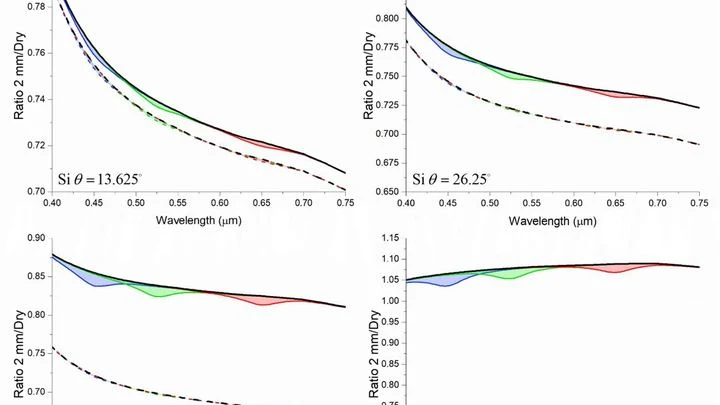
A water droplet on a leaf disappears faster under the sun than heat calculations would predict. A few years ago, a hypothesis emerged: light itself, without heating, could knock water molecules off the surface. This was dubbed the photomolecular effect. If it exists, clouds, climate, and even everyday clothes drying could work differently.
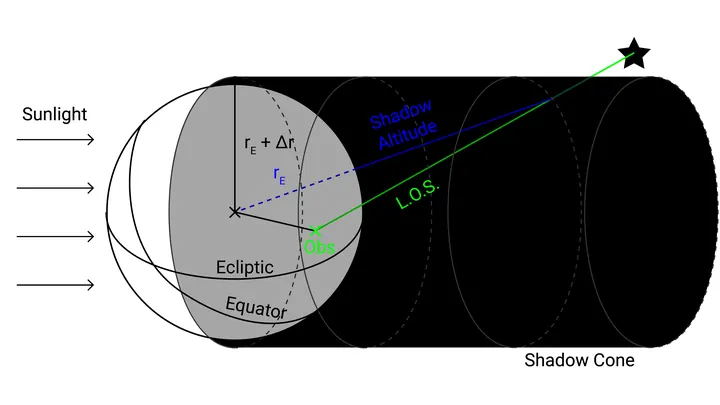
At night, the sky is never completely black. Even far from cities, the upper atmosphere glows faintly: sunlight makes hydrogen atoms emit a reddish glow that astronomers call geocoronal emission. For a telescope, it's like a fogged-up window: it adds extra light and hinders seeing distant galaxies.
Supermassive bodies warp space, turning into a lens that bends light from distant objects. Such spacetime curvature allows astronomers to see the invisible. Recently, this method helped detect a hidden clump with the mass of a million Suns.