Vacuum energy is the intrinsic energy density of empty space. In quantum field theory, even a perfect vacuum is not truly empty: it seethes with virtual particles that pop in and out of existence, and each quantum field contributes a baseline energy to every point in space. The theoretical prediction for this energy is astronomically large — roughly 10^120 times the energy density we observe in the universe today. This colossal mismatch, known as the cosmological constant problem, is one of the deepest unsolved puzzles in physics.
History
The concept emerged from early quantum field theory in the 1930s, with notable contributions from Paul Dirac and others, but it gained prominence in the 1960s when Yakov Zeldovich connected vacuum fluctuations to the cosmological constant. The term 'vacuum energy' became standard in the late 20th century as dark energyobservations sharpened the problem.
How it works
In quantum mechanics, the Heisenberg uncertainty principle allows temporary violations of energy conservation, so particles and antiparticles can spontaneously appear and annihilate within incredibly short time intervals. Each such fluctuation contributes to the vacuum's energy. When physicists sum up all possible quantum fields and their allowed frequencies, they get an infinite value, which is 'renormalized' to a finite but still enormous number. In cosmology, this energy acts as a form of dark energy: if it has a positive value, it exerts negative pressure, driving the accelerated expansion of the universe.
In practice
Vacuum energy is central to the Casimir effect, where two uncharged metal plates in a vacuum attract each other due to altered vacuum fluctuations, a phenomenon measured in laboratories and relevant to microelectromechanical systems.
Fun fact
The observed vacuum energy density is so small that it corresponds to about one hydrogen atom per cubic meter, yet it still dominates the universe's energy budget because it fills all of space uniformly.
The universe sometimes resembles an old fabric: after rapid cooling, wrinkles could have remained — thin, almost invisible threads of monstrous density. They are called cosmic strings. Usually, at the center of such a string hides a singularity — a point where the laws of physics lose their meaning.
A cold, black mirror — that's what the sea of dark energy, the invisible substance driving the expansion of the universe, looked like for billions of years. But the DESI spectrograph has caught a faint ripple.
The quantum world is often compared to a musical instrument. Each system, whether an atom or a chain of particles, sounds at its own frequencies, which physicists call energy levels. In chaotic systems, like an orchestra without a conductor, these frequencies usually fill the entire available range without gaps.
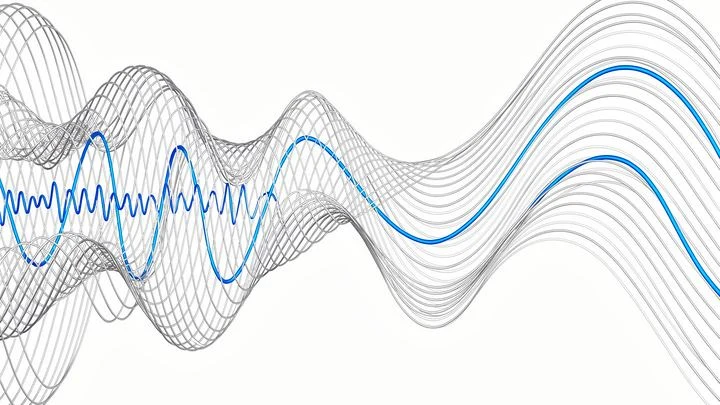
Quantum vacuum is not absolute emptiness. It is more like a taut membrane that constantly ripples from invisible particles popping in and out of existence. Even in total darkness, this membrane trembles. Physicists decided to see how it behaves around a thin spherical shell, inside which is ordinary flat space, like in our room.
Since Saul Perlmutter and his colleagues discovered the accelerated expansion of the universe, physicists have been scratching their heads over the nature of dark energy.
In the first moments of the universe's life, there was not even a hint of dark energy — the very force that today pushes galaxies apart ever faster. But if you look deeper, down to the Planck scale (billions upon billions of times smaller than an atomic nucleus), spacetime ceases to be smooth.
The explosion of a distant supernova told us something hard to believe: the universe is expanding faster and faster. The engine of this acceleration is dark energy — nearly 70% of everything that exists.
The story began with a missing mass. In the 1930s, Fritz Zwicky, measuring velocities in galaxy clusters, first suspected the presence of invisible matter. Later, Vera Rubin showed that the outskirts of spiral galaxies rotate too fast for the visible matter.
The universe is expanding at an accelerating rate, like dough that keeps rising faster even though the yeast ran out long ago. For twenty years, astronomers have been searching for the cause and call it dark energy. But what it is remains a mystery.
New work proposes an unexpected source: the vacuum inside the atomic nucleus.
The cosmic vacuum is not emptiness but a living ocean: its energy swells and subsides, echoing the expansion. Like a lunar tide, vacuum density sensitively responds to Hubble’s tempo — the conductor’s baton of the universe.
For nearly a century, astronomers have watched galaxies spin as if held together by invisible mass. Fritz Zwicky first noticed it, and Vera Rubin precisely measured the speeds of stars at the edges.
The universe is not a solid monolith, but a canvas of countless quantum threads. Spacetime doesn't flow like water, but vibrates like a tapestry in the wind. For a long time, physicists only saw the overall pattern, neglecting the tremor of individual threads.
Right after the Big Bang, space swelled at an unimaginable speed — that's inflation. Now expansion has slowed, but galaxies are moving apart faster and faster. The culprit behind the acceleration has been named dark energy.
For a long time, dark energy, the mysterious force prodding the expansion of the Universe, was considered eternal and unchanging, like yeast that never loses its activity. But explaining such constancy through the laws of the microcosm proved impossible, and scientists began to suspect that the “leaven” might be going flat.
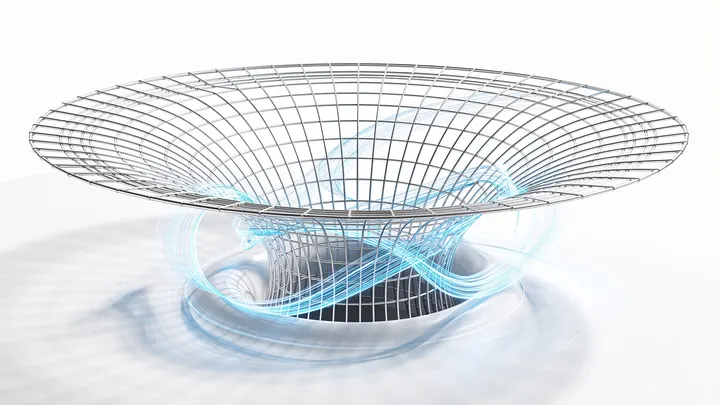
Spacetime sometimes resembles a sheet of paper in which you can punch a hole and connect the edges with a short tube: you get a wormhole. In the simplest mathematical models of such wormholes, massless scalar fields appear — something like an invisible fog filling everything around.
The mystery of dark energy is a chasm. Quantum field theory predicts a density 10¹²⁰ times larger than observed. In the string landscape, this abyss takes shape — myriads of vacua with different energies, and we are nestled in one of them.
The universe abhors monotony. A century ago, Edwin Hubble and Georges Lemaître gave us an elegant picture: an expanding cosmos, smooth as the surface of an inflated balloon.
The Universe is structured like a sponge: there are dense regions packed with galaxies and gas, and giant pores — cosmic voids. These voids occupy most of space, but their contents have remained a mystery because matter there barely reveals itself.
Now astronomers have 'felt' the voids using fast radio bursts — super-powerful pulses from distant galaxies.
An invisible film, a quantum field, is stretched over a rubber bagel. While the bagel is small, the film stays taut and doesn't sag anywhere: the vacuum remains empty. But once you stretch the bagel to a certain size, a dent spontaneously appears in the film — the field starts to be felt at every point.
This dent is not random.
Steam rising from hot metal is a familiar sight in the kitchen. But if you use rubidium instead of water, that cloud becomes a battery. It doesn't run on chemical reactions but on the quantum coordination of atoms.
An attempt to suppress room background noise by adding anti-sound turns into speaker howl if the circuit has an error. A similar glitch occurred with a theory that set out to remove the main cosmic hum — the inexplicably weak dark energy.
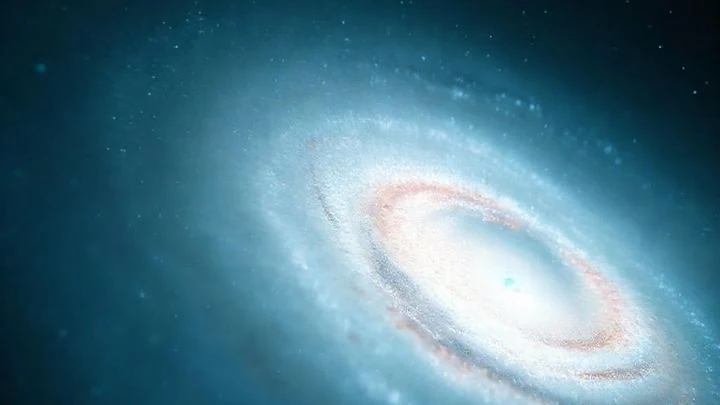
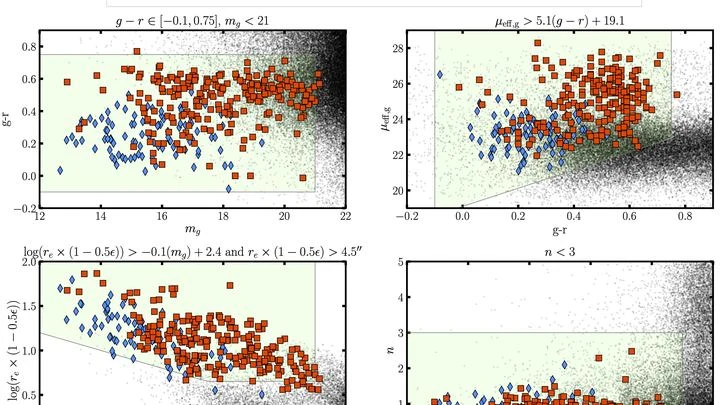
A population census, but instead of houses (galaxies, and instead of residents) stars. Astronomers set out to count the smallest and faintest "homesteads" in our cosmic neighborhood: dwarf galaxies. They are thousands of times fainter than the Milky Way, and spotting them in images is as hard as picking out a firefly in front of a spotlight.
In the standard cosmological model ΛCDM, galaxies recede under the pressure of dark energy — an invisible spring. However, different methods of measuring the expansion rate give different numbers, as if the ruler's scale is off.
Galaxies are flying apart, but the expansion rate measured from the afterglow of the Big Bang and from supernova explosions doesn't match: this problem has been called the Hubble tension. It's like two dancers losing their rhythm because they can't feel each other.
In the thirties, Pauli realized: without tiny ghost-like particles, the energy of stars doesn't add up. Thus neutrinos were born — intangible wanderers that permeate everything.
The universe is a pie baked from a single recipe, but the teaspoon and the kitchen scale stubbornly show different amounts of sugar. That’s how it is with the expansion of the universe: measurements from nearby stars (the spoon) give one number, while those from the ancient light of the Big Bang (the scale) give a completely different one.
The universe is putting on a show, and the lead role goes to dark energy. For a long time, the actor seemed unchanging: the cosmological constant (the vacuum energy that accelerates cosmic expansion) set the same tone throughout.
A century ago, quantum mechanics gave the world a neat picture: a particle rotating around a point can only have certain discrete amounts of angular momentum, integer multiples of Planck's constant. This rule seemed as solid as the law of gravity, and it followed from simple algebraic arguments.