The RomanSpace Telescope, formerly known as WFIRST, is a NASA observatorydesigned for wide-field infrared imaging and spectroscopy. Its primary goals include probing dark energy, characterizing exoplanets via direct imaging and microlensing, and studying infrared astrophysics from the early universe. With a field of view 100 times larger than Hubble's, it will survey vast cosmic regions, providing data on galaxy distribution and dark matter.
History
The concept evolved from the earlier Joint Dark Energy Mission, with the telescope officially named after Nancy Grace Roman in 2020. Launch is planned for the mid-2020s.
How it works
The telescope uses a 2.4-meter primary mirror and a suite of instruments, including a wide-field camera and a coronagraph for blocking starlight to image exoplanets. It operates in low Earth orbit, taking advantage of infrared wavelengths to see through dust and observe distant, redshifted light. Its surveys will map billions of galaxies to measure dark energy's influence on cosmic expansion.
In practice
It will conduct a microlensing survey to discover exoplanets, including free-floating planets, and a deep infrared survey to study galaxy formation and dark energy.
Fun fact
The telescope's coronagraph is designed to directly image exoplanets, a feat that could reveal atmospheres and even signs of habitability, as hinted in the article 'Рой крошечных парусов летит к Проксиме b'.
The night sky is like an ocean: the longer you stare, the more faint lights you notice in the depths. That's how astronomers, peering into the outskirts of the Milky Way, found Aquarius IV — a tiny stellar system that had been hiding in the dark until now.
The system was spotted in images from an early survey by the future Vera Rubin Observatory.
Edge of the spotlight. Remove the dazzling light of the central star, and a theater of shadows emerges. The James Webb coronagraph, like a dense curtain, hid the star TW Hydrae — and on a stage 120 astronomical units long (four times the distance to Neptune), its protoplanetary disk came alive.
In 2024, the Hephaestus project sifted through millions of stars and flagged a few dozen suspicious ones: they shone brighter in the mid-infrared than a normal red dwarf should. Two of these candidates, labeled D and E, looked especially tantalizing, as if an invisible heater were working next to the star.
The Universe is a giant labyrinth of curved mirrors. The mass of galaxies and clusters distorts the light of distant quasars, as if toying with our perception of the cosmos. Hidden in this hall of mirrors is the key to the greatest mystery: dark energy, which is pushing space apart ever faster.
The universe is a vast orchestra playing the score of expansion. Galaxies race apart to the beat of inaudible music of dark energy. But here's the trouble: the conductor's baton held by Edwin Hubble, Adam Riess, and Vera Rubin sets two incompatible tempos.
Black holes come in lightweights, born from dying stars, and supermassive ones at galactic cores. The missing intermediate link had been hiding. Fast radio bursts, cosmic signals lasting milliseconds but carrying the energy of days of sunlight, helped crack the case. Think of these bursts as cries from the depths of the universe.
A handful of coins accelerates to one-fifth the speed of light. That's what Coracle interstellar probes will be like — tiny spacecraft weighing just a few grams, each with an ultrathin sail film. A powerful laser beam pushes them forward: light presses on the sail like wind fills a yacht's sails, except instead of air, it's a stream of photons.
The night sky in a telescope image looks like a photo taken through a fogged-up window: bright stars are visible, but everything faint drowns in a murky haze. That haze is noise — random interference from electronics, heat, and the atmosphere itself.
For six straight years, the HARPS-N telescope on La Palma island stared at the Sun as if it were a distant star — taking spectra, tracking brightness, and recording every quiver of spectral lines. All this was to understand how to distinguish a star's subtle sway from a genuine planetary signal.
A star doesn't sit still: its surface boils like a pot of soup.
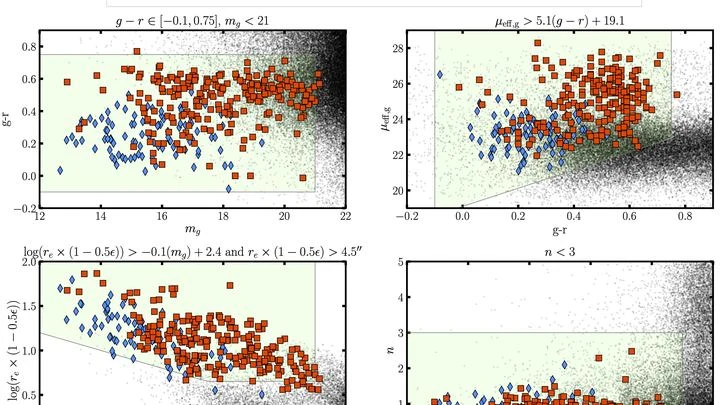
A population census, but instead of houses (galaxies, and instead of residents) stars. Astronomers set out to count the smallest and faintest "homesteads" in our cosmic neighborhood: dwarf galaxies. They are thousands of times fainter than the Milky Way, and spotting them in images is as hard as picking out a firefly in front of a spotlight.
Light from a distant star, after passing through air and telescope lenses, loses its sharpness, like looking at a streetlamp through wet glass. Astronomers call this blur the telescope's "fingerprint": each instrument has its own, and you need to know it down to the smallest detail.
Light usually travels straight, like a flashlight beam. But it can be twisted, like water in a funnel, creating a vortex in the beam. Such twisted light can carry more data: different vortices don't interfere with each other, just like different radio channels. The challenge was to make a source of such light small enough for a chip.
To spot life on other planets, you don't necessarily need to search for oxygen in the air. Living beings paint the surfaces of their worlds: Earth's plants in green, bacteria in purple. The future HWO space telescope will capture these "paints of life" on exoplanets.