Seconds That Change Everything express
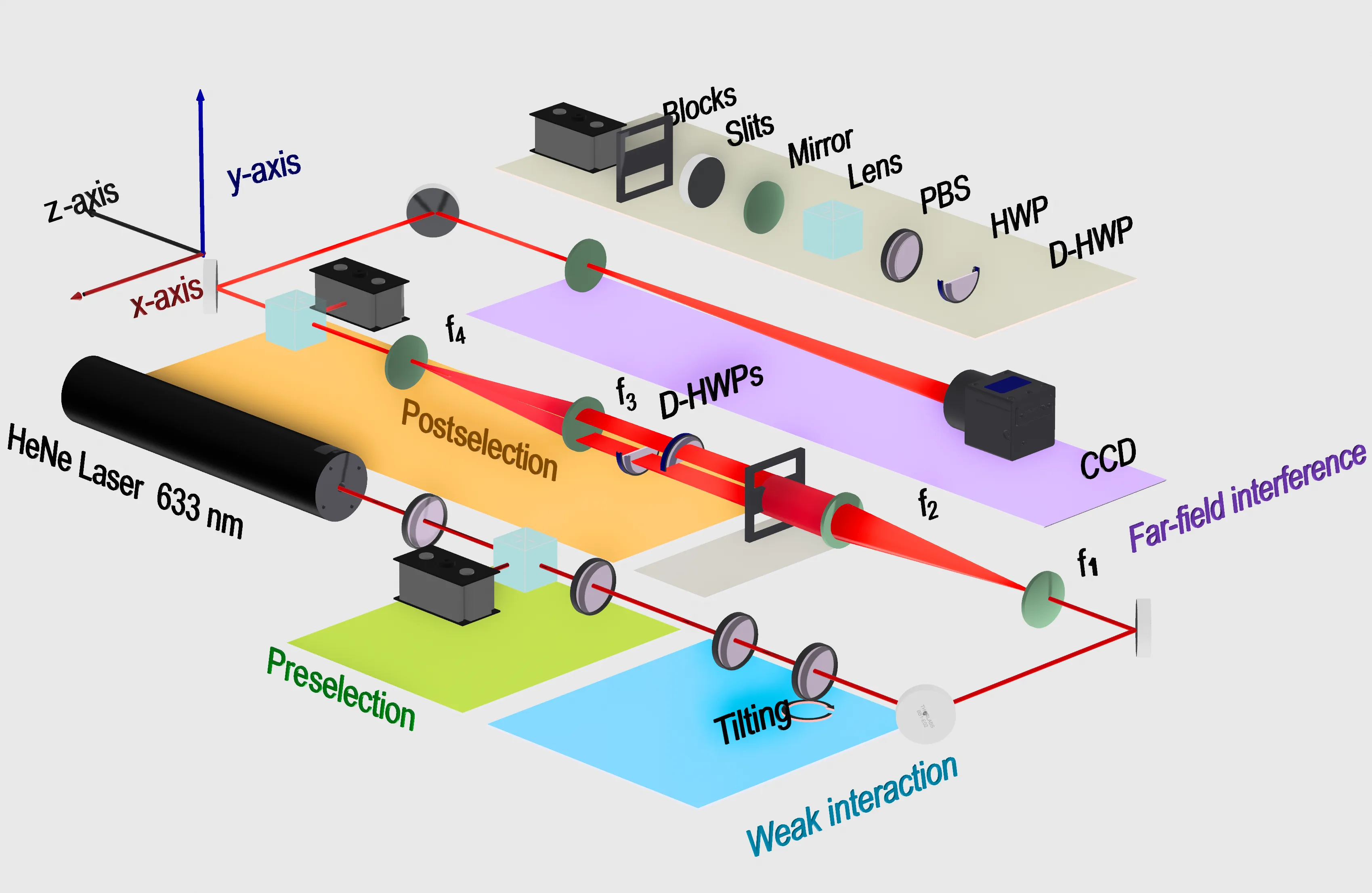
Light passing through narrow slits can reveal delays invisible to the eye. In a new experiment, physicists sent a laser beam through two slits simultaneously and measured how much one part of the wave lagged behind the other. The delay was a few attoseconds: that's one billionth of one billionth of a second. To grasp the scale: in one attosecond, light travels a distance three times smaller than the diameter of a hydrogen atom.
Conventional methods for measuring such tiny shifts drown in noise — random fluctuations that mask the signal. Here, they used a technique called weak amplification: the signal is first attenuated, but then measured in a way that the useful part stands out against the noise. As a result, precision improved a hundredfold compared to previous experiments. The key finding: noise decreases exactly as the number of captured photons, particles of light, increases. This means the method operates at the limit allowed by nature itself.
Such precision is not just for records. Gravitational wave detectors, ripples in space itself, catch signals that change within fractions of a second. The lower the noise, the weaker the waves you can spot. Perhaps this very method will help us hear black hole collisions at the far edge of the universe.
Original abstract
as written by the authors arXiv:2602.17035
We report a quantitative evaluation of weak-value amplification (WVA) for longitudinal phase measurements using Allan variance analysis. Building on a recent double-slit interferometry experiment with real weak values [Phys. Rev. Lett. 134, 080802 (2025)], our Allan variance analysis demonstrates measurement of a few attosecond time delay approaching the shot noise limit at short averaging intervals of $$T$$ = $$0.01-0.1$$ s, representing two orders of magnitude variance reduction compared to the $$T=300$$ s operating point in prior implementations. We demonstrate that the Allan-variance noise floor scales with the inverse of the detected photon number $$1/N_r$$, confirming shot-noise-limited operation with WVA. Furthermore, this $$1/N_r$$ scaling experimentally validates that WVA can outperform conventional measurement under fixed detected photon number and detector saturation, in the presence of technical noise, as theoretically predicted [Phys. Rev. Lett. 118, 070802 (2017)]. Our results provide rigorous, quantitative evidence of the near-optimal noise performance achievable with WVA, establishing a new benchmark for precision optical metrology. This advancement is particularly relevant to applications such as gravitational-wave detection, where signals predominantly occupy the high-frequency regime ($$>10$$ Hz).
An attosecond is so short that in one attosecond, light travels a distance smaller than the size of an atom.