The double-slit experiment is the quintessential demonstration of wave-particle duality in quantum mechanics. It involves firing particles — such as photons, electrons, or even molecules — at a barrier with two narrow slits. When both slits are open, the particles create an interference pattern on a detector screen, as if each particle passes through both slits simultaneously and interferes with itself. This behavior defies classical intuition: particles seem to behave like waves until observed, at which point they behave like particles.
History
Thomas Young first performed the double-slit experiment with light in 1801, demonstrating the wave nature of light. In 1961, Claus Jönsson performed it with electrons, and in 2013, researchers extended it to molecules containing over 800 atoms.
How it works
The experiment works because quantum particles are described by wavefunctions that evolve according to the Schrödinger equation. When a particle encounters the double slit, its wavefunction splits into two components, one passing through each slit. These components recombine on the other side, and the probability of detecting the particle at any point is proportional to the square of the sum of the two wave components. The interference arises from the phase difference between the two paths. If a detector is placed at the slits to determine which path the particle takes, the interference pattern disappears, because the wavefunction collapses into a definite path.
In practice
The principles of the double-slit experiment underpin quantum computing, quantum cryptography, and the design of interferometers used in gravitational wave detectors like LIGO.
Fun fact
The double-slit experiment has been performed with molecules so large that they contain thousands of atoms, yet they still exhibit interference — a fact that continues to challenge our intuition about the boundary between quantum and classical worlds.
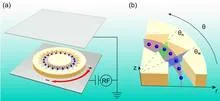
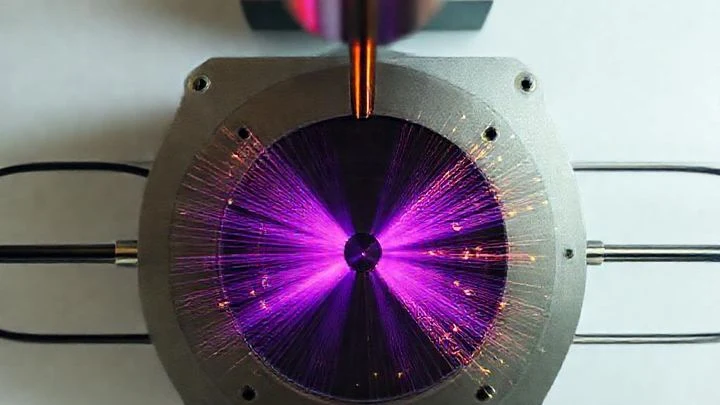
In a ring-shaped channel between two toothed rings, microspheres are suspended: some with a radius of 8 micrometers, others 14. The discharge is switched on, and the particles start moving. The small ones go one way, the large ones the other. It is like a shopping mall where escalators for people of different heights run in opposite directions.
A storm in the upper atmosphere lasts a few millionths of a second. A cosmic ray, a proton or a helium nucleus, strikes air molecules, sending a swarm of particles downward. Most of them stay together, but occasionally one particle gains so much energy that it surges ahead.
A polar molecule is like a tiny dumbbell with opposite charges at its ends. Normally, such particles quickly stick together or fly apart when they meet — electric forces are too strong. But the authors of the work found a way to turn this aggressiveness into a controlled game.
A carousel doesn't just spin you around in a circle — with each revolution, it also slightly screws itself into the ground. This corkscrew-like motion is the essence of the NUT charge, a special property of spacetime that physicists have been studying since the mid-20th century.
Every quantum particle has spin — an intrinsic magnetic property, like a tiny arrow. In an experiment, a beam of such particles passing through a magnet splits in two, like a coin that lands either heads or tails. That’s exactly how particles like a hydrogen atom behave.
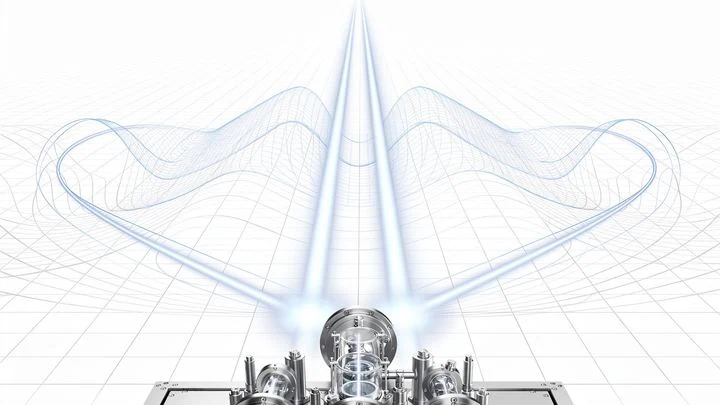
Two parallel streams of atoms, released from Bose condensates, begin their journey in free fall. In the classical picture, their separation remains unchanged — like two skiers gliding down a perfectly smooth slope. But if spacetime is not frozen snow, but a living, rippling membrane, then every tremble of it is transmitted to matter.
A deuterium molecule, two atoms of heavy hydrogen, falls apart under a laser pulse. One electron is ripped away, leaving an ion behind. At that moment, they are still linked: the direction of one immediately tells you which way the other went. This link is called quantum entanglement.
A sheet of graphene one atom thick is like a perfectly smooth tablecloth on which electron marbles roll. Place an electric barrier in their path, and usually they'll bounce back. But in graphene, it's different: under certain conditions, electrons pass through the barrier without even noticing it, as if the wall were made of mist.
In turbulent air, droplets don't fly in straight lines: they get tossed around like dust motes in a beam of light. Physicists have built a setup that tracks each droplet, which is about a tenth of the thickness of a human hair. A camera captures their motion, and a computer reconstructs their trajectories.
Drop two pebbles into a pond: each sends out ripples, and on the water you'll see crests where waves reinforce each other and troughs where they cancel. Protons behave much the same way: when there are two, they create a double ripple that adds up into a recognizable pattern.
Light from a single source can be made to 'meet' itself, and then fringes appear on the screen, like ripples from two pebbles dropped into water. Physicists have long known how to do this with two photons, but making four particles of light merge at once was tricky: single-photon sources lost too many particles along the way.
In the quantum world, particles do not have precise properties until they are measured. The official model refuses to explain what lies behind this uncertainty. But the idea that invisible 'pilots' control particles has been around since the 1920s.
In the first moments after the Big Bang, the Universe underwent rapid expansion: inflation. But perhaps it was contracting before that, and then bounced. Both scenarios leave nearly identical imprints on the cosmic microwave background, and cosmologists have debated for decades which one is correct.