Time delay in physics refers to the difference in arrival time of a signal between two spatially separated detectors. This concept is fundamental in astronomy and particle physics, where it allows scientists to locate sources and study the properties of the medium the signal travels through. For example, in gravitational wave astronomy, the time delay between detectors like LIGO's multiple sites helps triangulate the position of a merger on the sky. Similarly, in neutrino detection, time delays can reveal information about the source and the Earth's interior.
History
The use of time delay in astronomy dates back to the 1960s with the first very long baseline interferometryexperiments, but the concept became widely known in the 1970s with the detection of gravitational lensing time delays. In gravitational wave astronomy, the first detection in 2015 used time delays between the two LIGO detectors to estimate the source's location.
How it works
When a signal (light, gravitational waves, neutrinos) travels from a distant source, it reaches different detectors at slightly different times because the detectors are at different distances from the source. By measuring these time differences and knowing the speed of the signal, scientists can calculate the direction and distance to the source. In some cases, time delays also arise from the signal passing through different media, such as the gravitational lensing of light, where one path is longer or slowed by curved spacetime.
In practice
Time delay measurements are used in GPS satellite navigation to correct for relativistic effects, and in astronomy to measure cosmic distances and test theories of gravity.
Fun fact
In the first gravitational wave detection, the time delay between the two LIGO detectors was about 7 milliseconds, which allowed scientists to roughly locate the merger in the southern sky.
A light ray passing by a massive body gets deflected: this is the effect of gravitational lensing, familiar from images of distant galaxies. The astrophysicists started with a rotating black hole (Kerr spacetime) and added a tiny correction to how light itself propagates.
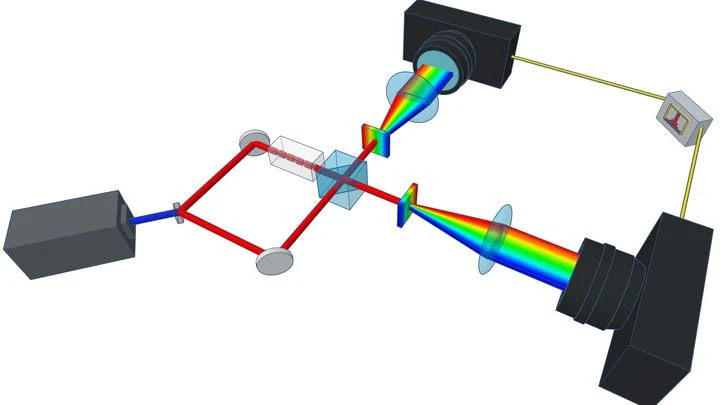
Two photons meet at a half-silvered mirror. If they arrive at exactly the same time, they always leave together — side by side, like twins who refuse to be parted. This effect, discovered in 1987, became the basis of a quantum ruler for measuring tiny delays.
Decades of radio astronomy have listened to space, hoping to catch narrowband radio transmissions — the technogenic 'voice' of distant exoplanets. But our own technological evolution reveals a paradox: loud analog signals, like 1960s TV broadcasts, are just a brief squawk of a newborn civilization.
Two rulers show slightly different lengths for the same table. That's roughly the situation in cosmology with the Hubble constant — the number that tells how fast the universe is expanding.
Place two identical alarm clocks on a table and set them off at the same time. If one is on a slippery surface and starts to slowly slide, its timing will be thrown off, and within a minute they'll ring out of sync. That's roughly how the new method proposed by astrophysicists for supermassive black holes works.
In giant accelerators, particles zip through detectors in billionths of a second, and telling one from another requires a stopwatch of incredible precision. The new µRWELL-PICOSEC detector acts as such a stopwatch: it captures the moment a particle passes with a precision of 48 picoseconds: that's 48 trillionths of a second.
In 2017, the IceCube detector caught a neutrino from the distant galaxy TXS 0506+056. It was like hearing a phone ring from across the ocean: the signal came from where the most energetic particles in the Universe are born. At the same time as the neutrino, astronomers spotted a gamma-ray flare, and two to three years later, radio waves. Why was the radio late?
Two coins are flipped in different cities, but they always land the same way. Physicists call this entanglement: particles behave as if an invisible thread connects them. But what if the thread isn't instantaneous, just very fast — still not faster than light? Then some signal could slip between measurements, and the coincidences would be explained without any magic.
Gravitational waves are ripples in space, born, for example, when pairs of supermassive black holes spiral around each other. To catch them, scientists monitor pulsars — dead stars that emit radio pulses with clockwork precision.
A pair of neutron stars is like two heavy bowling balls slowly spiraling toward each other. They are born together from a binary system of massive stars, but it can take hundreds of millions of years before they finally collide. When they do, a short gamma-ray burst erupts — a brilliant explosion visible across half the universe.
Time flows slower near the ground than on the roof: this was predicted by Einstein in his theory of relativity. To spot the tiny difference, physicists propose using a pair of photons, linked like voices in a duet.
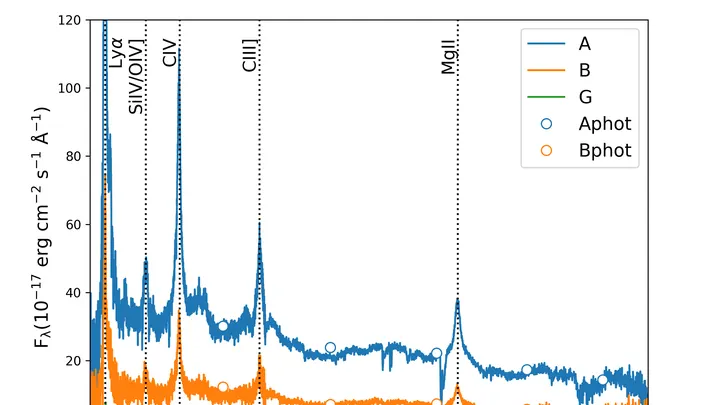
Light from quasar PS J2305+3714 has been traveling toward us for more than eleven billion years. On its way, it passes near a massive galaxy whose gravity bends its path, like a heavy ball denting a stretched sheet. Through a telescope, we see not one quasar but two images — two points of light that are actually the same distant object.
Mass curves spacetime like a heavy stone pressing into an asphalt road. Light passing by skirts around this dent, its path lengthens, and it arrives late. Astronomers have observed this Shapiro effect many times near the Sun and planets.
A new plan proposes to recreate this delay on a lab bench.
A ruler made of light: that's one way to describe a new method for measuring tiny time delays. In 1987, Chong Ki Hong, Zhe-Yu Ou, and Leonard Mandel noticed that when two indistinguishable photons hit a beam splitter simultaneously, they always exit together from the same port.
The ocean doesn't always stick to the same schedule. Sometimes the warm El Niño current strengthens, sometimes it weakens, and each regime dictates its own reaction speed to the past. These hidden regimes are like shifts in currents that remember their path with different depths.
The ocean remembers its past. Heat given to the water off the coast of Norway does not vanish without a trace: it embarks on a long journey across the Atlantic, only to return decades later and alter the temperature at those same shores once again.
A wave travels westward, reflects off the coast, and returns six months later to alter temperatures along the eastern Pacific. This journey of Rossby and Kelvin waves Mori-Zwanzig formalism turns into an equation with memory. Previously, climatologists added delays to El Niño models by intuition, relying on physical insight.