The false alarm rate is a measure of how often a detector or measurement system mistakes pure noise for a genuine signal. In physics and engineering, every sensor operates against a background of random fluctuations — thermal jitter, electronic noise, or quantum vacuum fluctuations. The false alarm rate quantifies the price of sensitivity: if you set a threshold too low, you catch every faint whisper but also every random blip; set it too high, and you miss real events. It is the fundamental trade-off between catching true signals and being fooled by noise.
History
The concept emerged with early radar and communication theory in the 1940s, formalized by statisticians and engineers working on detection problems, notably in the context of the Neyman-Pearson lemma.
How it works
A detector continuously measures some quantity, and a threshold is chosen. Whenever the measured value exceeds the threshold, the system declares a signal. The false alarm rate is the probability per unit time that noise alone pushes the value above that threshold. Lowering the threshold increases sensitivity but also raises the false alarm rate; raising it does the opposite. In quantum sensing, the challenge is that even the vacuum itself fluctuates, setting a floor on how low the noise can go — and thus on the false alarm rate for any given sensitivity.
In practice
It is central to gravitational wave observatories like LIGO, where a false alarm rate of less than one per hundred thousand years is required to claim a detection, and to quantum key distribution, where false alarms would corrupt the secret key.
Fun fact
In gravitational wave astronomy, the first detection of merging black holes was announced only after the false alarm rate was calculated to be less than 1 in 5.1 million years.
Units by system: SI: hz · CGS: hz · Planck: 1t p · natural: gev
A lone fish sees a shadow overhead. Should it flee? If it's just a leaf, it wastes energy and gives away its position to a predator. If it's a heron, hesitation is fatal. That's the eternal trade-off of the solitary individual: quick reactions mean many false alarms, while caution means risking being eaten.
In a school, it's different.
Fatty liver disease often goes unnoticed, but over time it can lead to serious problems. To avoid taking a tissue sample, doctors use ultrasound: sound waves pass through the tissue and attenuate differently depending on fat content. This parameter, the attenuation coefficient, shows how "fat" the liver is.
But the method has a flaw.
You're listening to the faint whisper of stars, and nearby someone keeps moving a chair. In gravitational wave telescopes, that role is played by scattered light: it reflects off trembling surfaces and creates false signals.
Low-frequency radio waves (from 30 to 300 kilohertz) carry information through water and earth. But catching them with an ordinary antenna is hard: the wavelength reaches several kilometers, and a small receiver barely feels such a field.
In a room, air touches the skin, and we feel its temperature. But if your body suddenly accelerated at a colossal rate, heat would come even from absolute emptiness. This is not fiction but a strict consequence of quantum field theory: for an accelerating observer, the vacuum becomes a warm bath.
When a radio wave encounters a building in its path, it doesn't just reflect or get absorbed: it bends around it, much like ocean waves flowing around a rock, leaving calm water behind. In radiophysics, this phenomenon creates a radio shadow — a complex pattern of zones where the signal is amplified or attenuated, which scientists call a radio portrait.
A regular radar works like an amateur photographer: it takes a series of blurry snapshots and tries to stitch them into a panorama. Details are smeared, and in a long corridor or crowd, the robot easily gets lost.
The principle is simple: like a bat, the radar emits a wave and catches the echo.
A laser is like a tuning fork that rings at a single note. But even in complete silence, its sound trembles slightly. Previously, it was thought that this tremor, random kicks from spontaneous emission of light by atoms inside the laser, was the main limit to precision.
The 120 residents of Montelago are not people but digital characters. Each, besides a name and biography, has three hidden coordinates: trust in municipal authorities, assessment of source credibility, perceived adequacy of information. These numbers are known to the creators but not to the system itself.
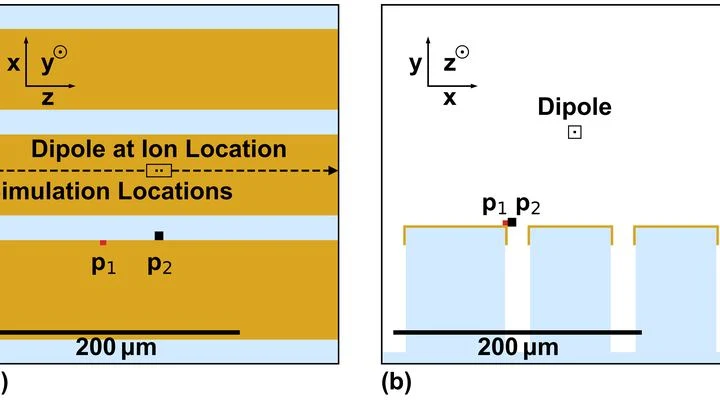
A quantum computer is like an orchestra where each ion is a musician and laser pulses are the conductor's baton. But if someone in the audience rustles, the delicate melody of quantum states goes off key.
Two clouds of ultracold atoms, almost frozen at temperatures of a few nanokelvins, mix in a trap. One cloud consists of light atoms, the other of heavy ones. They push each other differently. Physicists have long been able to describe such mixtures with simple equations, but those work only if the atoms are perfectly identical.
A baker follows a recipe for a cake, but instead of a fluffy sponge, they get a hard crust. They start running through possible causes: maybe the flour was damp, or the oven heats unevenly, or the eggs were too cold.
Gravitational wave detectors are microphones listening to the trembling of space. But their own noise drowns out weak signals. To hear more, physicists add special "squeezed" light to the instrument: it reduces quantum noise, like noise cancellation in headphones.
A laser that usually produces a steady beam starts to tremble near its threshold, like a string about to sound. This trembling is not a defect but quantum noise: atoms inside the laser emit light randomly, without any external cause.
Atomic clocks are pendulums that tick at the frequency of light. Inside a trap, an aluminum ion hangs, and a laser probes it like a tuning fork. If the laser's frequency matches the atom's natural frequency, the atom responds. The clock's rate is checked against this response.
Imagine reality as an undeveloped photograph: until the moment of measurement, it exists only as a cloud of probabilities — a superposition of all possible states. Only the act of observation, like developing film, forces a particle to acquire definite properties.
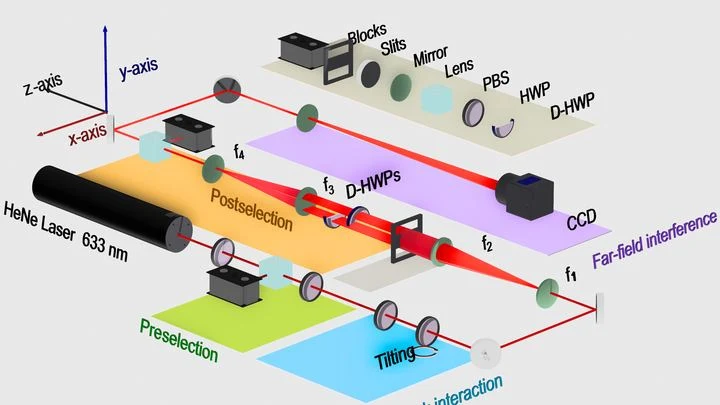
Light passing through narrow slits can reveal delays invisible to the eye. In a new experiment, physicists sent a laser beam through two slits simultaneously and measured how much one part of the wave lagged behind the other. The delay was a few attoseconds: that's one billionth of one billionth of a second.
Optical fiber transmits light, but along the way it jitters and dims. To ensure that two parties at opposite ends of the line get the same set of random numbers for encryption, the receiver uses a digital corrector, like noise-canceling headphones that subtract the street hum but sometimes also eat the quiet notes of the music.
Modern encryption is unthinkable without truly random numbers. But a standard source can be unreliable or even deliberately corrupted. The solution came from experimenters who built a 98-ion quantum processor: it works like a high-speed filter, turning a 'dirty' signal into one that's crystal-clear and unpredictable.