A Crystal That Twists Light on Command express
Silver niobium oxide, AgNbO₃, is a layered pie of silver, niobium, and oxygen atoms. At room temperature, it behaves like an ordinary dielectric, but when cooled, the atoms start to shift, and the crystal gains electric polarization, like a compass needle, but instead of pointing north, it points in the direction of the internal electric field. For a long time, it was unclear what exact structure emerges at low temperatures.
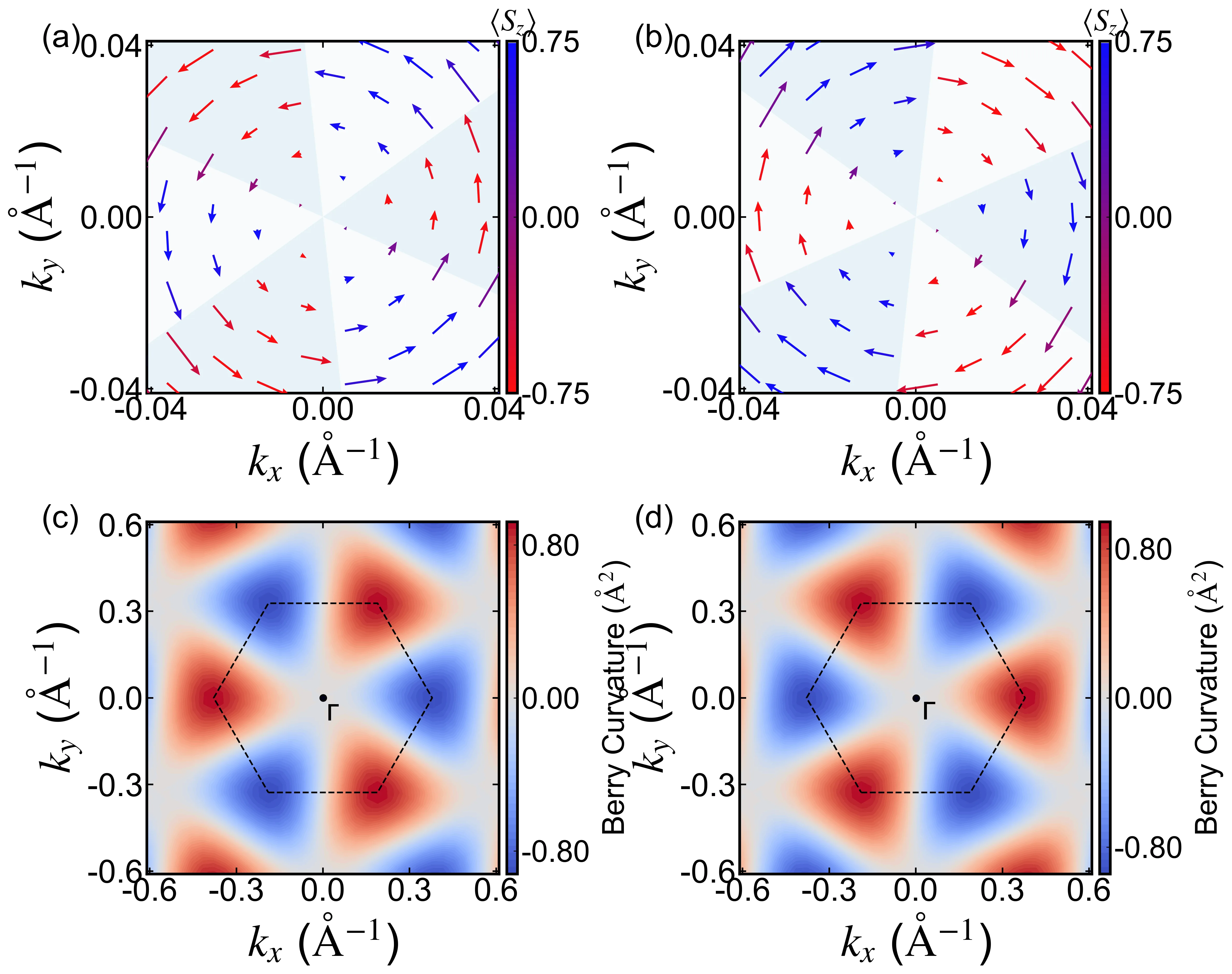
The authors of the new study ran a computational search over all possible atomic arrangements and found a phase that had been overlooked. In this phase, the crystal lattice twists into a spiral: looking along one axis, the atoms rotate either clockwise or counterclockwise. This property is called chirality, like left and right gloves, which don't match when superimposed. It turned out that the twist direction is tightly linked to the polarization direction: flip the field, and the spiral flips too.
This coupling offers a simple way to control optical properties: apply a voltage, the crystal changes its twist, and light passes through differently. No moving parts, just an electric field. Such switches can operate very fast and could be useful in optoelectronics — where light needs to be modulated for data transmission or new types of displays.
AgNbO₃ is an inorganic, lead-free material, making it safer than many modern piezoelectrics. And the ability to control chirality with an electric field is extremely rare: usually, this requires complex molecules or magnetic fields. Here, it's all done with a simple voltage, like from an ordinary battery.
Original abstract
as written by the authors arXiv:2602.19036
AgNbO$$_3$$ is a lead-free perovskite with considerable potential for energy storage and optoelectronic applications, yet its low-temperature crystal structure has remained controversial. In this Letter, we revisit its low-energy structural landscape using a systematic first-principles structural search based on symmetry-adapted phonon-mode theory. We uncover a previously unreported chiral ferroelectric phase with space group $$R3$$, which exhibits a large spontaneous polarization and a low polarization switching barrier, enabling polarization reversal under electric fields. Crucially, the structural chirality of this phase is intrinsically locked to the ferroelectric polarization, allowing electrical control of the chiral handedness. Consequently, chiral optical responses--including circular dichroism, circular photogalvanic effect, optical activity, and second-order nonlinear optics--can be reversibly switched by an external electric field. These results not only clarify the complex low-temperature structural behavior of AgNbO$$_3$$ but also establish a rare purely inorganic platform for electric-field-tunable chirality, opening a pathway toward ultrafast, electrically controlled chiral optoelectronics.
Chirality matters in pharmaceuticals: a drug with the "wrong" molecular twist can be useless or even harmful. In AgNbO₃ crystals, the twist can be changed at will, opening the door to materials with tunable properties.
Controlling light with an electric field evokes the "lightsaber" technology from Star Wars, where a beam is controlled by a force field. Though here, we're talking about more modest but real switches.