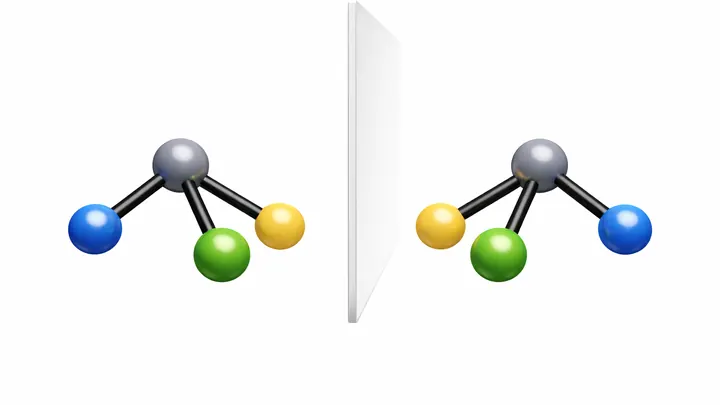
Chirality is a geometric property where an object cannot be superimposed on its mirror image, like left and right hands. In molecules, chirality means two versions exist that are mirror images but not identical — called enantiomers. These can have vastly different chemical and biological effects, which is why chirality is central to pharmacology, biochemistry, and fundamental physics.
History
Louis Pasteur first discovered molecular chirality in 1848 when he manually separated left- and right-handed crystals of tartaric acid and observed their opposite effects on polarized light.
How it works
Chirality arises when a molecule has an asymmetric center, typically a carbon atom bonded to four different groups. The two arrangements are mirror images, like left and right gloves. They have identical physical properties (mass, boiling point) but interact differently with other chiral objects, such as enzymes or polarized light. In physics, chirality also refers to the handedness of particles, related to their spin and momentum.
In practice
Chirality is exploited in drug design (one enantiomer may be therapeutic, the other toxic), in chiral catalysis for producing specific enantiomers, and in optical technologies using circularly polarized light.
Fun fact
The weak nuclear force violates chirality symmetry — it only interacts with left-handed particles and right-handed antiparticles, which is why the universe is made of matter rather than antimatter.
In nature's workshop, there is a strange lathe: it cuts threads on screws but forbids left-handed ones. You can tighten a screw as much as you like, in any clockwise direction, but counterclockwise is not allowed. This lathe is not a fantasy but an exact quantum rule that physicists have just built for magnetic materials.
A slice of eucalyptus a tenth of a millimeter thick is placed under a polarized light microscope, and the wood suddenly blooms: blue, yellow, and pink bands twist into spirals, forming rings and swirls. This is not paint but the play of light: the cellulose fibers that make up cell walls transmit light differently depending on their orientation.
A thrown stone arcs through the air and falls. A planet orbiting a star is the same stone, but it falls forever, looping around the star in a closed curve. In Newton's world, that curve is a perfect ellipse, and the planet returns to the same point each orbit. In reality, the orbit slowly rotates: its closest point to the star, the perihelion, shifts.
The early Universe was not just a hot soup of particles. In the first fractions of a second, mirror symmetry could have been broken: the world and its reflection would not be quite identical. If so, the large-scale cosmic web of galaxies would retain a barely noticeable 'curl'—as if all matter were slightly twisted in one direction.
The Standard Model of particle physics is a catalog of all known building blocks of the universe: electrons, quarks, and others. But it is silent about dark matter and doesn't get along with gravity.
An ordinary flashlight emits light whose waves oscillate in all directions at once. But pass that light through a special filter, and you get a beam that oscillates strictly in one plane: that's polarized light. When such a beam travels through biological tissue, the tissue's internal structure slightly alters the orientation of the oscillations.
Erwin Schrödinger pondered how life maintains order despite the second law of thermodynamics. He could never have imagined that part of the answer lies hidden in the instability of giant stars.
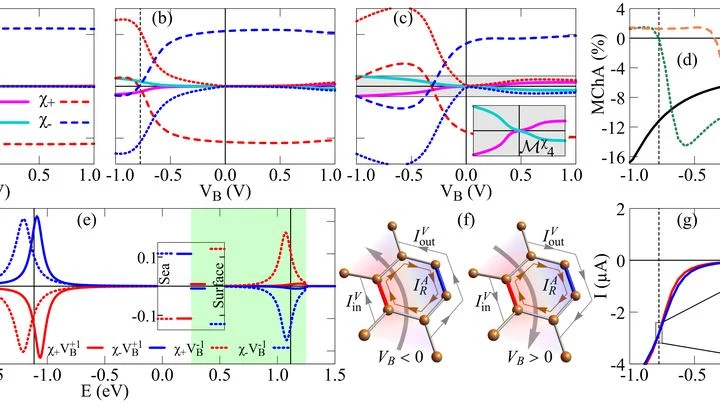
A spiral staircase sets the rhythm of footsteps: if a stream of people runs up it, their motion inevitably twists. Something similar happens in helical molecules — for example, in DNA or certain proteins. When an electric current is passed through such a molecule, electrons don't just fly straight.
Imagine a translator working in a noisy hall. The hum of voices, the clatter of dishes, fragments of other people’s conversations: it seems they should constantly make mistakes. But by the end of the day, their notes match perfectly with what they would have written in the quiet of an office. This is roughly how the quantum rule known as the axial anomaly behaves.
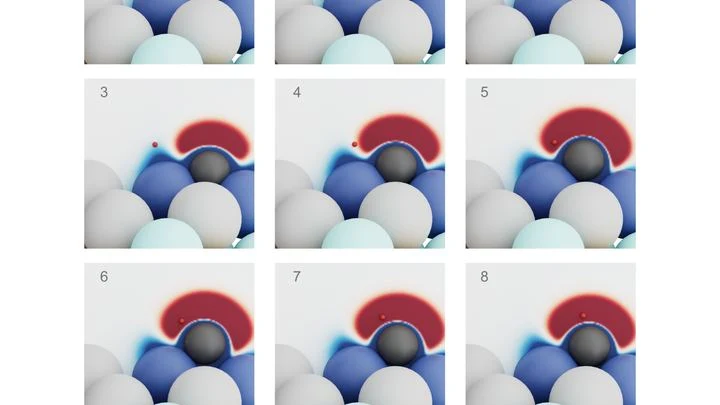
A kitchen sponge soaked in syrup: in some spots there's more syrup, and your finger sticks right away; in others, it barely touches. That's roughly how a catalyst surface works. Molecules don't react everywhere but at especially sticky points — active sites.
Many molecules, like gloves, come in left- and right-handed versions. Their energy difference, caused by the weak interaction, is minute, like a whisper in a noisy room. Physicists have figured out how to turn that whisper into a chorus. A mixture of precursor molecules in an ultracold gas yields mirror-image pairs.
Imagine a carousel with two types of seats: some spin clockwise, others counterclockwise. If you push all of them at once, the carousel jerks but stays in place. That's how a Weyl semimetal crystal works: electrons are born in pairs—'left' and 'right'—and their contributions to current cancel each other, like two identical motors running in opposite directions.
Light loves symmetry: in an open channel, it flows equally both ways. To steer it one way, physicists often use magnets. A new approach does without, using rotation — just the speed of a vinyl record — and interference from two atoms. Rotation changes the “pitch” of light for different directions, just as a siren’s tone shifts when a car approaches or recedes.
Two ultra-thin sheets, each just one atom thick, are placed on top of each other and slightly rotated. Like two sheets of colored tracing paper: while they lie flat, the picture is one thing, but give them a twist and a moiré pattern appears. Here, though, the pattern isn't visible to the eye, but it completely changes how the material handles light.
Two entangled photons fly apart in opposite directions but continue to behave as a single whole: measuring one instantly determines the state of the other. That's quantum entanglement. But sometimes it resembles a seasoned spy — leaving no traces detectable by ordinary checks.
A plastic heart rests on the water and doesn't tip over, no matter how you turn it. It freezes in any position, as if the water were holding it by invisible strings. This trick is possible thanks to the Zindler curve — a shape in which all lines that divide the area in half have the same length. The Zindler curve is a closed curve where any chord that bisects the area has the same length.
In the quantum world, there are rules that seem to be broken. One of them is the conservation law: if in classical physics symmetry guarantees the conservation of charge, then in the quantum description this guarantee can disappear. This phenomenon is called a quantum anomaly.
The universe wasn't born alone — alongside it came a mirror twin where everything is reversed: left and right are swapped and time flows from future to past. After the Big Bang, the world, according to Alan Guth's idea of superfast inflation, should have contained equal amounts of matter and antimatter.
To align particle spins in one direction, physicists usually cool a substance to near absolute zero and place it in a strong magnetic field. That is expensive and bulky.
A new method resembles tuning many spinning tops with a gentle touch: mediator molecules temporarily bind to target atoms and pass on their order.
Light can get stuck inside tiny structures, like sound in a perfectly tuned bell: the energy does not escape, even though there are no walls around. Such states are called 'bound states in the continuum'—light is trapped but not confined in a box. Until now, they were produced in ordinary crystals, where left and right directions are indistinguishable.
A sugar solution can twist light — many have seen this in polarization experiments. Surprisingly, a similar trick appears in the fabric of the cosmos itself.
An electron in a molecule is like a top spun in the right direction. Chiral molecules, twisted one way like a spiral staircase, let electrons pass only if they spin in a particular direction. This property is called chiral-induced spin selectivity, and it allows controlling spin without magnets.
Many molecules, like amino acids, are like musical notes: their left and right versions sound almost identical, yet the difference is critical. One heals, the other is poison. Picking up this difference is hindered by inescapable noise, like in a room where a fan is loudly running. Regular spectroscopy misses the nuances.
Two massive spheres in the cosmic void. Push one, and the second will feel the push only after a moment: gravitational influence travels, like an echo of a shout in the mountains, with inevitable delay. This is how curved space transmits signals locally, step by step — predicted by Einstein long ago.
A snowflake falling from a cloud chooses between a left-handed and a right-handed form. The difference between them is almost imperceptible, like a breath of wind, yet it is that very breath that decides which pattern will grow.