Light in the Stellar Crowd: How Mathematics Speeds Up Calculations express
If you shine a flashlight into thick fog, the light doesn't pass straight through: it bounces off countless droplets and scatters sideways. Light inside a star or in its extended atmosphere behaves much the same way. To understand exactly how it travels, scientists solve radiative transfer equations: it's like mapping out every possible light path in detail.
The catch is that in real conditions, light doesn't scatter equally in all directions (that's called anisotropy), and its frequency can also change with each scattering event. So the calculations become very heavy: the matrices (tables of numbers describing the problem) turn out to be huge and dense. Standard methods for solving such systems can be slow or even fail.
The authors propose using so-called Krylov methods — a special class of iterative algorithms that gradually approach the answer without storing the entire matrix in memory. It's like solving a puzzle by looking at individual pieces rather than the whole picture at once. It turns out this approach works surprisingly stably: even without extra tricks (preconditioning), the method converges quickly and doesn't depend on how finely the medium is divided or how many light directions are considered.
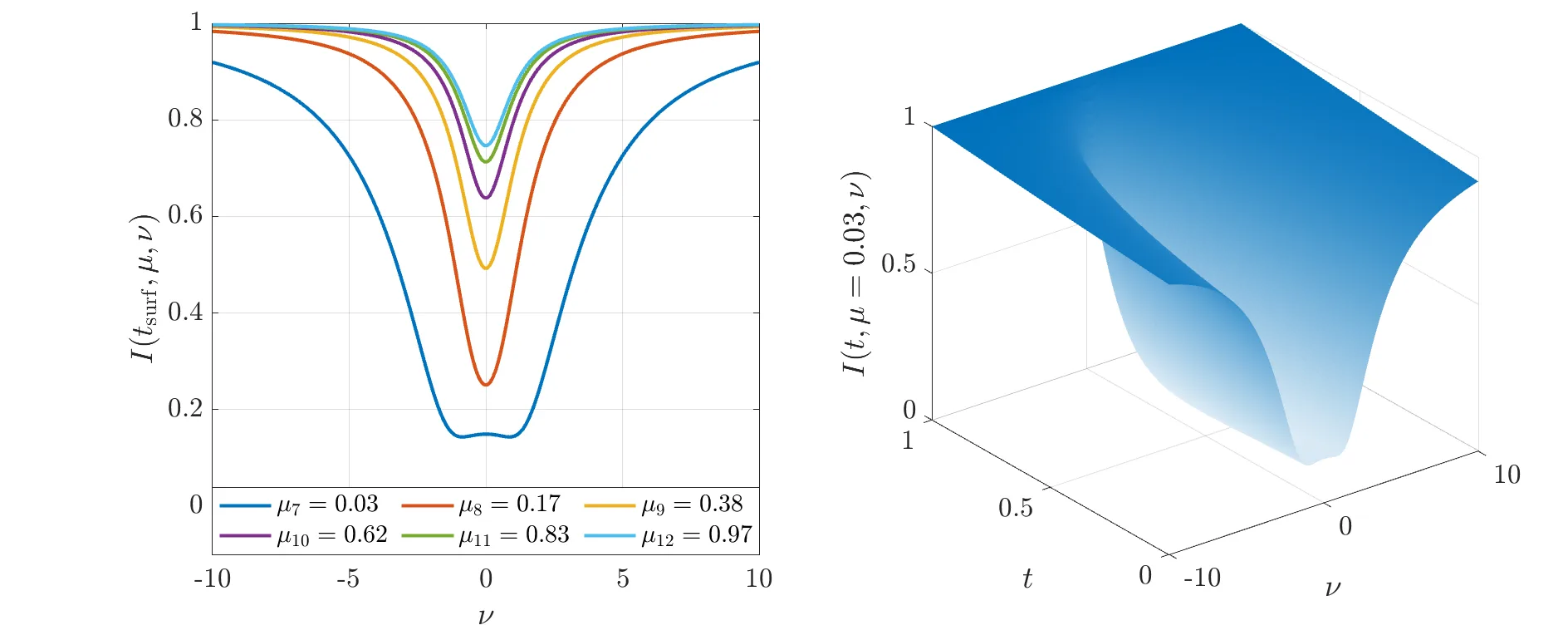
The mathematicians explained this phenomenon using so-called symbol theory. It allows predicting how the eigenvalues of a matrix will behave before even running the calculations. It turns out that due to special properties of the original differential operators (they are compact), the spectrum of the matrices "clusters" near one, which guarantees fast convergence.
The practical benefit is enormous: modeling radiative transfer in stellar atmospheres is a key problem in astrophysics. Our understanding of temperature, chemical composition, and motion of matter in stars depends on it. If calculations become faster and more reliable, scientists can explore more realistic models without hitting computational limits.
So the light we see from distant stars can now be "traced" in computer models much faster, and that brings us closer to understanding what's going on inside those giant, scorching spheres.
The spectrum of the matrix in the radiative transfer problem clusters near one: it's as if all possible light paths had almost the same "speed" of convergence, and the algorithm doesn't need to adapt to each path individually.