math.NA math.NA

19 articles

articles

math.NA2023-08-082 minarXiv:2308.04167
A Gravitational Portrait of Earth from 500 Kilometers Up
Setting up an orchestra without a conductor: the algorithm itself decides which instruments (basis functions) and at what volume (weights) should play to reproduce Earth's gravitational symphony.
math.NA2024-02-232 minarXiv:2402.15184
Colored Noise: How to Hear Memory in Random Jolts
A translator in a conference room hears not only the words but also the echo of previous phrases still bouncing around the ceiling. If they get distracted by every reverberation, an hour of conversation turns into two. Similarly, a complex system, whether an ocean or a power grid, receives random jolts that do not vanish instantly but drag behind them a tail of memory.
math.NA2024-07-152 minarXiv:2407.10931
The Climate Clockwork: New Math Captures Seasonal Rhythms
Every winter, the Pacific Ocean warms slightly off the coast of Peru, and every summer it cools. This rhythm is set by the gears of the climate machine, but some turn fast, others slow, and still others speed up or stall. Linear inverse models have helped us glimpse these gears in data for decades, but they were blind to seasonal changes in pace.
math.NA2024-09-103 minarXiv:2409.06797
Noise with Memory: How Colored Noise Alters Climate Causality
Ocean currents intertwine like sticky spider silk: every disturbance leaves a trace that does not vanish instantly. Climatologists have been used to treating random jolts in this web as invisible and memoryless, but new research shows that noise has memory, and that memory strengthens connections between distant nodes.
Three Translators and the Dance of the Vortex
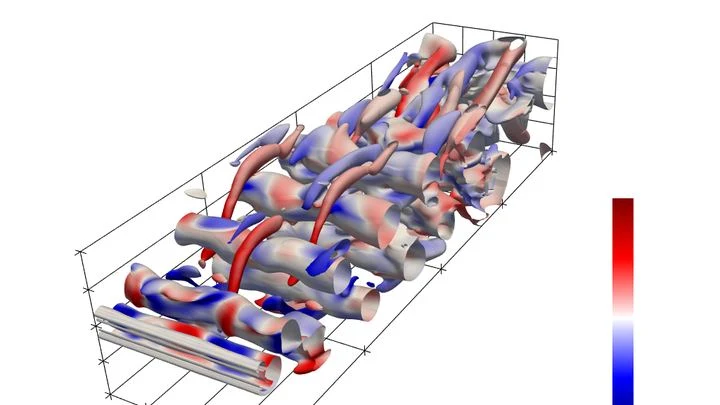
A vertical pipe with a sudden expansion is a classic testbed for turbulence. Air swirling like a tornado rushes into a wider chamber and spawns vortices, recirculation zones, and regions where glass particles 45 μm in diameter, about half the thickness of a human hair, dart along intricate paths.
math.NA2025-03-312 minarXiv:2503.24234
A Lens That Sees the Skew: Nonlinear Climate Models
Glasses with flat lenses show a symmetric world: rise and fall, heat and cold look the same. For decades, climatologists have viewed El Niño through such glasses, using linear inverse models. These captured the rhythm of oscillations but missed that the warm phase of El Niño is typically sharper and stronger than the cold La Niña.
cs.CE2026-01-011 minarXiv:2601.00505express
How a Drug's Charge Alters Its Path Under the Skin
After an injection under the skin, a drug doesn't just spread out like ink in water. Antibody molecules carry an electric charge, and that charge makes them interact with surrounding tissues — much like a magnet attracts or repels iron filings.
Fluid Dynamics2026-01-201 minarXiv:2601.13971express
A Falling Plate Without a Supercomputer
A sheet of paper released from a window flutters, tumbles, and sometimes pauses flat for a second. Until now, to honestly predict such behavior, you had to run millions of equations on supercomputers for every drop of air. That's like simulating every atom of a cash register to count change at a store. The new approach is smarter.
Fluid Dynamics2026-01-241 minarXiv:2601.17341express
A Thin Plate Wakes Turbulence Early
A thin plate stands across a flow of water or air. Behind it, a wake forms — a region where the flow becomes tangled and mixed. Usually, such a wake becomes turbulent when the flow speed is high enough, quantified by the Reynolds number.
Medical Physics2026-02-031 minarXiv:2602.03744express
Spectromicroscopy: Seeing the Unseen in Just 4% of Measurements
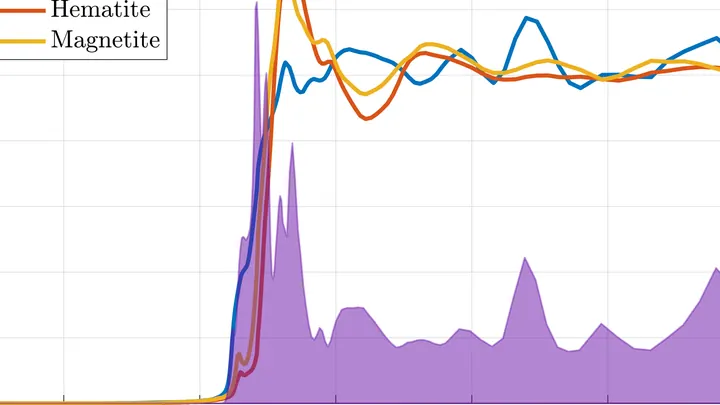
A chemical map of a sample is like a mosaic: each point has its own color, its own chemical composition. To assemble such a mosaic, a spectromicroscope scans the sample point by point, recording a spectrum at each location — a "fingerprint" of how the material absorbs or emits light.
math.NA2026-02-121 minarXiv:2602.11849express
Chemistry Without Hints: Reconstructing Reaction Mechanisms from Data
When chemists see how concentrations of substances change, they need to figure out which reactions are behind those changes. It's like trying to reconstruct a recipe from photos of plates at different stages of a meal. Previously, this often involved derivatives — instantaneous rates of concentration change.
math.NA2026-02-252 minarXiv:2602.21958express
Light in the Stellar Crowd: How Mathematics Speeds Up Calculations
If you shine a flashlight into thick fog, the light doesn't pass straight through: it bounces off countless droplets and scatters sideways. Light inside a star or in its extended atmosphere behaves much the same way. To understand exactly how it travels, scientists solve radiative transfer equations: it's like mapping out every possible light path in detail.
Plasma Physics2026-03-291 minarXiv:2603.27828express
Plasma without a textbook
Plasma is a gas in which electrons are stripped from atoms, behaving like a soup of charged particles. To predict how such a soup flows and heats up, you need to know how particles collide and exchange energy.
General Relativity2026-04-241 minarXiv:2604.22734express
How to Make a Simulation Wall Transparent
Every computer model of a black hole runs into the same inconvenience. A machine's memory is not infinite — at some point you have to cut off the calculation, as if placing a solid wall across space.
q-bio.TO2026-05-012 minarXiv:2605.01083express
How a Cell Transplant Can Set the Heart's Pace
After a heart attack, the dead section of heart muscle can be replaced with living cells grown from stem cells. But a common problem arises: the fresh transplant starts acting as its own pacemaker, and the heart falls out of its proper rhythm. Doctors see the arrhythmia on an ECG, but what exactly happens at the junction between 'self' and 'foreign' remains hidden.
math.NA2026-06-083 minarXiv:2606.09369
The Nineteen Notes That Make Up El Niño
An orchestra plays in a dark hall, and the listener hears only a hum: hundreds of instruments blend into a dense noise in which no melody can be discerned. That is roughly what spectra extracted from climate data by methods like the Koopman operator look like: hundreds of components, each with its own frequency, and it is unclear which ones are true musicians and which are the rattling of chairs.
math.NA2026-07-012 minarXiv:2607.00335
Balancing on a Quantum Tightrope: How Numerical Methods Tame the Dirac Equation’s Tremors
A tightrope walker steps onto the wire. Every move is a calculation: shift your weight just right, or you’ll fall. In the world of quantum particles described by the Dirac equation, there’s a different kind of abyss — the wave function’s furious oscillations.
math.NA2026-07-232 minarXiv:2607.20846express
Shock Absorbers for Every Floor of Turbulence
A car with a single suspension setting for all wheels — smooth on asphalt, but bumpy on dirt roads. That's roughly how modern computer models of fluids and gases work: all disturbances, from large whirlpools to fine ripples, are calmed with one common "brake." Stochastic modeling of flows has long been seeking a more refined tool.
General Relativity2026-08-091 minarXiv:2608.08863express
How Waves Fade into Infinity
A stone falls into a pond. Ripples spread, weaken, and soon vanish. But if the pond were infinite and the water perfect, the disturbance would last forever, gradually fading. In physics, such decaying remnants are called "tails"—they live long after the main wave has passed.