Convergence in numerical analysis describes the process by which an iterative algorithm approaches a final, accurate solution through repeated refinement. Each iteration brings the approximation closer to the true answer, and convergence is achieved when further iterations produce negligible change. This concept underpins virtually all computational physics, from quantum chemistry calculations to machine learningtraining.
History
The formal study of convergence dates to the 19th century with mathematicians like Augustin-Louis Cauchy, who defined rigorous criteria for sequences and series. Numerical convergence became central to computing in the mid-20th century as digital computers enabled iterative methods for complex problems.
How it works
An iterative method starts with an initial guess and applies a mathematical operation repeatedly, generating a sequence of values. Convergence occurs when this sequence approaches a limit—the solution—within a desired tolerance. The rate of convergence (linear, quadratic, etc.) determines how quickly the algorithm reaches accuracy. Techniques like error estimation and adaptive step sizes help ensure and accelerate convergence.
In practice
Convergence is essential in computational chemistry for optimizing molecular structures, in neural networktraining where loss functions must converge, and in solving differential equations for weather prediction and engineering simulations.
Fun fact
In some chaotic systems, tiny changes in initial conditions can prevent convergence entirely, a phenomenon known as sensitive dependence on initial conditions.
DFTB is a high-speed train in the world of quantum chemistry: hundreds of times faster than classical DFT, yet still on electronic rails. But its engine — iterative self-consistency of charges — sometimes resembles an orchestra where each instrument starts from an arbitrary note.
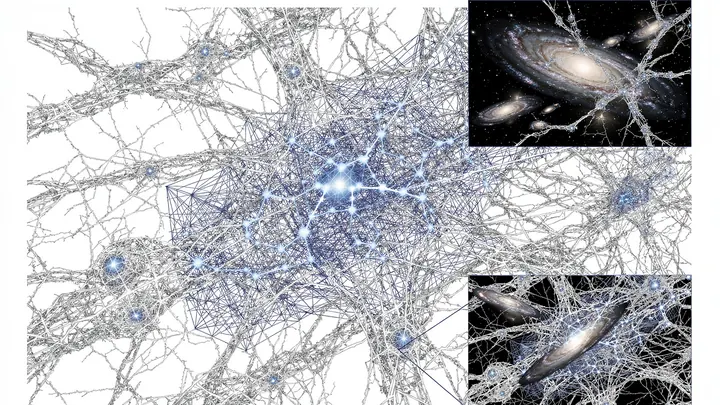
Light from distant galaxies travels to us for billions of years, but along the way it gets bent and twisted by the invisible web of dark matter. This effect, predicted by Albert Einstein within general relativity, is called gravitational lensing.
Strike a tuning fork. The frequency is 440 Hz. That's the note A — the standard of sound.
In the world of numbers, there's a standard too. It's tuned not to sound, but to prime numbers. Though their distribution seems random, it obeys strict laws. All primes resonate together. There's just one value: λ∞ ≈ 0,674036.
Molecules float in a test tube. Their abundance (say, the concentration of some protein) becomes the input signal. And the output isn't just a cloudy solution but a clear yes-or-no answer.
The authors build a chemical cascade that does exactly that.
Quantum annealing works like a smart way to find a path through a maze: instead of checking every dead end, it uses quantum effects to find the exit faster. But this maze has a quirk: the numbers that describe the walls and corridors must be roughly the same size.
When chemists calculate the behavior of molecules on a computer, they use approximate methods because exact calculations are too complex. For light atoms, there are well-established benchmarks, but for heavy atoms, where relativistic effects matter, such benchmarks did not exist. It's like checking a ruler against another ruler rather than against a standard meter.
An electron in an atom is like a note on a string: it has a set of allowed energies, and the physicist's task is to find these notes. Usually, the space around the nucleus is divided into small pieces and the behavior of the electron in each piece is calculated. The finer the pieces, the more accurate the answer.
An optician turns the frame, adjusts the focus, and a blurry spot becomes a sharp image. The new algorithm GOAL works much the same way: it rotates the data cloud, compresses redundant dimensions, and brings into focus what truly matters.
Fog thickens over the line "def max(a: Int, b: Int): Int". What does it do? It returns the larger of two numbers, but how can you verify that? You could write a dozen tests with specific pairs: max(2,3)=3, max(5,5)=5, max(-1,0)=0. Still, a nagging doubt remains: what if it breaks for, say, a million and minus a million?