Whispers of Atoms: How a Warm Crystal Gives Away Its Secrets express
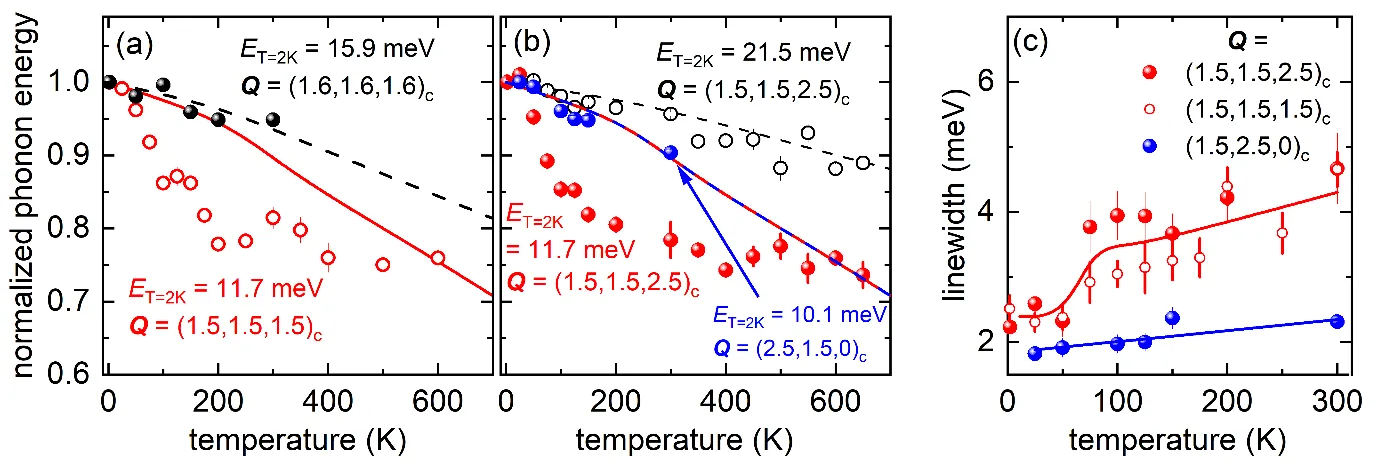
Heat a crystal, and its atoms start to tremble more vigorously, like strings tightened or loosened. In a LaCoO3 crystal (a compound of lanthanum, cobalt, and oxygen), heating from 2 to 650 K triggers two major rearrangements: around 100 K, the magnetic state of cobalt ions changes, and around 550 K, the material transforms from an insulator into a conductor. Between these temperatures, physicists noticed unusual behavior in one of the oxygen atomic vibrations.
This vibration, with an energy of about 10 meV (millielectronvolts — a tiny packet of energy, like a barely perceptible string tremor), becomes anomalously soft. A soft vibration is like a loosened string: it trembles slower and with greater amplitude. This softening occurs only at a specific point in the crystal's "musical tuning"—at the wave vector q = (1/2, 1/2, 1/2). It's as if one particular note in a chord suddenly sounded louder and lower.
This specific "note" matches a prediction made back in 1958 by John Goodenough. He suggested that in this material, cobalt ions could arrange into an ordered pattern of two different magnetic states, like a chessboard alternating "strong" and "weak" magnets. Now, the trembling of oxygen atoms has revealed that such patterns do indeed emerge, albeit briefly, like a flicker rather than a permanent picture.
The connection between atomic trembling and magnetic rearrangements is key to understanding how the material changes its properties. When electrons rearrange, they alter the forces between atoms, and this is audible in the crystal's "music." Such research helps create materials with desired properties — for example, thermoelectrics that convert heat into electricity, or smart sensors.
Original abstract
as written by the authors arXiv:2602.22725
We investigate lattice dynamics in LaCoO$$_3$$ using inelastic neutron and x-ray scattering over $$T = 2\mbox{-}650\,\mathrm{K}$$, spanning the spin-state crossover at $$T_{1} \approx 100\,\mathrm{K}$$ and the insulator--metal transition at $$T_{2} \approx 550\,\mathrm{K}$$. Comparison with quasi-harmonic $$ab-initio$$ lattice-dynamical calculations helps reveal anomalous softening of a $$\approx 10\,\mathrm{meV}$$ oxygen phonon, confined to the temperature interval $$T_{1} \leq T \leq T_{2}$$ and localized in momentum space at $$\boldsymbol{q}_{\mathrm{SSO}} = \left( \frac{1}{2},\frac{1}{2},\frac{1}{2} \right)_{c}$$. This wave vector corresponds to the spin-state ordering originally proposed by Goodenough [J. Phys. Chem. Solids 6, 287-297 (1958)]. Our results therefore provide momentum-resolved evidence for dynamic correlations of high-spin and low-spin Co$$^{3+}$$ states in LaCoO$$_{3}$$, linking spin-state fluctuations to anomalous phonon renormalization.
The energy of 10 meV corresponds to a temperature of about 116 K — warmer than liquid nitrogen (77 K), but colder than a freezer.