Black Hole Echo: What the Horizon Sounds Like
When two black holes merge, ripples spread across the fabric of spacetime — gravitational waves. But what if one of them isn't a run-of-the-mill black hole but something else — an exotic compact object?
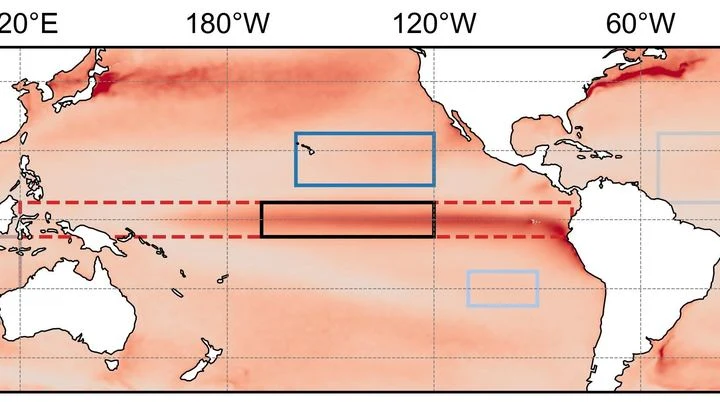
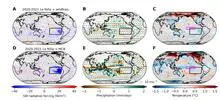
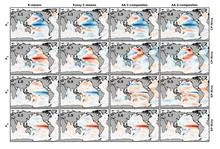
A seesaw in atmospheric pressure between the eastern and western tropical Pacific, linked to El Niño and La Niña.The Southern Oscillation is a large-scale pattern of atmospheric pressure changes across the tropical Pacific Ocean. Normally, air pressure is higher in the eastern Pacific (near South America) and lower in the western Pacific (near Indonesia and Australia). The Southern Oscillation describes the periodic reversal of this pressure difference: when pressure rises in the east, it falls in the west, and vice versa. This seesaw is not just a curiosity — it is the atmospheric counterpart to the oceanic temperature shifts known as El Niño and La Niña, together forming the El Niño–Southern Oscillation (ENSO) phenomenon.
The term was coined in the 1920s by Sir Gilbert Walker, who discovered the pressure seesaw while studying the Indian monsoon for the British colonial government. His work was largely statistical, and the physical connection to ocean temperatures was clarified decades later by Jacob Bjerknes in the 1960s.
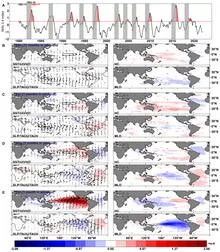
The pressure difference between the eastern and western Pacific drives the trade winds, which blow from high to low pressure. When the pressure gradient weakens (the eastern Pacific becomes relatively low pressure), the trade winds slacken, allowing warm surface water to pool in the central and eastern Pacific — this is El Niño. When the gradient strengthens, trade winds intensify, pushing warm water westward and enhancing upwelling of cold water in the east — this is La Niña. The Southern Oscillation index, calculated from pressure readings at Tahiti and Darwin, quantifies the strength of this seesaw and serves as a key predictor of ENSO events.
The Southern Oscillation index is used operationally to forecast seasonal climate anomalies, such as droughts in Australia, floods in South America, and monsoon strength in India, helping agriculture and disaster management plan months ahead.
During a strong El Niño, the Southern Oscillation can shift global weather so dramatically that it reduces the number of Atlantic hurricanes but increases tropical storms in the Pacific.