Superconductor flows one way without a magnet express
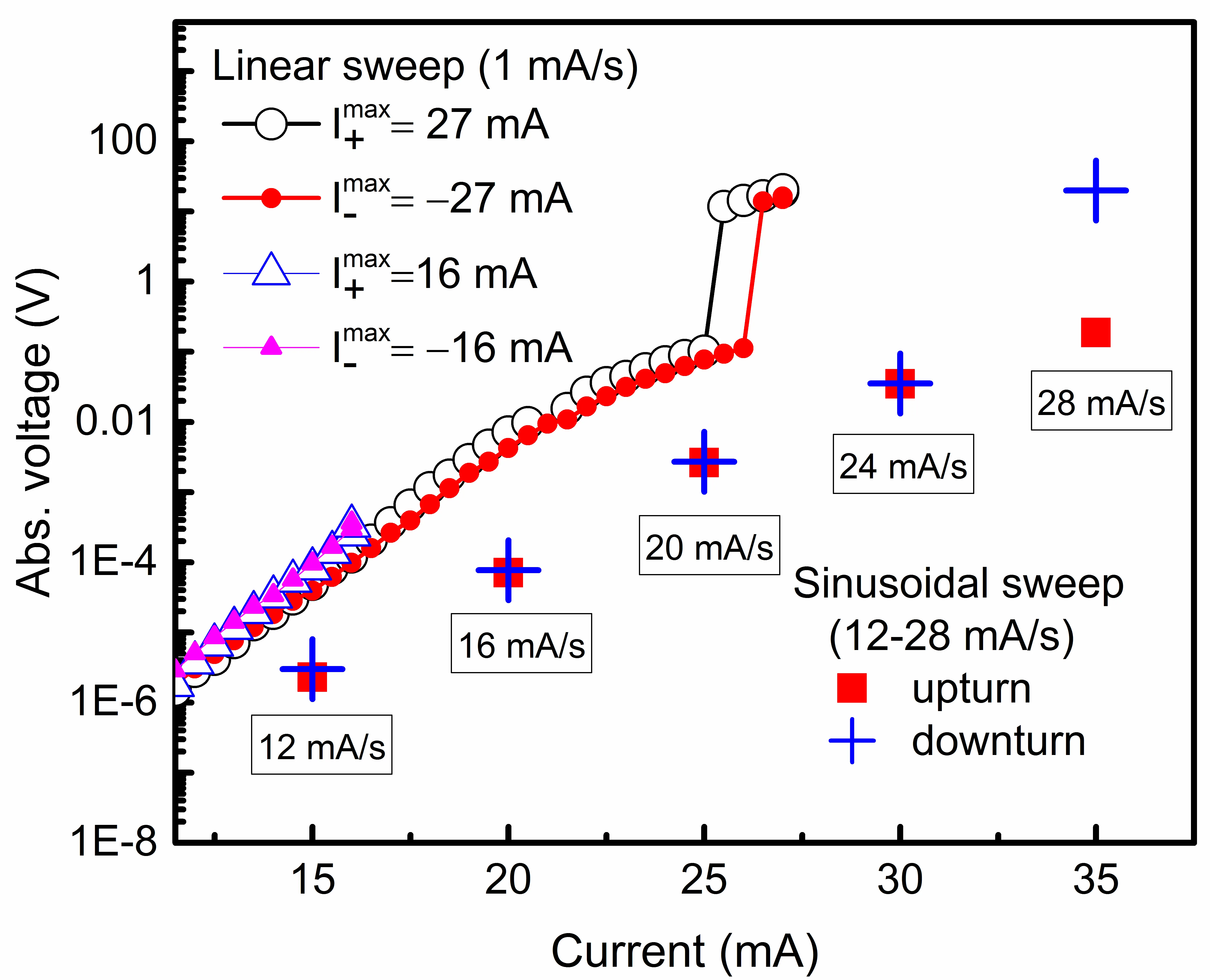
An ordinary conductor carries current equally in both directions, like a door that swings both inward and outward. A diode, by contrast, is a door with a self-closing hinge: it opens easily one way but pushes back the other. Scientists have found that a superconductor based on copper oxide (Tl₂Ba₂CaCu₂O₈) behaves like such a door at 100 K (−173 °C), even though no magnet was nearby.
The researchers fabricated a microbridge from this compound and measured how it conducts current. It turned out that in one direction the current flows freely, while in the other it struggles. Moreover, the picture did not change even when a weak magnetic field of up to ±100 oersteds was applied. Such behavior indicates that time-reversal symmetry is broken inside the superconductor: if you could "rewind" the processes, the picture would not match.
This is already the second such observation: previously, the diode effect without a field was noticed in a similar compound Bi₂Sr₂CaCu₂O₈₊δ. So, time-reversal symmetry breaking may be a common property of all cuprate superconductors. And that is a serious blow to theories that explained high-temperature superconductivity without accounting for such breaking.
Original abstract
as written by the authors arXiv:2602.23552
We present measurements demonstrating that copper-oxide high-temperature superconductors can exhibit broken time-reversal symmetry in the absence of external magnetic fields. Using $$Tl_{2}Ba_{2}CaCu_{2}O_{8}$$ microbridges, we observe a pronounced superconducting diode effect at 100 K under strictly zero-field conditions. This nonreciprocal response remains unchanged in magnetic fields up to $$\pm 100 Oe$$. Our results are consistent with recent reports of zero-field diode behavior in $$Bi_{2}Sr_{2}CaCu_{2}O_{8+{\delta} }$$ and together indicate that time-reversal symmetry breaking may be an intrinsic property of the cuprate superconducting state. These findings significantly constrain theoretical models of high-temperature superconductivity that rely on time-reversal-symmetric mechanisms.
The diode effect in superconductors resembles the behavior of a one-way mirror: light passes from one side but reflects from the other. Only here the "mirror" is the material itself, and the "light" is electric current.