The second law of thermodynamics says that in nature everything tends to disorder. Imagine a room: you can tidy it up, but without effort it will become messy again. This law states: entropy (a measure of chaos) in a closed system never decreases. Heat always flows from hot to cold, and it is impossible to completely convert heat into useful work without losses.
History
In 1824, Sadi Carnot, in his work 'Reflections on the Motive Power of Fire', laid the foundations of thermodynamics by introducing the concept of an ideal cycle. In 1850, Rudolf Clausius gave the first formulation and introduced the concept of entropy. In 1851, Lord Kelvin (William Thomson) proposed an alternative formulation. Later, Max Planck and others generalized the law, linking it to molecular statistics.
How it works
Applied everywhere: from designing heat engines to climate prediction and cosmology. Limits: fluctuations in small systems can temporarily violate the increase in entropy, but statistically it holds. For open systems, entropy can decrease locally at the expense of the environment.
Fun fact
Precisely because of this law, a perpetual motion machine of the second kind is impossible: part of the energy always dissipates as heat that cannot be recovered.
A lake in a drought doesn't dry up all at once. First, islands of dry land appear on the water's surface, they expand and merge, and only then does the water recede from the exposed bed. A mirabilite crystal behaves similarly when it loses water: round patches of anhydrous salt appear on its surface, growing outward and then beginning to deepen.
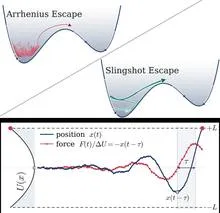
A particle sits in an energy pit like a pea in a dimple. To get out, it needs to go over the barrier, and usually this is rare: the higher the barrier, the longer the wait. The Arrhenius law says the waiting time grows exponentially, meaning doubling the barrier height increases the time by hundreds of times.
A superconductor is a material in which electricity flows without loss, like water through a perfectly smooth pipe. But if you squeeze it slightly, like a spring, its properties change. Scientists have long wanted to measure how much heat such a compressed material absorbs, but instruments couldn't fit into the cramped setup. Now they've devised a way around this obstacle.
Stare long enough into the night sky, and sooner or later your gaze hits a blackness beyond which nothing is visible. This is not just a distant fence: it is the edge of the universe accessible to us, the cosmic horizon. Light from more distant stars simply hasn't had time to reach us.
A spotlight beam fades into the darkness, but if you trace it backward, you hit the lamp. The history of the universe might be the same: tracing its expansion backward, we run into a beginning.
Physicists took the simplest model — a universe that stretches equally in all directions, like a cube with all sides growing.
A courtroom interpreter is distracted by every rustle: the creak of a chair, a cough in the back row, the rustle of papers. By the end of the day, they are translating not what the witness said, but what they heard through the noise. Rare translation errors are not the result of a single loud shout, but of the accumulation of many small disturbances.
In an oven, as temperature rises, molecules move faster and disorder increases. With language models like ChatGPT, it's the opposite. When developers increase the 'temperature' parameter, the model gets access to a wider choice of words, but its long texts suddenly start looping.
A team of researchers tested 11 different AIs by generating 12,000 text continuations.
The quantum vacuum is not empty: it is permeated by entanglement linking distant regions. But when physicists tried to compute this entanglement, it turned out to be infinite. The culprit: particles with very low energy that can smear out over arbitrarily large volumes. They are like waves with no shores to contain them.
Imagine a factory capable of producing a million parts per hour, yet it only makes a hundred. That's roughly how our Universe behaves when viewed through the lens of entropy — a measure of disorder that, according to physics, must only increase. The main "machines" of this factory are supermassive black holes.
A climber on a ridge notices something strange: the horizon around them seems to freeze. No forward, no backward — only emptiness and silence. This is roughly the picture painted by new calculations for our Universe. At some point in its expansion, the invisible boundary, the future event horizon, stopped growing.
Hot tea cools down, and ice cream melts — heat always flows from warm to cold, and this law seemed unbreakable. But in the quantum world, even familiar rules can be rewritten. Physicists placed a tiny mechanical resonator (a vibrating bridge the size of a microbe) in an optical cavity between two mirrors.
In a glass of water, oil gathers into droplets: that's equilibrium separation dictated by chemistry. But there are systems where order arises not from rest but from a constant flow of energy.
Imagine a pot of boiling water. Toss in a handful of pasta, and it quickly overcooks and clumps into a sticky mess. But in a huge restaurant kettle where the pasta floats freely, each piece stays separate.
A search party combs a foggy field. At first, people spread out wide: a high 'temperature' of search means a great variety of attempts. Upon finding a trace, they close in. But the speed of convergence is critical — narrow the circle too early, and the best find stays aside. The coordinator assesses the spread of searchers and commands when to speed up or slow down.
Imagine a packed subway car at rush hour. Passengers don't just stand there: they breathe, release moisture, squeeze toward exits, and sometimes get stuck in doors, blocking movement. Now imagine these passengers can remodel the car's walls, add handrails, or turn the floor into gel.
Machine learning has long ceased to be just a tool — it is becoming an investigator, independently fishing out the laws of nature from data. But how does a silicon mind come to understand?
An orchestra of billions of cesium atoms struck a single note, and it sounded for 17 hours without fading. That’s no exaggeration: Chinese physicists created a continuous time crystal with a record-breaking lifespan. A time crystal is a system that breaks time symmetry, spontaneously pulsating in an unchanging rhythm.
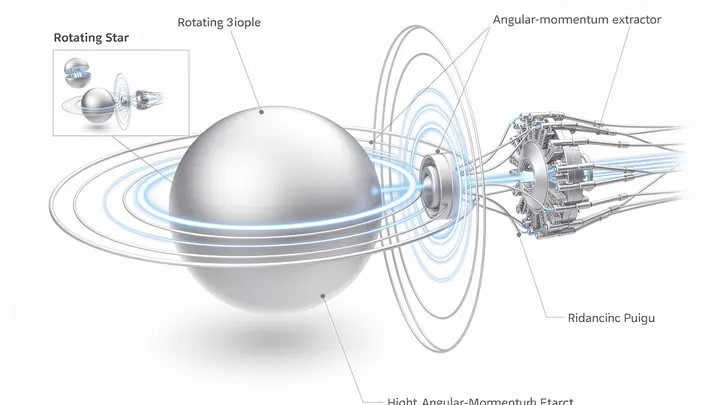
For decades, SETI has hunted for Dyson spheres — hypothetical shells that capture a star's light stars and re-radiate it in the infrared. But the cosmos remains silent. Perhaps an alien intelligence operates more elegantly: instead of collecting light, it tames the rotation of a sun, like a giant flywheel.
The search for life beyond Earth is like tuning an old radio: we listen to the chemical whisper of distant exoplanets' atmospheres, trying to pick up signs of biological activity.
Imagine a ball in an unfamiliar hall: two guests start from opposite corners. Their movements are not a smooth waltz but chaotic improvisation in search of rare treasures. Contrary to intuition, the outcome hinges not on tempo but on the geometry of the floor.
The search for new materials is like sailing across an uncharted archipelago: islands of stable crystals rise amid the raging ocean of possible combinations, and only a few survive the storm of thermodynamics. A true breakthrough came with entropy-stabilized oxides, where chaos, not order, binds the atoms.
The classical Mpemba paradox — hot water freezes faster than cold — has teased scientists for centuries. Only recently has nonequilibrium statistical mechanics explained it: it’s all about boundary conditions; the system seems to seek an excuse to “hit the wall” and speed up cooling.
In the intricate dance of active turbulence, where invisible engines spawn chaos, a soft droplet takes on the role of a detective. Its shape is not merely an outline but a sensitive cipher: it reads the hidden signals of its environment.
In water cooled to –40°C, a paradoxical pause sets in: perfect hexagonal ice is in no hurry to form. Instead, a disordered structure with interspersed cubic layers emerges — a real cradle for future symmetry, brimming with disorder yet already charged with hidden architecture.
Imagine an audition for a symphony orchestra, where out of hundreds of hopefuls, only those whose instruments sound pure and withstand the furious crescendo remain. In the world of materials, computers have learned to generate 'atomic scores'—thousands of virtual crystals that promise to become the foundation for quantum chips or superconductors.
The hunt for non-Abelian anyons is a quest for a quantum ghost that leaves only one clue: entropy. These particles live in two-dimensional systems at ultralow temperatures. Their exchange doesn't just flip the sign of the wavefunction — it entangles states, creating topological order.
In 1944, Erwin Schrödinger asked the question "What is life?", foreshadowing quantum explanations of biology. Almost a century later, physicists return to this puzzle, armed with the apparatus of quantum field theory.
Quantum matter rarely treats us to the spectacle of self-motion. Where the classical world teems with starling murmurations, fish schools, and bustling bacteria, quantum thermodynamics long remained serene.
Membraneless organelles, tiny factories inside the cell, defy conventional rules. Take the nucleolus: here ribosomal RNA is synthesized — long chains woven from carbon sugars, rich in oxygen phosphate groups, and stitched with hydrogen bonds, suspended in the watery environment of the nucleus.
In the new model, each active particle has an internal rhythm: it spins either left or right. Chirality is key: some twirl clockwise, others counterclockwise. But when such a particle bumps into an obstacle or a neighbor, it flips its spin, like a figure skater who, after touching the board, explodes into a reverse pirouette.
Imagine a book being simultaneously copied by trillions of scribes. As long as most of them check against the original, the narrative remains meaningful. But once control weakens, the text accumulates typos, which multiply until the manuscript turns into gibberish.
Plastic deformation is the language through which materials tell the story of their internal stresses. For almost a century, its grammar has been the theory of dislocations: tiny linear defects gliding through the crystal lattice and carrying shear.
When physicists drive electrons through an ultrapure gallium arsenide channel at helium temperatures, they expect to see a well-behaved, almost ideal fluid.
The old question of Maxwell’s demon, can an intelligent being circumvent the second law of thermodynamics and pump heat from cold to hot, gains new resonance in the quantum world.
Biological complexity has long eluded us: you can count genes, cells too, but how do you grasp the organization of the proteome itself — a multi-thousand ensemble of proteins woven from carbon, oxygen, and hydrogen?
A thin magnetic film is like a row of toy soldiers with tiny magnetic arrows. In the flat world, thermal jostling quickly disrupts this formation — even the slightest heating destroys the order. This is the Mermin–Wagner prohibition: in two dimensions, continuous symmetry cannot survive at finite temperature.
Two-dimensional worlds never cease to amaze: here even crystal melting is not a symmetry breaking but a vortex drama discovered by Kosterlitz and Thouless. At the heart of this theater are topological сингулярности, whose energy and энтропия bargain for order. This language is common to сверхтекучести и сверхпроводимости.
In a world striving for chaos, rhythm sometimes arises. The Belousov–Zhabotinsky reaction has amazed for decades: in a test tube, color waves run on their own, as if a living organism breathing matter. Something similar lurks in crystals where iron atoms balance between two magnetic states — high-spin and low-spin.
Today's Freon-based refrigerators and air conditioners silently poison the atmosphere. An alternative is solid-state caloric materials that cool under rapid pressure changes via the barocaloric effect.