Vacuum Controls Magnetism
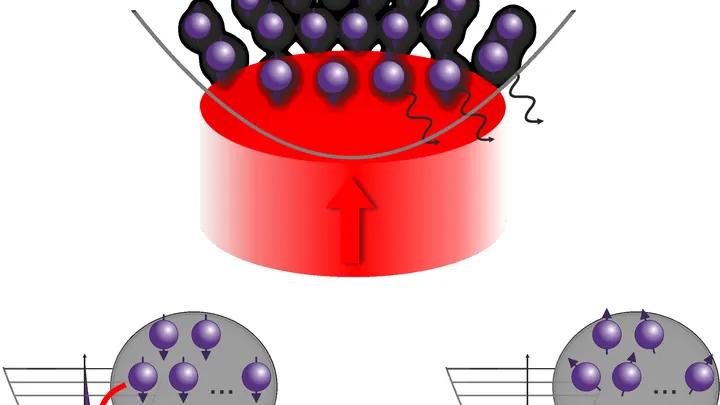
In a pot of boiling water, steam bubbles appear and disappear — a similar struggle takes place in two-dimensional materials. Here, electrons both create magnetism and try to extinguish it.
A phenomenon where a magnetic impurity in a metal causes electrons to form a screening cloud, increasing resistance at low temperatures.The Kondo effect is a quantum phenomenon that occurs when a magnetic impurity—a single atom with unpaired electrons—is embedded in a non-magnetic metal. At high temperatures, the impurity behaves like a simple scatterer, but as the temperature drops, conduction electrons begin to interact with the impurity's magnetic moment in a collective way. This interaction leads to a characteristic minimum in the electrical resistivity of the metal at low temperatures, which is counterintuitive because metals usually become better conductors when cooled.
The effect was first explained by Jun Kondo in 1964, who showed that a third-order perturbation theory calculation could account for the resistance minimum observed in dilute magnetic alloys. His work sparked decades of theoretical and experimental research, leading to the development of the renormalization group approach by Kenneth Wilson in the 1970s.
At low temperatures, conduction electrons near the impurity flip their spins to screen the impurity's magnetic moment, forming a correlated 'cloud' of electrons. This cloud grows in size as temperature decreases, effectively increasing the scattering cross-section for other electrons and thus raising resistance. The effect is a hallmark of strong electron correlations and many-body physics, where the behavior of the system cannot be understood by considering electrons independently.
The Kondo effect is crucial for understanding the behavior of quantum dots and other nanoscale devices, where it can be used to control electron transport. It also plays a role in the design of heavy-fermion materials and in the study of quantum phase transitions.
The Kondo effect has been observed in quantum dots, where a single electron can act as the magnetic impurity, allowing researchers to study the phenomenon in a controlled environment.