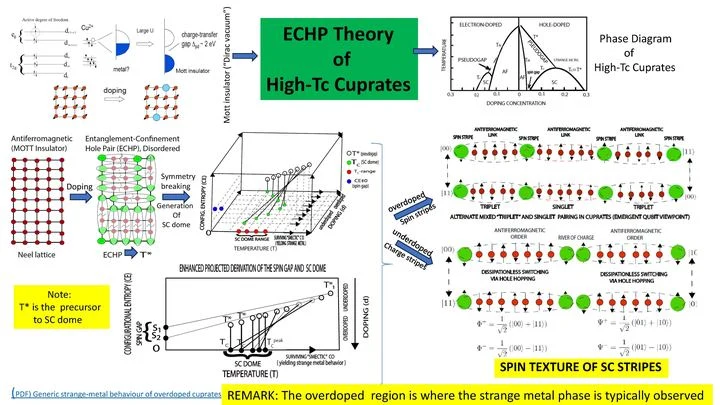
Cuprates are a family of ceramic materials containing copper and oxygen layers, famous for exhibiting high-temperature superconductivity — the ability to conduct electricity with zero resistance at temperatures far above those of conventional superconductors. Discovered in 1986, they shattered the previous record for superconducting temperature and opened a new field of physics, as their mechanism does not fit the standard theory of superconductivity (BCS theory). Cuprates are central to ongoing research into quantum materials, especially because they display a rich phase diagram with unusual 'pseudogap' and 'strange metal' states.
History
Cuprates were discovered in 1986 by Georg Bednorz and Karl Alex Müller at IBM Zurich, who found superconductivity at 35 K in a lanthanum-barium-copper-oxide compound. They received the Nobel Prize in Physics in 1987 for this breakthrough.
How it works
In cuprates, superconductivity arises from paired electrons (Cooper pairs) that move coherently, but the pairing glue is not the usual phonon (lattice vibration) mechanism. Instead, it is believed to involve magnetic spin fluctuations in the copper-oxide planes. The electrons in these planes are strongly correlated, meaning their motions are highly interdependent, leading to exotic behaviors like d-wave pairing symmetry (the pair wavefunction changes sign with direction). The exact mechanism remains one of the biggest unsolved problems in condensed matter physics.
In practice
Cuprates are used in high-field magnets for MRI machines, particle accelerators, and experimental quantum computing circuits, where their ability to operate at liquid-nitrogen temperatures (77 K) offers practical advantages over conventional superconductors.
Fun fact
The first cuprate superconductor was a ceramic that looked like a black stone, and its discovery was initially met with skepticism because ceramics are typically insulators.
A tiny black hole flies through a hydrogen cloud and stretches atoms like taffy. That is what a superconductor looks like when it traps a persistent current: a material in which electricity flows without losses turns into a miniature permanent magnet.
Old treasure maps were drawn from hearsay: someone found gold by a river, someone else in the mountains, and each person dug in their own spot. High-temperature superconductors went the same way: cuprates were found in some compounds, iron pnictides in others, nickelates in yet others, and there was no common map.
A metal made of five different atoms is like a soup with bits of carrot, peas, potato, onion, and meat floating in it. Each bit is its own element: chromium, vanadium, titanium, niobium, and tantalum. Such an alloy is called high-entropy: there is no single order, and the atoms are mixed almost randomly.
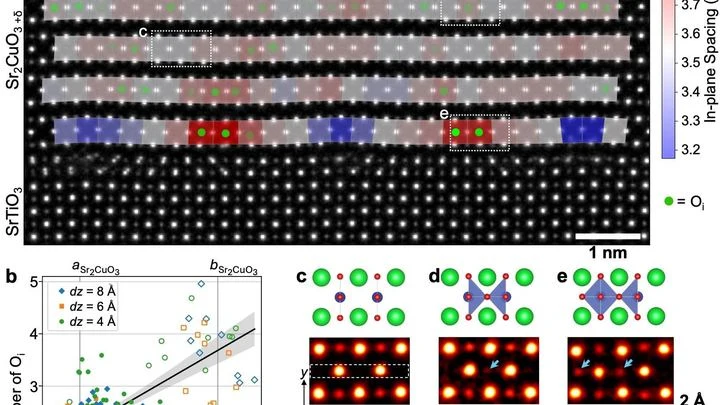
A superconductor is a material that conducts electricity without loss, like water flowing through a perfectly smooth pipe. In copper-based superconductors, tiny oxygen additions act like a volume knob: a bit more and the material starts superconducting; a bit less and it stops. But the oxygen atoms themselves are so small that seeing them directly was impossible.
In chemistry's storeroom, records of substances no one thought were special gathered dust. It turns out that among them hide 2D materials — thin as a sheet of paper, but strong and with unexpected properties. Scientists ran a computer search through databases, and it pulled out 38 candidates that had not been recognized as 2D before.
An ordinary wire heats up when current flows through it — some energy is wasted. A superconductor lacks this flaw: electricity flows through it without loss, like water through a perfectly smooth pipe. The trouble is that most superconductors require either very low temperatures or colossal pressures, like those found in the depths of planets.
A tiny sandwich of oxides, grown layer by layer, becomes perfectly conducting at about minus 200 degrees Celsius. This is not a magic trick but a new chapter in the search for high-temperature superconductors.
A film sliver thinner than a human hair was placed between diamond anvils and squeezed. The pressure climbed — a hundred thousand atmospheres, half a million, a million… Yet the material kept conducting electricity without resistance.
Many materials behave like finicky ice: at one pressure they melt, at another they turn harder. Superconductors in the cuprate family are no exception. Their ability to carry current without loss depends on how tightly the crystal lattice is squeezed. In a new study, physicists traced this dependence for the compound Bi-2223.
A piece of metal is cooled to minus two hundred degrees, and electric current begins to flow through it without the slightest friction, like water in a pipe flowing without touching the walls. This behavior is called superconductivity.
Imagine trying to overhear a whisper between two people in a noisy hall. That's roughly the challenge physicists face when they want to understand how electrons pair up inside a superconductor. And if the "hall" is also squeezed by a giant press to pressures of hundreds of thousands of atmospheres, the task seems impossible.
The authors of the new study found an ingenious solution.
Superconductivity is often pictured as a frozen dance of electrons: they pair up and move without resistance, like figure skaters on perfect ice. But in high-temperature superconductors, that ice turns out to be not so smooth.
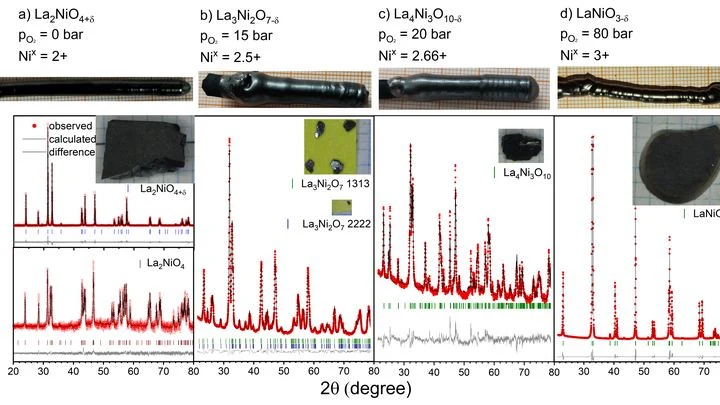
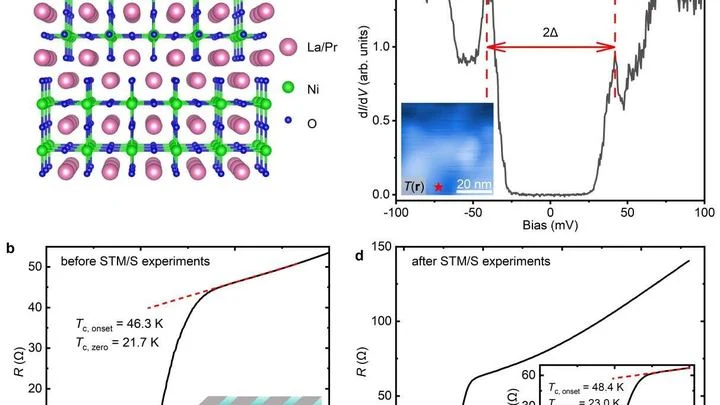
The nickelate family consists of layered crystals, like a stack of pancakes: nickel and oxygen layers alternate with lanthanum spacers. Two years ago, superconductivity was discovered in them — the ability to conduct electricity without resistance when cooled.
In the crystal CsV3Sb5-xSnx, which becomes a superconductor at low temperatures, current does not flow as a uniform stream but along narrow, winding paths. A scanning microscope with a sensitive magnetic field sensor helped reveal these paths: it picks up the faintest currents, much like a sonar probes the seafloor.
Usually, superconductivity is a story about cold. The lower the temperature, the easier it is for electrons to pair up and flow without resistance. But in a new study, physicists grew thin films of nickelates doped with europium and saw the opposite picture.
A thin film of yttrium barium copper oxide warms under a stream of infrared light, and suddenly stops dissipating energy. That's superconductivity: electrons pair up and move as a single quantum swarm. But in underdoped samples, the harmony breaks long before the pairs fall apart. The pairs are there, but the collective rhythm isn't.
In some materials, electric current can flow without any loss: this is superconductivity. But before becoming a superconductor, a substance often passes through a strange state: electrons already sense each other and form pairs, yet they cannot move in unison.
Using laser spectroscopy — a method akin to listening to the echo from a crystal — physicists examined the layered material. They found regions where electrons move freely (Fermi pockets) and noticed that each such region behaves in its own way.
Superconductors conduct current without loss, but usually require extreme cold. Hg1223 — a mixture of mercury, barium, calcium, copper and oxygen — breaks the rule: it stops resisting current already at –139°C. The secret is that the strong electrical repulsion between electrons forces them to pair up.
A long, narrow pan, and a thin pancake sets in uneven stripes. For decades, scientists saw a similar picture when modeling the behavior of electrons in superconductors — materials that conduct electricity without loss. They used elongated "cylinders," and the result was always the same: rigid magnetic "stripes" that were thought to hinder superconductivity.
Imagine a sandwich where the bread is made of copper oxide layers and the filling is a thin layer of strontium ions. That's the infinite-layer cuprate, the simplest version of superconducting ceramics, conceived nearly 40 years ago.
A superconductor carries current without resistance, like water running through a pipe without friction. The secret lies in electron pairs: two electrons stick together as one, even though they normally repel. In an ordinary superconductor, the spins of the electrons in a pair point in opposite directions: this is the singlet state.
Using the JWST space telescope, astronomers conducted a chemical analysis of the centaur Chiron, an icy body from the fringes of the Solar System. It turns out its gas activity resembles a layered cake. Carbon dioxide evaporates from the surface, forming a top crust.
A bridge made of two rows of planks bends under the feet of pedestrians, and each step gets a boost from the elastic motion of the deck. A similar principle underlies superconductivity: electrons glide without resistance because the atomic lattice itself adapts to them. In nickel-based materials, this picture has long been elusive.
A packed stadium: fans mill about chaotically, creating jostling and resistance. That's how electrons behave in an ordinary conductor. In superconductivity, they pair up and move in sync, like spectators holding hands and calmly leaving the stands, without losing energy.
The La3Ni2O7 crystal resembles a layered pie, where the filling of nickel and oxygen atoms alternates with lanthanum layers. At ambient pressure, it does not conduct without resistance, but squeeze it or grow it as a thin film, and high-temperature superconductivity emerges.
In familiar metals like copper, electrons move almost independently, like cars on an open highway. Resistance arises from rare collisions and can be described by simple formulas.
A crystal is like a city: if the streets are crooked, traffic jams. In a crystal, the streets are atomic rows, and the traffic is the flow of electrons. Any tiny imperfection, impurity, or atomic displacement makes electrons scatter. Scientists from several labs have learned to grow crystals so that the "streets" are almost perfectly straight.
The method is called horizontal vapor transport.
An orchestra where every musician plays their own part, and the conductor tries to catch the overall melody. That's roughly how physicists view electrons in cuprates — ceramic materials that conduct electricity without resistance at temperatures above liquid nitrogen.
When you flip a switch, the light doesn't come on immediately — electrons in the wires need time to 'get going' and move together. In ordinary metals and semiconductors, current builds up gradually, like water in a hose when you first open the tap.
In the world of superconductors, electrons don't like to be alone. They typically pair up into Cooper pairs and move without resistance, like figure skaters holding hands. But you can make them dance in fours. The authors of this work propose a scheme where Cooper quartets, groups of four electrons exchanging partners in a rapid rhythm, are born.
A superconductor is a material that, when strongly cooled, loses its electrical resistance: current flows through it without losses. Scientists took a layered crystal of PdTe2, similar to a stack of sheets of paper, and cooled it to temperatures below 1.8 kelvin (that's about -271°C).
Inside copper-based superconductors, materials that carry current without loss at unexpectedly high temperatures, there is a hidden phase. It behaves like an ordinary metal, but it's invisible in standard measurements.
A copper crystal is squeezed in diamond anvil cells. As pressure mounts, a battle unfolds inside the material between two states: one prepares electrons for superconductivity, the other hinders their pairing. Scientists tracked this struggle using ultrashort laser pulses.
A thin wire of the new material conducts electricity without loss when cooled to three degrees above absolute zero. It's like water flowing through a pipe without any friction against the walls. The material is called PtPb3Bi, and its hallmark is an internal structure resembling a bundle of threads: electrons run freely along a thread but struggle to jump between threads.
The crystal of the uranium compound UTe2 resembles a layered cake where electrons flow without resistance. But if you examine its surface under a microscope, you see ripples, like waves on water from a thrown stone.
In a superconducting resonator, light doesn't just bounce around: it embraces the qubit so tightly that their joint dance can no longer be described by old textbooks. The researchers took an indium arsenide nanowire, turned it into a superconducting qubit, and placed it inside a microwave resonator.
A piece of silver antimony telluride is like a sponge: it readily soaks up heat and turns it into electricity. Such materials are called thermoelectrics, and they already work in space probes and car refrigerators. But if you squeeze this sponge, it starts behaving like a superconductor — current flows with zero resistance.